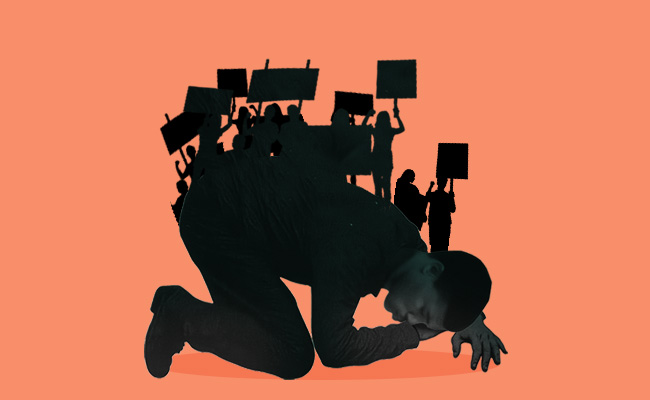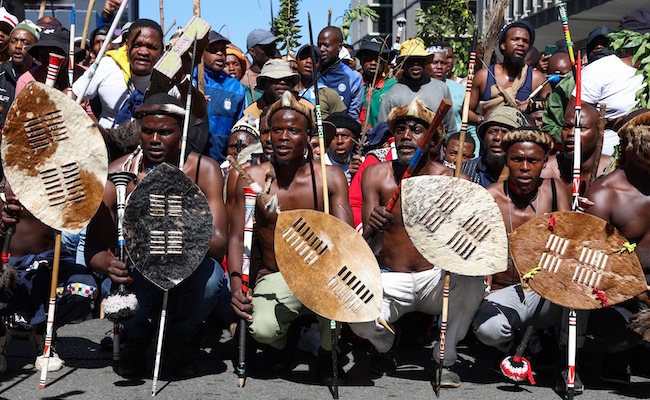

Xenophobia is a shameful stain on South Africa. That needs to be said before anything else.
But let us also be clear about what kind of xenophobia we are talking about. The targets are not European or North American immigrants. They are fellow Africans and others from the Global South: Zimbabweans, Nigerians, Mozambicans, Congolese, Somalis, Pakistanis, Bangladeshis. And while the leaders of the anti-immigrant movement frame their demands around illegal immigration, that distinction evaporates at the point of violence and intimidation. Anyone who looks or sounds like an immigrant is vulnerable, documented or not.
Describing this movement as xenophobic is not an accusation levelled at every South African frustrated by immigration policy. It is a description of what happens when that frustration is weaponised into intimidation and violence.
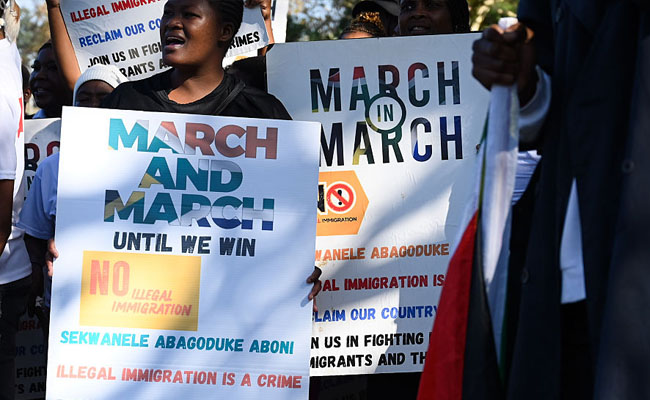
With this week’s “March on March” anti-immigrant protests looming, I wanted to look at a few connected issues: what investigative journalists have uncovered about the political and criminal networks that appear to lie behind this movement, and the danger of mainstream media and digital platforms amplifying voices that at times may constitute advocacy of hatred based on race or ethnicity and is incitement to cause harm – expression that falls outside the protection of section 16 of our constitution.
Attacking the journalists who expose this
One of the clearest signals that something more than civic activism is at play came on June 22 when the MK Party launched a vitriolic attack on Business Day political editor Hajra Omarjee after she reported that sources close to Jacob Zuma said there were discussions about a possible repeat of the July 2021 unrest as the anti-immigrant protests built up towards Tuesday’s deadline. The South African National Editors’ Forum (Sanef) condemned the attack as unprecedented, noting that if the party had complaints, it had recourse to the Press Council or the Broadcasting Complaints Commission of South Africa (BCCSA), not to harassment and intimidation.
But Omarjee was not alone. Sanef confirmed that eNCA journalist Nobesuthu Hejana was aggressively accused by March and March founder Jacinta Ngobese-Zuma of pushing a “xenophobic narrative”; that DW correspondent Dianne Hawker-Kalubi and her camera operator were physically manhandled after asking questions of Ngobese-Zuma, with bodyguards covering their camera during a live broadcast until police intervened; and that News24 journalists were threatened, shoved and ordered to delete footage of violent attacks by the movement’s supporters, what Sanef called “a deeply troubling escalation that threatens the safety of media workers and the public’s right to information”.
Attacking the journalists covering you is not the behaviour of a bona fide civic movement. It is the behaviour of a movement that has something to hide.
Follow the money
Those attacks on journalists look even more significant when set alongside what investigative reporters have been finding. Writing in News24, Qaanitah Hunter argues that what looks like a grassroots protest movement is nothing of the sort. According to multiple senior intelligence and law enforcement sources she consulted, March and March and associated formations may be functioning as part of a broader extortion strategy. At the centre is a prominent KwaZulu-Natal traditional leader who, Hunter reports, “sits at the centre of construction mafia networks that are currently the subject of serious extortion allegations”.
Sources told Hunter that anti-foreigner sentiment has become a leverage tool: the individual allegedly used the threat of public mobilisation against foreign nationals as leverage to secure more favourable treatment regarding his mounting legal exposure. Officials believe that June 30 could follow a familiar script, not unlike July 2021, where mass mobilisation around Zuma’s incarceration was not the objective but the tool. As Hunter puts it: “We are entering territory where public anger becomes a resource and fear becomes a strategy.”
Read alongside the Daily Maverick’s investigation into the political connections, a picture emerges of a movement that is neither spontaneous nor apolitical. South African Federation of Trade Unions general secretary Zwelinzima Vavi, quoted in Hunter’s piece, alleged co-ordination between MK and March and March, warning of “the political hand of the very same forces that generated the July 2021 unrest”.
The MK Party’s formal position is that it supports peaceful protest and that “if crimes are committed during their protests, that is not our baby; it’s the baby of the police”. Yet MK participated in March and March press conferences, its officials publicly embraced the movement’s leadership, and a party vehicle was filmed with an occupant calling for immigrants to leave, whether documented or not. When challenged on that, the party’s spokesperson called it “foolishness” from one member, while in the same breath reaffirming support for March and March.
The media question
Alan Rusbridger published a sharp piece earlier this month on the toxic legacy of Brexit, tracing how dangerous rhetoric about migrants became mainstream in Britain not through spontaneous public anger, but through a specific ecosystem: funded media platforms, opportunist politicians, and social media amplification that moves from narrative to mob with terrifying speed. The riots in Belfast and Southampton didn’t come from nowhere.
South African media should read it as a mirror. We have our own version of that ecosystem. Mainstream broadcasters and social media channels have been over-selecting xenophobic voices for talk shows and opinion programming, amplifying rather than contextualising. This is not a call for censorship. News must report what is happening. But there is a meaningful distinction between covering a protest movement and giving its most extreme voices a megaphone.
South African media operates within a regulatory framework that is quite clear on where editorial responsibility lies. Both the Press Council’s code of ethics, which governs print and online media, and the BCCSA’s code of conduct for broadcast licensees are grounded in the same constitutional foundation: section 16 of the Bill of Rights, which protects freedom of expression while explicitly excluding advocacy of hatred based on race or ethnicity that constitutes incitement to cause harm.
The BCCSA code requires broadcasters presenting controversial issues of public importance to make reasonable efforts to present opposing points of view fairly. That is not a requirement to suppress anti-immigrant voices. It is a requirement not to over-select them while effectively marginalising those who contextualise, challenge or rebut them.
The border fantasy
There is a legitimate conversation to be had about immigration management. But it needs to be grounded in reality. South Africa shares land borders with six countries totalling 5,244 kilometres: Botswana (1,969km), Lesotho (1,106km), Namibia (1,005km), Mozambique (496km), Eswatini (438km) and Zimbabwe (230km). For comparison, the entire US-Mexico border, one of the most heavily patrolled and most crossed borders in the world, is 3,145km long, less than 60% of South Africa’s total land frontier.
Donald Trump promised a wall spanning its entire length, and that Mexico would pay for it. Neither has happened yet. During Trump’s first term, about 705km of barrier were built along that border, mostly replacing existing fencing. In his second term, despite Congress approving $46.5bn (approximately R768bn) for the next phase of the project, CNN reported this week that only about 130km of new primary barrier had been added as of mid-2026, with full completion not expected until the end of 2027 at the earliest.
Given the cost and complexity of building border walls and fences along South Africa’s 5,244km of land borders, large portions of which are not protected by natural boundaries, anyone promising to seal them is selling a fantasy.
The responsibility for broken border control and compromised immigration systems lies with the people South Africans elected, not with the migrants who navigate a system riddled with corruption. There is, of course, a legitimate set of steps the state can and should take: tightening immigration administration, rooting out the corruption that makes the system so easily circumvented, and improving border management within realistic expectations.
But the more honest, more difficult and longer conversation goes beyond that. It is about regional development: investment in countries in our region so that economic desperation is not the primary driver of migration. And it is about actively supporting democracy and democratic political movements across the region, because the people crossing South Africa’s borders are not only economic migrants. Many are fleeing political instability, repression and state failure.
What we are watching for
The state has a clear responsibility on June 30: to protect vulnerable communities from violence, whether documented or not. One would like to believe the protests will be smaller than feared, and that the worst can be avoided. But given what happened in 2021 and the intelligence picture emerging this week, it would be reckless to take that for granted.
We are watching to see how institutions hold. And we will need to keep watching long after June 30, because the forces driving this will not disappear when the day passes.
Michael Markovitz is director of the Media Leadership Think Tank at Gibs. This story first appeared on his Substack, Media Explorations.
ALSO READ:
- The X-men stirring hatred in South Africa
- PODCAST: ‘Sharp Sharp’ – are South Africans really xenophobic?
- Myth-busting: why foreigners aren’t taking local jobs
Top image: A protest march against illegal immigration to Mary Fitzgerald Square in Joburg on April 29. Picture: Gallo Images/Luba Lesolle.
Sign up to Currency’s weekly newsletters to receive your own bulletin of weekday news and weekend treats. Register here.