JDV On Air is a vodcast on leadership, risk and the people who take it on. Host Johan de Villiers talks to entrepreneurs and adventurers about what they’ve learnt the hard way. He then breaks it down for Currency readers into lessons for business leaders.
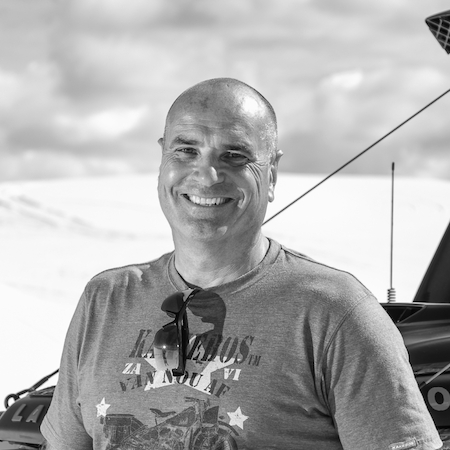
In this interview, extreme adventurer David Grier – the first person to run the Great Wall of China in both directions – talks about crumbling ramparts, 45-minute operations, and why the best bets risk little and pay for everything.
4,200km of wall, one 45-minute operation
Shanhaiguan, the eastern end of the Great Wall, where the old stone runs into the Bohai Sea. A grey winter morning. David Grier stood with the water at his back and 4,200km of crumbling rampart ahead of him, a long drop on either side, and started to run. He’d done it once before, 12 years earlier, in the other direction. This time he ran it backwards, to become the first person to run the whole wall both ways.
He covered about 60km a day to manage it. For months.
I had him across from me in the studio recently, expecting tales of the running – the tornadoes and sandstorms, and the crumbling ledges underfoot. He gave me all of it, dryly, like a man describing a bad road. But the running was never the point. The Great Wall is the marketing. The mission is a child you’ll never meet.
Grier runs for Operation Smile, through the Cipla Miles for Smiles foundation, which pays for corrective surgery on children born with a cleft lip or palate. The operation takes about 45 minutes. Forty-five minutes, and a child who couldn’t feed properly or be understood walks out with a face that works. He’s run more than 25,000km over a dozen years to pay for thousands of those mornings.
A lesson in asymmetry
That gap – months of effort converted into a 45-minute fix – is the most underrated shape in investing. The professionals call it asymmetry: a bet where the most you can lose is small and known, and the most you can gain is large and isn’t. Get enough of those running and you needn’t be right often to come out well ahead.
We’re hopeless at it. The market leans over your shoulder and murmurs: “Why nibble at some small, boring edge when you could go big?” – and most of us listen. We want the all-in bet, the conviction trade you can wave both hands about at the braai. Grier’s way is duller: a small, bounded, repeatable input aimed at a payoff worth many times its cost. Each operation is cheap. Each smile is not.
I’ll put my hand up here. For years I confused a big bet with an asymmetric one – all-in on the dramatic deal, downside wide open, upside doing all the talking in my head. It’s the investing version of bogging the Monster to her axles and flooring the accelerator: all noise and spray, digging in deeper. The man who’s done it before drops the tyre pressures, lays the sand tracks, and lets 2.5 tonnes of Landy walk out on almost nothing. Small, correct input. Whole vehicle freed.
And it isn’t willpower that keeps Grier going. He was a chef before he was a runner, and he fuels these runs on the low-carb, high-fat eating about which he co-wrote a bestseller: The Real Meal Revolution – a system built to keep a body intact for five months. The asymmetric bet is the same: not one brave trade but a system. Small positions and low costs take the farm off the table. Conviction makes the headline; the system does the work.
Where the bet goes wrong
The lesson turns dangerous the moment “small bet, big upside” becomes a licence to gamble. Most things dressed up as asymmetric bets are nothing of the sort. The penny stock, the leveraged punt, the friend’s can’t-lose scheme – a little money for a shot at a lot. But the downside isn’t capped – it just hasn’t shown up yet – and the upside lives mostly in the telling. Grier’s is real because both ends of the bet hold up: a cost that is bounded and known, and a payoff that dwarfs it. Take away either end and you’re just flooring the accelerator in the sand, calling it strategy.
For the investor worn out from hunting the one big winner, Grier is the model: place a row of small, bounded bets and let the arithmetic carry the years. For the one who wants the adrenaline of the all-or-nothing swing and the Monday story, he has nothing. There’s no rush in a 45-minute operation repeated into the thousands. Just quiet, enormous results.
That stretch of wall at Shanhaiguan is still there, the sea still washing its foot. Grier ran its length twice and the wall remembers none of it. But somewhere in KwaZulu-Natal a child can now eat, and speak, and be understood – with no idea that a man once ran 4,200km of Chinese stone, in winter, the wrong way, to pay for the 45 minutes that changed everything. The wall was never the achievement. The child is.
Listen to Episode 11 on your preferred platform
Spotify
Apple Podcasts
YouTube
Johan de Villiers is the author of ‘Overlanding Through the Boardroom: Using Adventure Principles for Success in Business’, which is published by Rockhopper Books.
ALSO WATCH:
- VODCAST: ‘JDV On Air’ – Kingsley Holgate on playing the long game
- VODCAST: ‘JDV on Air’ – from near paralysis to Dakar finish
Top image collage: Rawpixel; Currency.
Sign up to Currency’s weekly newsletters to receive your own bulletin of weekday news and weekend treats. Register here.