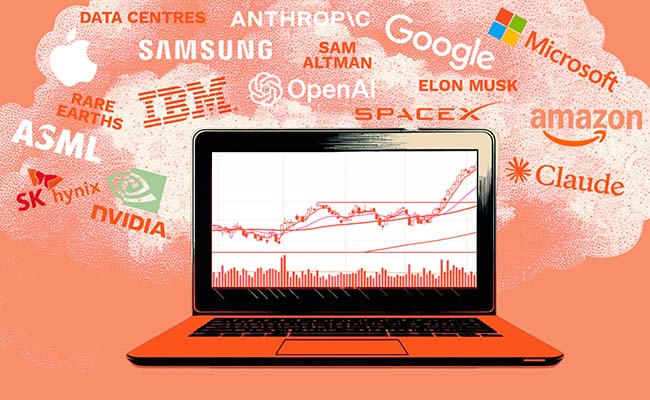

If you consider that Google is up 13% year to date, Nvidia has gained 12%, Apple 16% and Amazon 9.3%, talk that the party is over for the so-called “Magnificent 7” shares might seem either remarkably greedy or decidedly off the mark.
Yet, set against the likes of companies involved in memory storage and the production of semiconductors like SK Hynix (up 207%), Samsung (up 117%), Micron (204% higher) and ASML (up 53%), the comparison becomes less flattering.
Then there’s Microsoft, which has lost 18.6% in value, and Meta which is flat, year-to-date. Both companies, along with Google, happen to be the biggest spenders on AI; Microsoft’s bill may hit $190bn, while Mark Zuckerberg’s firm is likely to splash up to $145bn, with returns hardly guaranteed.
It makes picking your way through a blanket “AI-trade” that much trickier.
For Benguela Global Fund Managers’ Zwelakhe Mnguni, “there is real substance behind this drawdown, not just sentiment”.
The trigger, he believes, was Meta signalling it had surplus AI computing to sell rather than only buy via its planned Meta Compute cloud unit, “which challenges the perpetual GPU-scarcity thesis that has underpinned valuations across the AI hardware complex for two years”.
That, combined with fears that these “hyperscalers” will spend almost $700bn in total this year, ahead of any demonstrable returns, explains the more than $1-trillion of market value wiped off the market earlier this month.
Still on a run
Yet Otto1890’s David Shapiro, who manages only clients’ offshore portfolios, argues that some context is also key.
“When [Fed chair] Kevin Warsh mentioned that we haven’t got over inflation, that was an incredibly powerful admission of failure of central bankers; that’s still hanging in the air. In other words, in a high interest-rate environment, there’s been nowhere else other than the AI play,” he tells Currency.
That this has now flattened out, reckons Shapiro, is because the Magnificent 7 “carried this trade for so long, you’re starting to get people looking for the next best thing. I believe that’s wrong.”
In his view, their run isn’t over. Far from it.
“Maybe that sounds pretty boring – because you want to look for some obscure company that’s been developed in a garage in San Antonio … those companies are emerging, but they haven’t been around long enough for you to know whether they’re sustainable,” he warns.
In fact, he argues that because the share price performances of the big guns have become that much more pedestrian, there is a strong reason to buy.
“Yes, they’ve carried the market for four years, but that doesn’t mean their run is over. In fact, I find that because they’ve been downgraded or rerated downwards, they’re still looking very attractive.”
Mnguni is more sceptical.
“Our internal work on AI capex returns puts the industry at roughly 22c of return generated per dollar of required return at current spending levels. Until that gap closes in reported numbers, not guidance, I would not call the broader hyperscaler complex indiscriminately cheap,” he says.
Beyond the noise
A valid fear is whether the Mag 7 can sustain their profits; as the earnings base of these companies has ballooned, growing by 40%-50% every year becomes that much harder.
But, says Shapiro, “you forget what’s embodied in these big companies: the amount of experience and the amount of skill in terms of engineering, and also their balance sheets. You’ve got to move away from the noise and look at the cash they’re generating – and you can’t operate without ASML, for example.”
For Mnguni, the “genuine opportunity” is in the “picks-and-shovels layer”; those companies “with visible, contracted, return-on-invested-capital-positive revenue from the build-out itself, rather than those still asking the market to trust a monetisation story”.
These are the firms like Micron, Samsung and Broadcom “capturing high-margin, immediate cash flows today”, he says.
Consider that in Micron’s most recent quarter, revenue vaulted 346% year on year to $41.5bn, while Broadcom’s AI revenue grew 143% to $10.8bn.
This, says Mnguni, “is the kind of hard evidence that separates the two camps”.
For Shapiro, companies providing the energy are also worth considering; firms like Quanta Services and NextEra Energy.
Spreading exposure
Interestingly, both Mnguni and Shapiro are keen on ETFs to spread exposure and limit risk. “A basket approach is not a hedge against being wrong about AI as a technology; it is an honest acknowledgement that which specific businesses convert that spending into durable, defensible returns on capital is genuinely still an open question, and will likely remain one until at least the 2027 and 2028 capex and earnings cycles play out,” Mnguni says.
One of Shapiro’s key portfolio holdings is the iShares Semiconductor ETF, or STOXX.
“Why I liked STOXX is that it was very tight: the top 10 shares made up the bulk of the value. So you got Broadcom, you got AMD and Qualcomm and Micron,” he says. The index has gained about 80% in value this year, “so even if it comes down 10% you can relax for the next five years”, he quips.
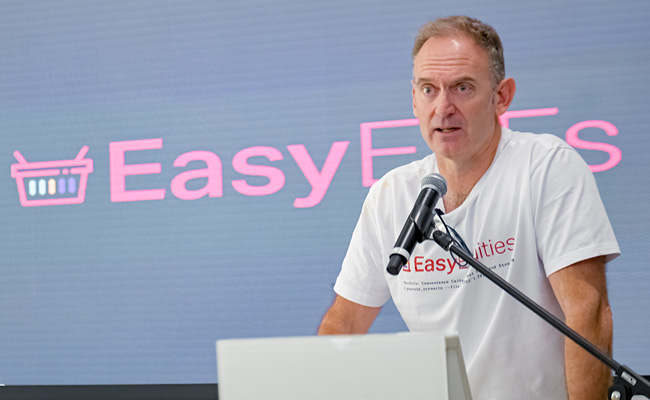
Benguela, in fact, is building an actively managed ETF in partnership with EasyEquities.
Called the AI Revolution AMETF, it targets the “bottleneck” layer of the AI value chain – semiconductors, memory and the infrastructure build-out. “High-bandwidth memory supply, for instance, is reported to be sold out through most of 2027, which is the kind of demand signal that doesn’t depend on a forecast,” says Mnguni.
“As the monetisation picture becomes clearer … we intend to progressively rotate the strategy towards the businesses capturing that monetisation directly, rather than only those supplying the tools.”
Ask AI
It would seem daft, in an article asking which companies will prosper from the AI revolution not to consult, er, AI.
So to leave you with their input, here’s a list of shares from Claude and ChatGPT. But, you know, do your own research.
Claude’s top 10
- Nvidia: captures roughly 90% of AI accelerator spending
- Broadcom: controls custom silicon and the networking infrastructure connecting GPUs
- Taiwan Semiconductor: the foundry manufacturing nearly all leading-edge AI chips
- Micron: high-bandwidth memory
- Vertiv: data centre power and cooling
- Arista Networks: data centre networking switches
- ASML: a monopoly on EUV lithography
- Constellation Energy: muclear baseload power
- Vistra: the largest unregulated US power producer
- Equinix: data centre landlord collecting rent from hyperscaler tenants
Chat GPT’s top 10
Nvidia, Broadcom, Taiwan Semiconductor, ASML, Micron, Arista and Vertiv too, plus:
- GE Vernova: power generation and grid equipment
- AMD: second-source GPU accelerator exposure
- Eaton: electrical equipment, switchgear and power management
This story was produced in partnership with Stanlib.
ALSO READ:
- The AI bubble that isn’t quite a bubble yet
- Did the AI bubble pop – and we just didn’t notice?
- Is the AI frenzy today’s new dot-com moment?
Top image collage: substackcdn.com; Rawpixel; Currency.
Sign up to Currency’s weekly newsletters to receive your own bulletin of weekday news and weekend treats. Register here.