In ‘Overlanding Through the Boardroom’, Johan de Villiers turns bush lessons into business ones. In this edited excerpt from the book’s seventh chapter, he crosses Myanmar on a hired dirt bike with no guide and no insurance, watches a mechanic in the Chin Hills beat the world’s best chain lubricant with a toothbrush and a jar of sump oil, and argues that the same thing is now happening to white-collar work.
The Russian
Kim and I were on our second glass of Anura’s 2018 Malbec Reserve on a Sunday afternoon in February 2019 when we settled on Myanmar. The rule of the game is simple. Name the most foreign country either of us has ever heard of, then work out how to cross it on two wheels. The military junta had loosened its grip, the borders had opened to tourists, and I did not believe the window would stay open for long. It didn’t.
Finding two dirt bikes and a guide in Mandalay in 2019 was not a matter of comparing suppliers. There was one company. A man with a thick Russian accent answered the phone and wanted the full amount upfront.
“Trast me,” he said. “Yust pay the money, and I’ll have the bikes ready ven you arrive at the hotel.”
I googled him. He did not exist. He was also our only option, so we paid him.
The bikes were waiting in Mandalay: two brand new Honda 250 CRFs with 200km on the clock, driven straight from a dealership, delivered with no insurance forms, no licence check and no paperwork of any kind. I phoned the Russian to ask about our guide.
“You vanted two bikes,” he said. “Zere’s your two bikes. Yust don’t break my property.”
The guide, it turned out, could not make it. He offered a substitute.
“If you go vest and keep ze sun on your back all ze vay, you’ll be fine.”
Our first stop was 800km away. Myanmar has no national road network worth the name, no signage a foreigner can read, and a script that looks like what would happen if the Cyrillic alphabet walked into a field of burning ganja and inhaled. What it does have, thanks to Huawei, is 4G in places where you will not see another human being for a day. We cable-tied a phone to the handlebar, opened Google Maps and followed the line.
Three weeks and 2,500km later we handed the bikes back without a mark on them.
The toothbrush
What almost ended that trip was not the Russian, and it was not the roads. It was the chains.
Mindat sits in the Chin Hills in the west, and every kilometre between us and it was dirt. Dust in the air filters is a chore. Dust in a chain is something else. A dry chain on a loaded dirt bike, 400km from the nearest person who has ever held a torque wrench, is not a maintenance issue. It is a countdown.
By the third day mine had found a voice.
“Feed me,” she said, “or I will let go on a switchback and you can explain that to the Russian.”
There was no chain spray in Myanmar. No Honda spares, no chain tools, no accessory shops, no aerosols. The locals ride cheap Chinese scooters and none of the parts fit a Japanese scrambler. So we did the only thing left, which was to go and find somebody who did not have our problem.
We found him in a Chinese bike shop. I asked what he used on his chains and he pointed at a jar on the concrete floor, filled with something black and thick that announced itself from 2m away. Gearbox oil. The stuff you drain out and throw away. He took an old toothbrush, dipped it, and began painting it onto my brand-new chain.
I should be honest about what I was thinking while I watched him do it. I sell technology for a living. I have spent 30 years in boardrooms explaining to clients that the cheap option is the expensive option. And I stood in that shop quietly certain that this filthy improvisation was going to destroy a motorcycle that did not belong to me.
I was wrong. Comprehensively, 2,500km wrong.
We repeated it every day after that. Find a shop, find the jar, find a toothbrush, paint the chains, ride. Not one link failed.
A can of good chain spray in Cape Town costs about R300 and gives you 10 or 12 useful squirts. Gearbox oil costs about R5 a pint. The mechanic in Mindat was not making do. He was right; he had been right for 20 years.
I made a rule in that shop and I have not broken it since. When the expensive answer and the cheap answer disagree, test the cheap one first. It costs almost nothing to find out.
The doubling
That story is not about a motorcycle chain. Something is happening to professional work in South Africa that has the exact shape of a man with a toothbrush and a jar.
Start with the arithmetic. In 1965, Gordon Moore, who went on to co-found Intel, noticed that the number of transistors you could fit on a chip was doubling on a predictable clock, and that the price was collapsing as it did. Moore’s Law has been pronounced dead every few years since and it keeps declining to lie down. The compounding is the whole point. A thing that doubles is not a thing that improves. It is a thing that arrives.
Watch what that clock does to a real price. In September 2001, just after the Human Genome Project finished, sequencing a single human genome cost about $95m. The machines are now being sold on the promise of a genome for under $100. A factor of a million, inside one working career.
Your laptop becomes a doorstop in two years for the same reason. Not because it got worse, but because the ground moved.
Now put that clock against work that used to be safe. Drafting a standard contract. Building a model. Cleaning a data set. Writing the first version of a brochure. Producing a set of management accounts. Every one of those was a billable professional service three years ago, and every one is now available in a form that is cheaper, uglier, faster and good enough. Not better. Good enough.
The machine is not coming for your job. It does not want anything. It simply performs the 10,000 repeatable steps you were paid for, at 3am, without a chair, a medical aid or a grievance procedure. And it improves every few months, which is a thing no employee has ever done.
That is the jar on the floor of the shop. The professionals are standing around it, discussing the aerosol can.
Three wheels or two
The instinct, when the cheap thing arrives, is to defend the price. It has never worked once. The aerosol can did not win the argument in Mindat by pointing at its own packaging.
The defence is not price. It is motion.
A child’s tricycle has static stability. It stands up on its own, it stays where you leave it, and it will not fall over whatever you do to it. A bicycle has no stability at all standing still. Stop pedalling and you go down. Every bit of its balance comes from movement, and the faster it moves the steadier it becomes.
We were all raised to build tricycles. Get the education, get the qualification, get the job, and you are upright for 40 years. That was not a stupid model. It was the correct model for a world in which a skill had a working life of a generation and a career was something you set up once and then maintained.
That world has gone and it is not coming back. A qualification is a receipt. It records what you knew on the day you paid for it.
There is a certificate on an office wall in Sandton right now, framed and lit, recording what its owner knew on a Tuesday in 2011. The frame is beautiful. The wall is fine. Every process behind that certificate is being automated by people who do not hold it, in a language its owner does not speak, at a price he cannot match.
He is a tricycle. Upright, and not moving.
Learning has to be the bigger number
I have carried an equation around for years and I have not found a better one: L>C2.
L is learning. C2 is change and competition; they do not add to each other, they multiply. Change is the hill and the corner. Competition is everybody else on the road. Learning is the pedalling. The inequality has to hold. The moment L drops below C2, you are back on three wheels.
It is deliberately uncomfortable, because it does not tell you to learn. It tells you to learn faster than the thing coming for you is improving. That is a considerably higher bar than a certificate and a two-day workshop with a lanyard.
At First Technology we put money behind it. We fund any degree, diploma or course with a plausible return to the business on a two-year training contract. Leave at 12 months and you refund half. Leave after 24 and you owe us nothing, because by then we have had the value. It runs to hundreds of thousands of rand a year.
It is not charity. It is the most selfish thing we do. A client sitting across the table from someone who has visibly grown in five years is having a different conversation from a client sitting across from a price list with a name badge. I would rather fund the growth and occasionally lose the person.
Where my own story lets me down
Now let me take that story apart, because I have been leaning on it and it will not carry the weight I have put on it.
The chain held. That is the only reason Myanmar is wisdom instead of a cautionary tale. If a link had let go on a switchback outside Mindat, I would be writing a different article, with exactly the same conviction, about why you never improvise on a machine that is not yours. And you would be nodding along to that one too. I made a decision under pressure with no information, I got a good outcome, and I have been dining out on it ever since. That is a survivor explaining his survival, which is the least reliable testimony there is.
The second problem is more useful, and it is the part everybody skips.
Gearbox oil won on lubrication. It lost on everything else. It flings off the chain and coats the swingarm, your boots and your luggage. It picks up dust and holds it, which turns a chain into a grinding paste.
So the cheap answer did not beat the expensive answer. The cheap answer beat it at the one thing I desperately needed in Myanmar and lost at everything I could afford to ignore. In Cape Town, on tar, with a clean bike and R300 to spare, I use the spray. Of course I do.
That is the honest shape of what is happening to professional work, and both of the loud camps have it wrong. The machine is not coming for all of it. It is coming for the lubrication, the repeatable mechanical part, and it will do that part cheaply and stink the place out while it does. What it will not do is judgment, taste, accountability, or being the person in the room whose name is on the outcome.
And one more concession, which I make as the man who owns the company. Telling people to learn faster is a very cheap thing to say from behind a desk. The people whose work is most exposed have the least time and the least money to retrain. Adapt is not a plan when you are working two jobs and load-shedding takes the evening. If you run a business and your entire strategy is instructing your staff to be more agile, you have not built a strategy. You have built an excuse.
Who should pedal, and who shouldn’t bother
Take this seriously if your work can be written down as a set of rules. If somebody could hand a competent stranger a 12-page document and get 80% of your output, you are the lubrication. Take it seriously if you run a business and training is the first line you cut in a bad quarter, because what you are buying with that saving is a room full of tricycles, and you will discover the price of that at the worst possible moment.
Do not bother if what you intend to do is collect certificates. The certificate was never the point, and the wall is being automated too.
And do not bother if you are going to chase every tool that appears, sign up for all of it, and mistake motion for progress. A bicycle needs you to pedal. It does not need you to fall off enthusiastically in a new direction every six weeks.
I still think about that shop in Mindat. The jar on the concrete floor, the old toothbrush, the R300 aerosol can that was not there and would not have helped if it had been. He was not a genius and he was not disrupting anything. He had been solving the same problem for 20 years with the only thing he had, and he had become very good at it.
There is a jar like that on the floor of your industry right now. Somebody has already picked up the toothbrush. I would find out what is in it before your clients do.
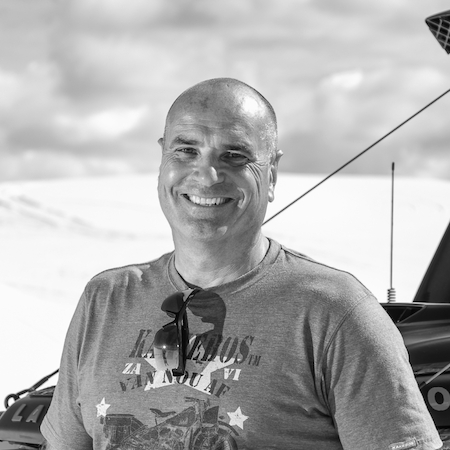
Johan de Villiers is the leader of First Technology Western Cape, an award-winning IT provider in South Africa. His book, ‘Overlanding Through the Boardroom: Using Adventure Principles for Success in Business’, is published by Rockhopper Books.
ALSO READ:
- Chapter 6: Importance vs urgency
- Chapter 5: Why team selection matters
- Chapter 4: Lessons from black swans
- Chapter 3: The Dunning-Kruger effect
- Chapter 2: The Swiss cheese effect
- Chapter 1: The mindset factor
Top image collage: Rawpixel; Currency.
Sign up to Currency’s weekly newsletters to receive your own bulletin of weekday news and weekend treats. Register here.