
In ‘Overlanding Through the Boardroom’, Johan de Villiers turns bush lessons into business ones. In this edited excerpt from the book’s sixth chapter, he explores why the loudest demands on your attention are rarely the most consequential – and how a chance encounter on a Himalayan trail revealed how easily distraction can tip into danger.
It’s a Saturday afternoon. You’re finally getting around to something you have been meaning to do for years: backing up your digital photo library. Then your phone pings. A friend has spotted a flash sale on T-shirts – 50% off, for the next hour only. You drop everything, race to the store, fight off other shoppers and emerge triumphant with 10 cotton shirts in assorted colours. Your photo library remains a mess.
Organising your photos is important. The T-shirt sale is urgent. They are not the same thing.
The example is trivial; the principle is not. People make a great deal of noise about things they consider urgent – and the louder they shout, the harder it is to focus on anything else. When the world is screaming at us, it is human nature to pivot towards what is loud rather than what matters. This is particularly true when the urgency belongs to someone else. Most so-called emergencies are urgent only because someone failed to plan or chose to procrastinate.
You will never be truly successful if you cannot say no to other people’s self-imposed emergencies. The ability to lock out the noise – to say no to what is urgent and yes to what is important – will make you 10 times more effective than someone who reacts every time a colleague rushes in with their hair on fire.
Important, urgent and the difference
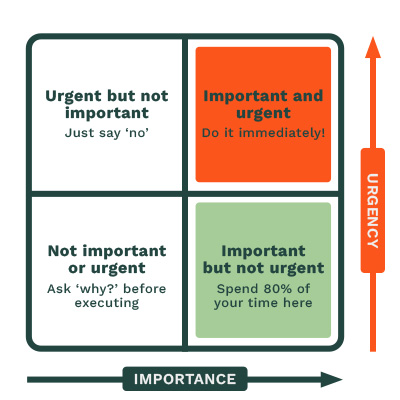
The framework is simple. Two axes: importance on one, urgency on the other. Four quadrants.
- Important and urgent decisions usually carry deadlines or consequences and significantly impact long-term success or survival. In business, this might be a client reporting a critical issue with your product that is interrupting their operations. The clock is ticking; both your client’s success and your company’s reputation are on the line.
- Important but not urgent decisions are crucial for long-term success, but don’t require immediate action. Ideally, this is where most of your time should be spent: developing long-term strategy, planning expansion and investing in employee training. These shape the company’s future.
- Urgent but not important decisions are the distractions: non-critical emails, meetings without a clear agenda and minor administrative tasks. They demand attention but contribute little to long-term success. The default answer here should be no, which doesn’t necessarily mean ignoring the task, but delegating or delaying it.
- Not important and not urgent are tasks that need doing but don’t require your specific skills set – filing systems, contact lists, routine admin. They have minimal impact on long-term success and can be avoided, delayed or delegated. Always ask “Why?” before executing.
Not every urgent task deserves your immediate attention. A normally urgent matter may, in fact, warrant a lower priority while you focus on what is actually important. When a colleague rushes into your office in a panic over a presentation they forgot to prepare, or your teenager calls urgently for something they need for tomorrow’s project, their lack of planning has become your emergency. Is it really critical for you to drop everything?
Speed, adaptability and the cost of waiting
In business, important tasks shape long-term growth. Urgent tasks are the alarm bells: customer complaints, looming deadlines, workplace conflict. They cannot be left on the back burner, but they should not be allowed to consume the time reserved for what really matters.
In survival situations, the principle is the same – with higher stakes. Imagine you’re stranded at sea on a life raft after your boat capsizes in a storm. Your urgent decisions are immediate: check the raft for punctures, secure yourself against falling overboard, signal with reflective materials, ration food and water. Your important decisions involve devising daily routines to maintain mental wellbeing, scanning the horizon for rescue, finding ways to collect rainwater. Now translate that to business: addressing a major product design flaw is the urgent decision; re-evaluating your long-term marketing strategy is the important one. The strategy can wait while the urgent issue is dealt with – but only briefly. Both must be allocated time.
When you do decide, decide quickly. The US general George S Patton once said: “A good plan executed today is better than a perfect plan executed at some indefinite point in the future.” Imagine you’re at the helm of a technology firm with an industry-changing product. Launch quickly, and you capture the market before your rivals know what hit them. Linger in the pursuit of perfection, and a competitor may outpace you. The cost of a missed opportunity through procrastination usually outweighs the cost of an imperfect call. An incorrect decision made in haste can usually be corrected. An inability to make a decision under pressure can be irrevocable.
Delegate, empower, get out of the way
Adaptability matters in the wilderness and the boardroom. So does the ability to delegate. Both enhance not only the chances of survival but the prospects of thriving in difficult conditions.
Imagine a mountaineering accident: a climber is injured, and the weather is deteriorating. The important decision is to ensure the casualty’s long-term wellbeing through proper first aid and stabilisation. The urgent decision is whether to continue the ascent, wait for help, or attempt a risky descent for medical attention. Delegation is essential. Someone with medical expertise tends to the injured climber. Others secure equipment or attempt to establish communication for rescue. Each plays to their strengths. Things get done more efficiently.
Now bring that into the boardroom. You’re the head of a busy start-up. Your in-tray is overflowing, emails are backed up and meetings are stacked. Take a leaf out of the survival handbook: delegate. Let your tech lead handle the software updates. Let the marketing lead take the campaign. By empowering team members to make decisions, you free up your time and create a workplace where each person’s strengths are visible. The result is an agile company.
“Anybody can steer a ship in calm waters,” runs the old maxim. Leadership is revealed in turbulence. The distinction between good management and great management is the ability to execute decisions under pressure without succumbing to self-doubt or hesitation. As a leader, that means empowering your line managers to make difficult business decisions independently, without constant escalation.
Picture the same technology firm racing to launch ahead of a competitor. A line manager identifies a critical software bug late in the cycle. Rather than waiting for upper management to authorise a response – which would burn precious days – she reallocates resources, collaborates with the tech team on a fix, and arranges parallel work to enhance other features that compensate for any potential delay. The product launches on schedule. The firm beats the competitor to market. None of it would have happened had she been required to escalate every decision upwards.
Ethical considerations
Ethical decisions surface in both contexts. During a natural disaster, the important decision might be to secure your home and gather supplies. The urgent decision is whether to evacuate or shelter in place. Ethical considerations – helping neighbours, ensuring vulnerable members of the community are safe – become significant.
In the boardroom, the dilemma takes a different form. As a corporate leader, you’re balancing the relentless pursuit of profit against the pull of social responsibility and environmental consciousness. Your job is not just about driving the bottom line – it’s about making choices that respect the world around you.
When making a decision in the heat of the moment, two questions matter. Is the decision ethical and legal? Does it make financial sense for the company? Provided the answer to both is a resounding yes and there is clarity on management’s accountability, the company – and, by extension, its customers – will benefit.
From distraction to danger
Effective decision-making isn’t confined to boardrooms. Distractions, however minor, can cloud judgment and lead us down unforeseen paths. A lapse in attention in the boardroom can change a company’s trajectory; a momentary distraction on a trek can be the difference between returning home and never being seen again. Kim and I learnt this firsthand in the Himalayas.
Nepal’s mountain range, home to eight of the world’s 14 8,000m peaks, beckons thousands of trekkers every year. Yet beneath the allure lurks a darker reality. On any major trekking route, lampposts are filled with flyers featuring the faces of the lost: “Missing Person, Last Seen …” Some are worn and faded, bearing testament to the passage of time. Others are disturbingly recent. The reasons range from solo trekkers losing their bearings, succumbing to altitude sickness, and falling off rockfaces or bridges or into crevasses, to possible human trafficking. By 2023, Nepal had banned solo hikes in all its national parks. But our trek to Everest Base Camp was in 2010, when solo hiking was still permitted, though never recommended.
After 10 days, our group of 10 was en route to Lukla, where we’d fly out to Kathmandu. The mountain pass narrows in places, forcing trekkers to walk in single file. Despite setting off together, the rugged terrain meant the group splintered, with members arriving at rest stops hours apart.
Two days out from Lukla, a young boy – no older than six, in a neat school uniform, holding a tied bunch of paalungo ko saag (spinach) – approached Kim. I was slightly ahead. His broken English was filled with innocent curiosity: her name, where she was headed, a compliment on her backpack. After their brief exchange, the boy disappeared, only to reappear later on the path, this time without his spinach.
“Where are the vegetables?” Kim asked.
He’d left them with someone, he said, and was on his way to his cousin’s. He waved goodbye, then reappeared sometime later – and again, and again. After he had materialised three or four times over a span of about three hours, Kim grew uneasy. Was he innocently curious, or was something else going on? She wrestled with the question, trying to listen to her instincts without coming across as paranoid.
She decided to wait at a tea house and join other trekkers. When she resumed her walk, accompanied by three of them, the boy was back, silently following. The group stopped to look at something. Kim was about 20m ahead and momentarily alone. The path veered sharply right. A steep hill rose in front of her. On edge, she pulled her metal water bottle from her backpack and looped its strap around her wrist.
The boy emerged from the foliage, blocking her path, and grabbed her hand.
“You’re coming with me,” he said, his voice suddenly aggressive. With surprising force, he yanked her arm. “My friends are waiting. They will look after you.”
In the struggle, Kim swung the water bottle, connecting with the side of his head, then ran up the hill as fast as she could. The sound of his laughter behind her was chilling. When she reached the top, I was waiting, unaware of what she had just escaped.
After she recounted what had happened, we sat in silence. It was clear the boy had been tracking her – perhaps the group – for hours. The missing-person flyers we had once glanced at on lampposts now carried an ominous weight. Danger doesn’t always announce itself loudly or from a distance. Sometimes it walks quietly beside you, cloaked in innocence.
What’s important in your own life
Not all important decisions concern business. Many are personal – and often neglected. Financial planning, physical and spiritual health, your choice of life partner, the company you keep, where you choose to live. None of these are urgent until they suddenly are. Constantly putting out fires diverts resources away from what matters in the long run – your health, foundational to your overall wellbeing and your capacity to manage everything else.
Many people postpone looking after themselves because they are preoccupied with more immediate concerns, like work. The reality is that you are not going to be of much use to anyone – least of all yourself – when your health fails because you have been neglecting it. Eat a balanced diet. Take the supplements you need. Exercise. Sleep enough. Keep up with annual health checks: dental, mammograms, prostate screenings, ECGs, liver and kidney functionality. Neglect doesn’t show consequences immediately. Over time, it can lead to problems that could have been avoided.
Financial health requires the same vigilance. When did you last review your cash flow? Compare income against expenses, scrutinise bank statements, ask whether bank fees can be reduced? If you own shares, monitor them and have a strategy for what to do when they depreciate. Engage with your retirement annuity – request regular performance analyses from your broker, query underperformance, understand the strategy being employed. Don’t wait until retirement to find your capital is dwindling. By then, the situation is not just urgent but critical, and you’ve run out of time.
Relationships need attention too. When did you last tell your loved ones what they mean to you? Visit your parents, or call if you cannot visit? Whenever you face a decision – about an investment, a walk on the beach, a long conversation with someone you love – ask whether the future you would be grateful for it. If the answer is yes, do it. Because it’s important.
The wheel of life
To put this into practice, draw a wheel: a circle, divided into seven spokes radiating from the centre. Label each: physical health, finances, career, social life, skills and qualifications, spiritual wellness, family. Rate yourself zero to 10 on each spoke – the centre is zero, the rim is 10.
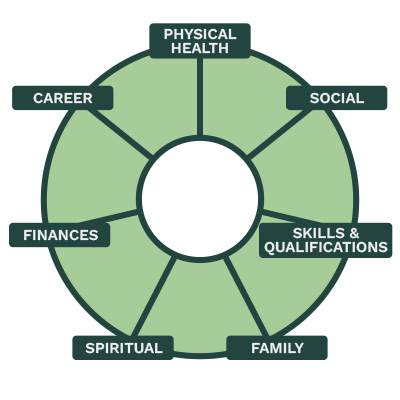
Think of the numbers as the temperature of a cup of coffee. An eight is piping hot. A seven is just below ideal drinking temperature. A six is lukewarm. Anything below six is the cup abandoned halfway through a long, boring meeting – at room temperature. A nine is exceptional, indicating you’re excelling in that area. Avoid rating yourself a 10 unless you’re certain there’s no room for improvement; a 10 is hubris, the precursor to complacency.
Mark each spoke. Connect the dots. The shape that emerges shows how balanced your life is – or isn’t. A near-perfect circle with everything sitting at seven or eight indicates a wheel capable of rotating evenly. If the wheel is misshapen, that’s normal. Most of us have areas that need work. The point is to see them – and to move them, immediately, into the important and urgent quadrant. Once stabilised at seven or eight, they shift to the important but not urgent quadrant.
If you can claw back the time and opportunities that the urgent has stolen, you’ll have more time for what truly matters.
Johan de Villiers is the leader of First Technology Western Cape, an award-winning IT provider in South Africa. His book, ‘Overlanding Through the Boardroom: Using Adventure Principles for Success in Business’, is published by Rockhopper Books.
ALSO READ:
- Chapter 5: Why team selection matters
- Chapter 4: Lessons from black swans
- Chapter 3: The Dunning-Kruger effect
- Chapter 2: The Swiss cheese effect
- Chapter 1: The mindset factor
Top image: Rawpixel/Currency collage.
Sign up to Currency’s weekly newsletters to receive your own bulletin of weekday news and weekend treats. Register here.