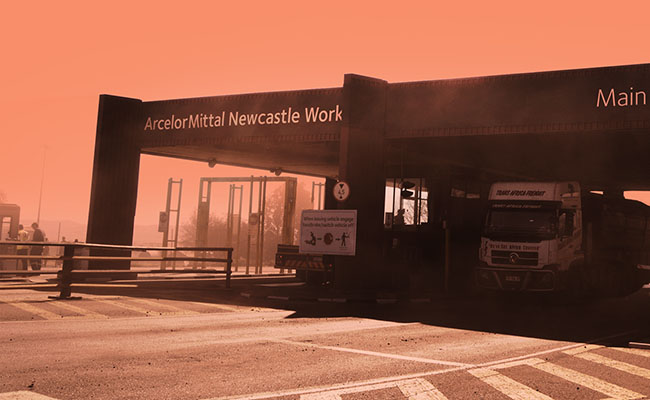

Employees of ArcelorMittal SA, and the communities around Newcastle and Vereeniging, face a bleak and uncertain future in the wake of the company’s decision to close its long steel business in the country.
This moment, while saying a lot about the fallout of deindustrialisation in South Africa, has also shone the spotlight on the indispensable role that workers play in sustaining the country’s social and economic fabric, and how frequently this is ignored entirely.
The spectre of job losses and economic anxiety has hung heavy over ArcelorMittal’s employees ever since the company announced in January 2025 that it would wind down the long steel business after prolonged pressure from high electricity and logistics costs, weak growth and competition from low-cost imports.
At the time, the company said 3,500 direct and indirect jobs could be affected, but the collateral impact on towns like Newcastle, which was heavily reliant on ArcelorMittal, would be far greater. For these communities, everything is on the line: families, school fees, grocery bills and the future of the generations they are raising.
In this context, it is hopelessly insufficient for companies to simply give workers accolades in speeches while factories fall silent and towns disintegrate.
In the end, despite a number of attempts to prevent this closure, ArcelorMittal went ahead and placed its long steel business into “care and maintenance”. ArcelorMittal still retains its other businesses – including the flat steel operation and other specialised units – but this left a considerably smaller footprint in towns like Newcastle.
Quite how this will play out eventually is unclear. The state-owned Industrial Development Corporation (IDC), which already owns 8.2% of ArcelorMittal and which put money into the business to prevent its collapse, is in talks about buying a larger stake, it seems.
Earlier this month, ArcelorMittal said it is “continuing to engage” with the IDC “in respect of a potential transaction”, though it hasn’t finalised a deal. ArcelorMittal said the anticipated timeline “has been delayed”, but much hinges on whether Eskom will agree to give it a reduced electricity tariff.
But this is clearly a business that needs an overhaul. In its financial results for the year to December, ArcelorMittal produced a R1.09bn pre-tax earnings loss, with sales down 12%.
The workers did not create this structural failure, yet they were the most impacted. And this damage didn’t stop at the plant gate, but ricocheted out to the wider micro economy.
Transporters lose contracts; informal traders lose customers; suppliers shrink; municipal pressure for service delivery and income generation grows. Younger South Africans see fewer reasons to stay in those communities, so they leave, creating a further squeeze.
This decline of industrial work becomes the decline of community confidence and sustenance. That is why this moment should matter not only to those directly employed by ArcelorMittal, but to everyone concerned about South Africa’s productive future.
New perspective needed
This is not just a story of one company collapsing; it’s a story of South Africa steadily shedding its industrial base, while workers and communities bear the brunt of the fallout.
This is precisely why a just transition lens is essential. The Presidential Climate Commission has been clear that any just transition must address a number of things, including jobs, local economies, skills, social support and governance.
Three core ideas underpin this: procedural justice, distributive justice and restorative justice. In other words, workers and communities must have a meaningful voice in decisions; the burden of change must be shared fairly; and areas damaged by transition must be actively supported.
Measured against that standard, a transition that begins with job losses and ends with community decline is not “just” – it is abandonment dressed up as inevitability.
So what does this mean for ArcelorMittal?
Well, first, any just transition for its workers would start with an honest, binding social dialogue. The consensus on just transition practice has made the same point: legitimacy depends on workers, communities, business and the state shaping the process together. That means no more closed-room decisions followed by public explanations.
Specifically, workers require material protection, not rhetorical concern. If operations are being wound down, they need income support, fair severance, debt relief pathways, retraining links to real jobs, and clear timelines for what support exists and how long it will last.
Communities need targeted recovery plans, including local industrial diversification, support for small enterprises, infrastructure investment and municipal stabilisation.
And, as a country, we need to pose the hard questions to government, business and labour: what does it mean to publicly sing the praises of your workers when they become the shock absorbers of industrial failure?
What needs to happen at ArcelorMittal is clear: there needs to be a binding just transition strategy for its workers and communities. This needs to include transparent social dialogue, funded social protection, credible retraining and specific economic recovery plans.
If the country is serious about worker dignity, this is the opportunity to prove it.
Tarisai Mugunyani is the head of the mining programme at the Centre for Environmental Rights.
ALSO READ:
- Saving South Africa’s steel sector
- Manufacturing meltdown: South Africa’s jobs crisis deepens
- Mozal goes dark as power prices crush beneficiation ambitions
Top image collage: arcelormittalsa.com; Currency.
Sign up to Currency’s weekly newsletters to receive your own bulletin of weekday news and weekend treats. Register here.