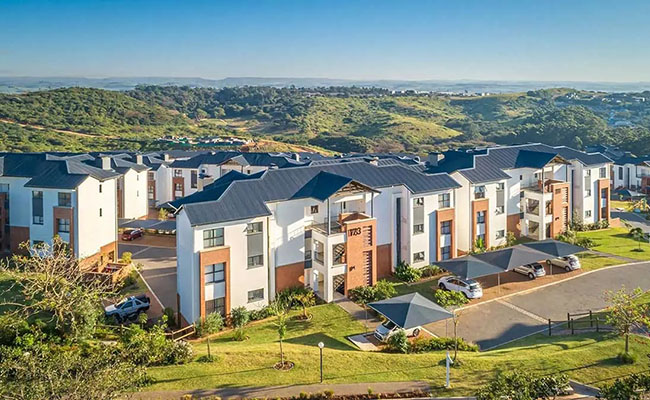

The JSE is not the right home for every business, and the R2.26bn offer to take Balwin Properties private is the latest example of how badly some companies are mismatched with the public market.
A consortium led by the Public Investment Corporation (PIC), acting on behalf of the Government Employees Pension Fund (GEPF), alongside founder-linked investors including CEO Stephen Brookes and MD Rodney Gray, has offered R4.35 a share in cash to acquire South Africa’s largest sectional title developer. If shareholders and regulators approve, Balwin will delist from both the JSE and A2X, ending a public-market run that began in 2015.
The news has been framed as a surprise. It shouldn’t be. The signs have been building for years.
In December 2024, I wrote a piece for the Mail & Guardian asking whether Balwin was too bold for the South African market and whether the JSE was still the right home for it. Profits had dropped 57%, and revenue was down 28% in the interim results to August 2024. The loan-to-value ratio was sitting at 40.2% – above the 35%-40% range property companies should target. Dividends had stopped. The flagship Munyaka development in Waterfall City, Midrand, had 3,705 of 5,020 apartments still unsold. And the share price had fallen from roughly R10 at listing to R2.30 at the time.
The full-year results to February 2026, released days before the buyout announcement, tell a different story – one of genuine recovery, but also of structural limits that no recovery can fully resolve.
Group revenue grew 21% to R2.7bn, from R2.2bn the prior year. Apartment sales rose 22% to R2.4bn, underpinned by a 17% increase in apartments handed over – 2,053 units against 1,749. Profit for the year increased 9% to R254.5m. Excluding non-recurring land disposal losses, underlying recurring profit grew 36% to R273.6m. The loan-to-value ratio fell to 38.1% from 40.4% a year earlier. These are not the numbers of a distressed business.
And yet the board resolved not to declare a dividend for the second consecutive year. That single fact captures the tension at the heart of Balwin’s listed life. Investors in property companies expect income. Balwin’s model – long cash-conversion cycles, multi-year inventory build-up, heavy infrastructure investment – makes consistent dividend payments structurally difficult. The board cited global macroeconomic uncertainty and its priority of reducing debt as reasons for withholding the payout. Both are legitimate. Neither is what listed property shareholders want to hear.
What the regional split tells us
The geographic story is also revealing. The Western Cape has surpassed Gauteng as Balwin’s largest revenue contributor, accounting for 54% of apartment sales revenue at R1.3bn – a 47% year-on-year increase. Gauteng, by contrast, contributed 39% of revenue despite 11 active developments. Revenue there grew just 2% to R959.7m. The results indicate a shift in Gauteng’s market dynamics, with a growing preference for rental over sectional title ownership.
The build-to-sell pipeline figures underscore the scale of unsold inventory. Across the entire portfolio of 41,226 planned apartments, 25,056 remain unsold. Tshwane alone accounts for 11,751 unsold apartments across active and inactive developments – a node where Balwin continues to invest in roads, stormwater, water capacity and electrical infrastructure. The group is betting on long-term demand that the public market has shown no patience for.
The consortium itself acknowledges the problem. Its announcement says Balwin’s business involves “long cash-conversion cycles” and “multi-year inventory build-up” – factors it concedes are “not always well matched to public-market valuation cycles”. That is a precise description of why a developer of this type should probably never have been listed in the first place.
The deal structure is worth understanding clearly. A new entity, Bidco – wholly owned by Volker Holdings, which is controlled by Brookes – will acquire all eligible Balwin shares. Once implemented, the PIC, acting on behalf of the GEPF, will hold about 49% of the privately held Balwin, with Brookes and Gray reinvesting their existing roughly 50% stake rather than cashing out.
The consortium has already secured irrevocable commitments from 63.5% of eligible voters, with Abax Investments, Tatovect and Bryte Insurance among the largest backers. The offer represents a 41% premium to the 180-day volume-weighted average price, 35% over 90 days and 23% over 30 days. Tangible net asset value per share at February 28 was about R9.72 – more than double the R4.35 offer, reflecting the discount at which Balwin has persistently traded. Going private removes that discount.
Actual value vs sentiment
The annuity businesses are showing real traction. Balwin Annuity delivered revenue of R219m, up 25%, maintaining an 8% contribution to group revenue. The rental portfolio, though still small at 369 apartments, achieved 99% occupancy at The Eastlake and 97% at Greenpark – proof that the product works when demand exists. The pipeline of 7,700 apartments identified for rental development on land already owned by the group is the most compelling long-term asset the business holds. Building it out requires exactly the kind of patient capital the GEPF can provide.
The share price hit a low of about 180c in May 2024 but has recovered more than 90% over the past year. That gap between what the business is worth on paper and what the market has been willing to pay is the clearest possible argument for taking it private. Private ownership allows Balwin to be valued on its actual potential rather than quarterly sentiment.
Going private removes the short-term pressure, but it does not automatically resolve the unsold inventory in Gauteng and Tshwane, the affordability constraints facing buyers, or the infrastructure dependencies that remain outside the company’s control. The real test will be how Balwin uses the capital and runway that private ownership provides.
Balwin is not the first listed South African company to conclude that public markets no longer serve its interests, and it will not be the last. As the JSE thins – through delistings, privatisations and a shrinking pipeline of new listings – the question of what the exchange is actually for becomes more pressing.
What I will be watching is whether the change in ownership structure actually unlocks the strategy: whether Brookes uses the runway to fix what the market wouldn’t fund, or whether private ownership buys time for the same problems. The first test will be Tshwane’s unsold inventory and the build-to-rent pipeline. The answer to whether the listing was holding Balwin back – or whether Balwin was the problem – is about to be settled, one way or the other.
Ash Müller writes the Ask Ash column on property, architecture and living spaces. Follow her on X @askash or email ash@askash.co.za.
ALSO READ:
- No single fix to Gauteng property pain, reckons Growthpoint
- Is Joburg’s property market on the mend?
- Missed the listed property bus? You can still profit in 2026
Top image: balwin.co.za.
Sign up to Currency’s weekly newsletters to receive your own bulletin of weekday news and weekend treats. Register here.