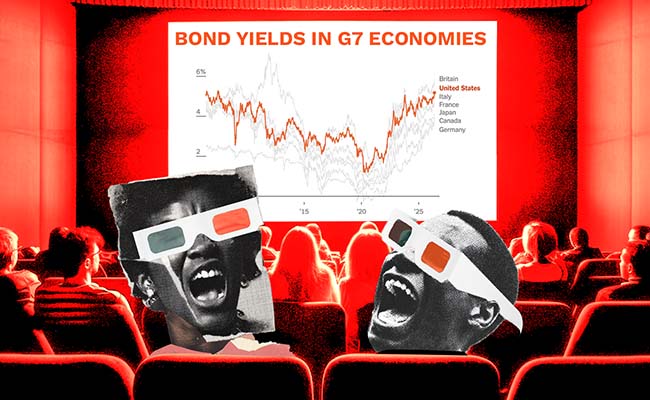

Most retail investors probably haven’t noticed, but fixed-income traders are sweating. Bond yields in some of the world’s biggest economies this week hit multi-decade highs, while equities, especially in the US, keep scaling fresh records.
Yields move inversely to bond prices, and a sell-off in US government debt pushed yields on 30-year US Treasuries to 5.2% on Tuesday, a level last seen during the 2007 global financial crisis. Bloomberg columnist John Authers this week described it as a “slow motion car wreck”.
“Bond markets set the price of money, and they have provided a prop for equity market valuations for two decades, so this cannot be ignored,” he wrote.
And as yields are spiking, the world’s most influential stock market – the S&P 500 – has set itself new highs, and is up 16% since the end of March, on probably the narrowest number of shares in recent memory.
“You have a massive conflict where the equity market is selling you one story, and the bond market is telling you a different story,” Stanlib chief economist Kevin Lings tells Currency.
Bonds are reacting to the protracted Iran conflict, and what a blocked Strait of Hormuz is doing to inflation, with critical commodities ranging from oil to sulphur, ammonia and natural gas held up.
Bigger problems
When the conflict started on February 28, says Lings, “an overwhelming majority of analysts – including ourselves – were saying things like ‘this should be over in a few weeks’. Now we’re deep into the third month, and you’re getting to a tipping point where we have a bigger problem here, and that is what I think is coming about now.”
The consequences are showing through in the data. The US April producer price inflation index last week printed at 6%, well above the 4.9% forecast. Sweden and Australia have already started hiking rates. Far from starting the year thinking about cuts, central banks worldwide may have to start lifting them again.
Governments, meanwhile, have sought to soften the blow of rising oil prices for citizens, rolling out fuel subsidies or, in South Africa’s case, temporarily reducing the general fuel levy.
“All of that is adding to the concern that not only are you not going to be able to cut interest rates, but you’ve got governments that are going to be even more indebted,” Lings says. “The bond market is just very efficient and reprices to tell you what the worry is.”
Bank of America’s latest Global Fund Manager Survey also reflects a change in mood, with a sharp risk-on shift in May: net equity allocations rose from 13% overweight in April to 50% in May, while net bond positioning moved to 44% underweight.
Extreme valuations
But if bond markets are being “efficient” and pricing in higher inflation and possibly a new wave of rate rises, why aren’t equity markets doing the same?
“They’re assuming Trump’s going to TACO or do a deal, and all will be fine, and all we need to focus on is the money we’re going to make [from] AI-linked investments,” quips Ninety One portfolio manager John Stopford – a reference to the trader-coined acronym for “Trump Always Chickens Out”.
The problem, though, is that the valuations of those AI-linked stocks have become “very extended”, he says. Stopford has been in the markets for 36 years and says the parallels between now and the late 1990s, before the dot-com crash, aren’t perfect, but the echoes are there.
“Valuations look quite extreme, there is a FOMO that’s causing people to remain fully invested even if they’re nervous, and meanwhile you’ve got this accident happening next to the stock market in the bond market that for a while [investors] can ignore, but not indefinitely if it carries on.”
FOMO to the max
Another way of looking at this dislocation, he says, is to consider what US Treasury yields above 5% actually mean: a buyer of US debt is getting paid more than 5% to lend to the government for 30 years.
“If you’re a rational investor, you need to believe that at current valuations you can earn comfortably more than 5% per annum for the next 30 years from equities to justify taking that risk. And that’s a big question.”
Even if many think the AI party is just too hot, it can keep going, “and you can start to underperform massively”, says Stopford. “And that’s partly the reason it just keeps going up, because everyone is frightened of betting against it.”
This story was produced in partnership with Stanlib.
ALSO READ:
- The Hormuz shock didn’t break markets – it repriced them
- What you need to know about bonds, now
- Bond maven, author, investing evangelist: Cartesian’s Anthea Gardner
Top image: Rawpixel; Factset, The New York Times; Currency.
Sign up to Currency’s weekly newsletters to receive your own bulletin of weekday news and weekend treats. Register here.