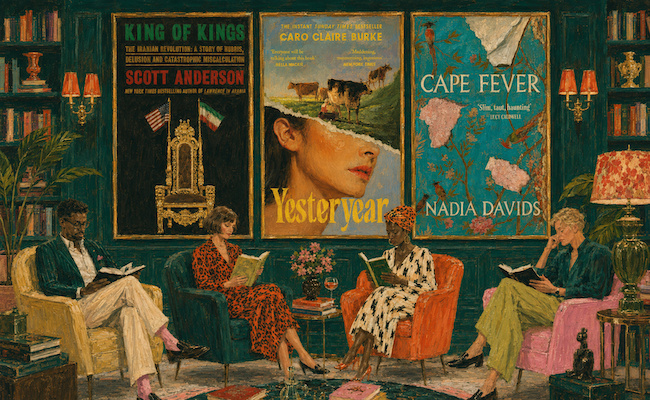

We’ve finally got it together as a team to do a wrap on the books that we’ve loved reading to date in 2026.
At the six-month mark, and as we head into the cold, quiet weekends of winter – perfect for withdrawing into a story – here are the reads that various members of the Currency team (with a little help from our friends) really rate. As always, we don’t narrow it to new releases only, or by genre.
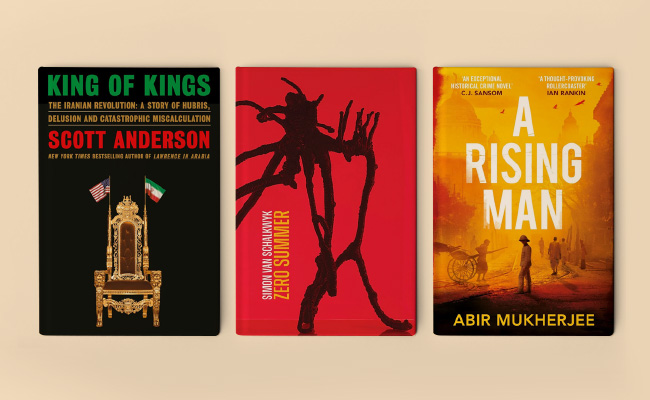
King of Kings: The Iranian Revolution – a story of hubris, delusion and catastrophic miscalculation by Scott Anderson (Penguin Random House)
We’ve all been keeping tabs, to one degree or another, on the goings-on in Iran this year. For a brilliantly told account of the Shah’s part in the country’s story, and of how the conditions for the Iranian Revolution were created, pick up Scott Anderson’s King of Kings. The book chronicles the gilded, increasingly detached world of the Iranian ruler and his sycophantic court, but its lens is much wider than that.
Anderson captures the jaw-dropping miscalculations of the US government, the deepening gulf between the Shah and his people, and the rise of a religious nationalism that would ultimately sweep away the monarchy. The story runs through to the Shah’s death in exile in 1980, rather than into the decades that followed, but it leaves you with a far clearer sense of the forces that reshaped Iran, and whose consequences are still playing out today. Sarah Buitendach
Zero Summer by Simon van Schalkwyk (Dryad Press)
I’m not a regular poetry reader by any stretch of the imagination, but I quickly lost myself in this new collection. It helped that one poem, “The Lawns”, is set in a Joburg park where I often walk, but van Schalkwyk’s work is witty, sharp and subtly unsettling.
Zero Summer contains sly digs at corporate jargon and our endless appetite for consumption, jarring and beautiful observations of Johannesburg, reflections on the way we are dismantling our fragile world, and more personal moments too. At times, the poems’ close-to-home dystopian atmosphere reminded me of Emily St John Mandel’s novels: familiar, yet just slightly off-kilter. Which is high praise indeed. Sarah Buitendach
A Rising Man by Abir Mukherjee (Penguin Random House)
The thrill of finding a good series of novels is unparalleled, and perhaps you are late to this one too. First published in 2016, A Rising Man introduces Captain Sam Wyndham and Sergeant Surendranath “Surrender-not” Banerjee as they investigate the murder of a British official in 1919 Calcutta.
It is the first of a series of six books set against the slow unravelling of the Raj and threaded with class tensions, political intrigue, First World War trauma and a little romance. Mukherjee is particularly good at making the city feel alive, while keeping the pace satisfyingly brisk – he must have done months and months of historical research on each one. I’ve read three so far, and am delighted there are three more to go. Sarah Buitendach
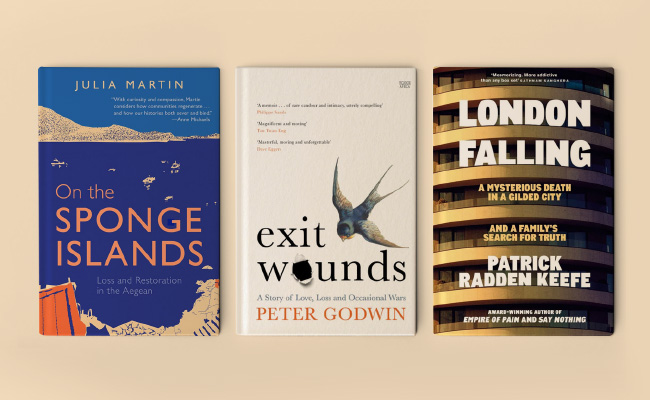
On the Sponge Islands by Julia Martin (Jonathan Ball)
As it is a curious topic for a South African author, I was mainly drawn to this book because I had read Julia Martin’s earlier effort, The Blackridge House, a beautifully told story about the death of the author’s mother. On the Sponge Islands explores the sponge industry, once the livelihood of the people of the Dodecanese islands of the Aegean, as a social and ecological metaphor for our times. It’s a book about change, loss and how everything is connected. It’s a cry to slow down and respect the earth. Also, it’s beautiful and moving, and I keep thinking about it. Kate Rogan
Exit Wounds: a story of love, loss and occasional wars by Peter Godwin (Pan Macmillan)
Peter Godwin made his name with rich, moving accounts of Rhodesia and post-independence Zimbabwe. Exit Wounds, his most recent book, is a more personal effort – and my favourite of his works so far. Less linear and more playful in structure, and very moving, it centres on the death of his mother and the end of his marriage.
Questions of grief, family and belonging run through it, as do the particular ache of émigrés and exiles trying to work out where home really is. Godwin is especially good on the strange accumulation of losses that comes with age, and the way memory can pull you back across countries – and decades – without warning. Sarah Buitendach
London Falling by Patrick Radden Keefe (Pan Macmillan)
Every book that Keefe has written so far is one that you want to fake illness for and stay at home and inhale. His latest is no different, and that surprised us. While the premises of Say Nothing (the Irish Troubles) and Empire of Pain (the Sackler family and America’s oxycontin crisis) were immediately compelling, the set-up of London Falling – a young man falling from a building on the Thames, and his parent’s search to find out why, seemed less immediately compelling.
But the American journalist can spin one hell of a yarn based on unimaginable amounts of fact gathering, and keep you enthralled from page one onwards. London gangsters, Russian oligarchs, rich kids, deception, bumbling police and a dog called Alpha Nero – this one has it all. Sarah Buitendach
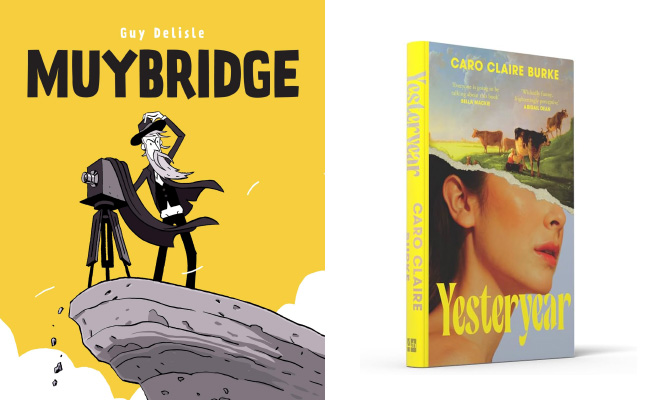
Muybridge: In a Fraction of a Second by Guy Delisle, translated by Helge Dascher (Drawn & Quarterly)
My favourite book of 2026 so far is Muybridge: In a Fraction of a Second, a rare foray into the biographical by French Canadian graphic nonfiction creator Guy Delisle, who usually focuses on the autobiographical. Delisle is a master of the graphic form whose most famous works to date have been travelogues featuring Pyongyang, Burma and Shenzhen.
Muybridge is realised in his signature drawing style, informed by his training as an animator. Eadweard Muybridge, the father of time-lapse photography, is brought to life by Delisle’s exceptional draughtsmanship and quirky character studies. This true story has it all: tragedy, betrayal, infamy and even murder. I read it in one sitting and was enthralled from beginning to end. Stuart Cairns
Yesteryear by Caro Claire Burke (Jonathan Ball)
Natalie Heller Mills is a wildly successful “tradwife” influencer whose carefully curated pioneer-style existence takes a rather darker turn when she wakes up in 1855 and is forced to live the life she has been selling online.
At first glance, this page-turner seems like a surface-level indictment of the superficiality of social media culture and influencers – but it’s actually far deeper. Burke has written a portrait of how that world can create enormous success while doing devastating psychological harm without anyone really noticing, or worse, even admiring it. Rob Rose
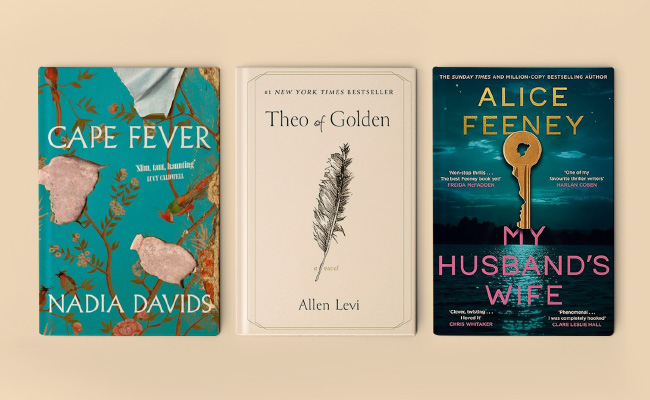
Cape Fever by Nadia Davids (Jonathan Ball)
South African author and playwright Nadia Davids has nailed South African gothic with this taut, compulsive novel. Set in 1920s Cape Town, it centres on a young woman who goes to work for a seemingly well-off widow in a house where very little is as it first appears.
As the carefully maintained façade begins to crack, Cape Fever becomes increasingly unsettling, upping the ante on tensions related to race, class and power in a city shaped by all three. Davids has a terrific feel for atmosphere and creating a sense that something is always faintly awry. It is a clever, compelling read and one where you’re certainly not going to guess what happens next. Sarah Buitendach
Theo of Golden by Allen Levi (Jonathan Ball)
A mysterious elderly man arrives in the small Southern USA town of Golden and, after spotting a collection of pencil portraits hanging in a local coffee shop, decides to buy them one by one and return them to their subjects. Each exchange opens up another life and another story.
Originally self-published, Theo of Golden became a word-of-mouth phenomenon, and it is easy to understand why. This is a gentle, beautifully observed book about that the impact that kindness and paying proper attention to other people can have. Jenny Buitendach
My Husband’s Wife by Alice Feeney (Pan Macmillan)
Artist Eden Fox heads out for a run. When she returns to her new home, her key no longer works, a woman who looks unnervingly like her answers the door and Eden’s husband insists that the stranger is his wife. My Husband’s Wife is the sort of domestic thriller that requires you to suspend belief (big time) and enjoy the ride rather than interrogate every twist too closely.
Feeney loads on the secrets, shifting identities and increasingly outlandish revelations at a brisk pace. It is dark, clever and you’ll absolutely never guess the ending – an ideal book for a weekend when you would quite like to ignore everything else you are meant to be doing. Jenny Buitendach
Did you miss our last book round up? Read it here.
Top image: Currency collage.
Sign up to Currency’s weekly newsletters to receive your own bulletin of weekday news and weekend treats. Register here.