
A few weeks ago, I shamefully admit, I was cynical about football governing body Fifa. Now that the Soccer World Cup is under way, however, I have to acknowledge my error. Fifa has been genius. Provided, of course, that what you admire is the cool, unsentimental ability to locate every last human emotion and convert it into a billable event.
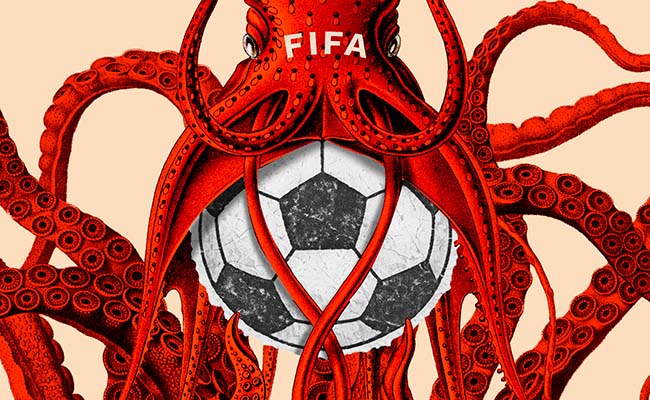
This World Cup has confirmed something long suspected but not always stated with sufficient awe: Fifa is no longer merely the custodian of the world’s most-loved sport. It is the new vampire squid of global entertainment, wrapped around the trembling wallet of anyone who has ever thought that football belongs to the people.
Big changes have been made to the format this year. Three host countries, not one. Which in turn allowed a total of 48 participants rather than the normal 32. Obligatory hydration breaks. And last but not least, dynamic ticket sales. Officially, this is about inclusion, opportunity and the glorious spread of the game. Unofficially, it is about more matches, more broadcast slots, more hospitality packages, more branded content, more official partners, more semi-official partners, more regional supporters, more fan zones, more “experiences”, more everything.
Not to slide back into cynicism, but the obvious additional benefit is lots of money. Really, lots and lots and lots of it. And for Fifa, obviously. Football is, in theory, the people’s game: cheap to play, universal to understand, tribal in the best and worst senses, capable of making total strangers hug in public and grown men cry into nylon flags. Fifa looked at this miracle of human togetherness and saw, with the icy clarity of a derivatives trader, inventory.
The numbers tell the story. Brazil 2014 brought in about $4.8bn for Fifa. Russia 2018 pushed the machine higher, with the World Cup itself delivering roughly $5.4bn, and the four-year cycle rising to $6.4bn. Qatar 2022 took the cycle to about $7.6bn.
But that is all chicken feed compared to this new World Cup. North America 2026 is expected to deliver almost double the previous high, about $13bn over the four-year cycle – a figure so large that it sounds less like a sporting budget than a mid-sized central bank intervention.
The brilliance of Fifa
Annoyingly, as far as I can see, it has worked.
The expanded tournament should have felt bloated. Instead, it has produced packed stadiums, wild underdog stories and games that people actually want to watch. Even fixtures that once sounded like something generated by a malfunctioning office sweepstake now draw vast crowds at absurd prices. New Zealand versus Iran in Los Angeles? Seventy thousand people.
Dynamic pricing is the purest expression of the new order. Once upon a time, a ticket had a price. Now it has a mood. This is not ticketing; it is emotional extraction conducted in real time.
And then there is the true masterstroke: the obligatory hydration break. Officially, naturally, this is about player welfare. But what a coincidence. Twice per match, at roughly the same moments, the game pauses. Fifa has discovered the commercial poetry of the quarter-pause, perfect for a new set of ad breaks.
The host cities, meanwhile, provide the scenery, the police, the traffic plans, the public-transport headaches and the civic enthusiasm, while Fifa keeps a firm grip on the commercial upside. And here is the terrible truth: Fifa is really good at this.
This is why the World Cup can simultaneously be a festival of humanity and a masterclass in gouging. The Japanese fans cleaning stadiums, Scottish supporters drinking Boston dry with philanthropic intent, Iranians leaving thank-you notes in the change room, strangers embracing under flags – all of this is real.
That is Fifa’s brilliance. It does not destroy the magic. It invoices it. The vampire squid has done its work. Worst of all, the football has been wonderful.
ALSO READ:
- From ‘Waka Waka’ to ‘Waka Wobble’: a World Cup in search of its party
- Fifa, Sony, and the mystery of the missing ‘Waka Waka’ millions
- Arsenal: a century of family devotion
Top image collage: Rawpixel; Currency.
Sign up to Currency’s weekly newsletters to receive your own bulletin of weekday news and weekend treats. Register here.