
South Africa’s tariff investigation system is sliding into crisis, with duty applications taking years rather than months, reviews of old duties barely happening, and private sector applicants increasingly walking away from a process they no longer trust.
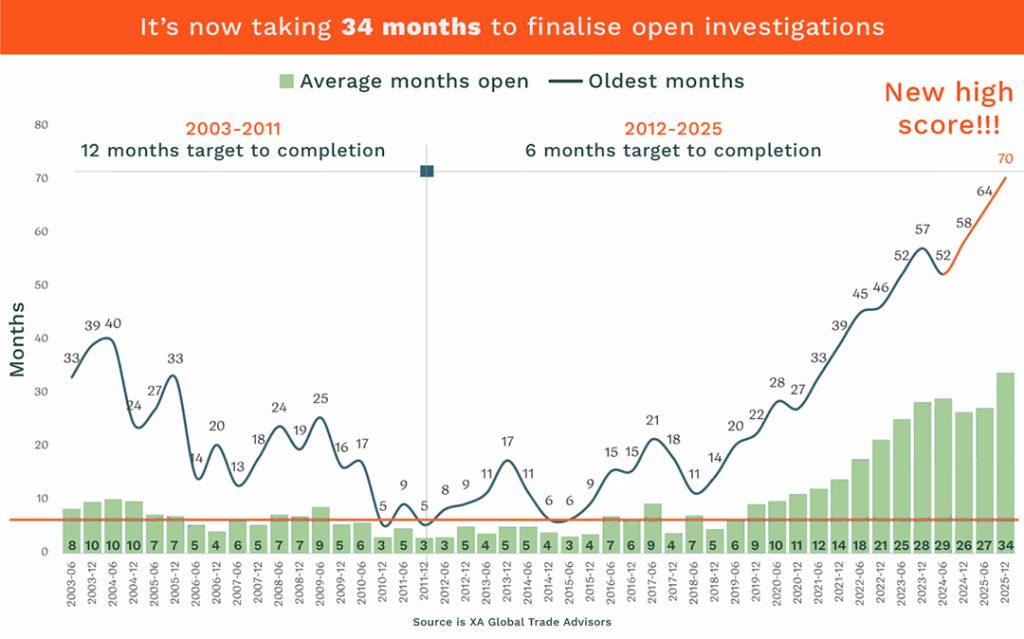
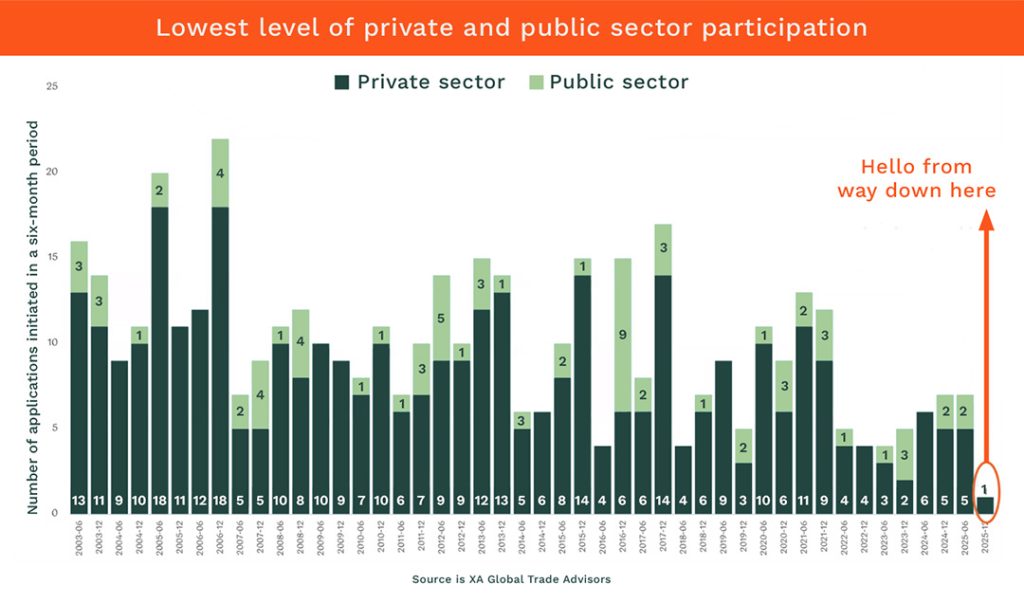
This sharp indictment comes from XA Global Trade Advisors’ eighth Import Duty Investigation Report, presented last week by XA Global Trade Advisors CEO Donald MacKay, who said the system has deteriorated dramatically since the firm first began tracking delays four years ago. Tariff investigations, he said, are “taking longer than ever before”, while the process has become increasingly unpredictable, duties have become “unbelievably sticky”, and participation by companies has fallen to the lowest level in the 23-year history of the International Trade Administration Commission (Itac).
According to XA’s analysis, Itac’s own tariff policy envisages investigations being completed in six months, yet the oldest open investigation had reached 70 months by the end of last year. Two of the oldest investigations turned six years old in February. In the current backlog, 97% of open investigations are older than six months, with only one case under that threshold.
The result is a trade-policy machine that businesses increasingly see as neither fast enough to protect them nor predictable enough to invest around.
A regulatory gamble
MacKay said the issue is no longer simply delays, but the way the process has changed. Where products not made locally might previously have had duties removed, businesses are now more commonly given rebates tied to permits. Those permits may need to be renewed quarterly or annually, leaving firms uncertain whether they will continue to qualify and under what conditions.
That matters because the rules attached to permits can shift. MacKay pointed to Itac’s current annual performance plan, which indicates that BEE ratings may be considered as a condition for permits. For a company planning a factory around imported inputs unavailable locally, such moving criteria can turn what should be a technical trade decision into a rolling regulatory gamble.
“It’s not healthy,” MacKay said. “Uncertainty is generally the enemy of investment.”
The report also highlights the persistence of “evergreen” duties. MacKay said 93% of tariff codes that carry duties have not been reviewed in the past 23 years, even where Itac had indicated duties should be reconsidered after a set period. The danger, he argued, is that protection becomes permanent, rewarding lobbying rather than competitiveness.
Equally contentious are reciprocal agreements, under which companies seeking tariff changes are required to make commitments on jobs, investment, exports or pricing. XA’s data shows that 62% of applicants over the past decade had to sign such agreements, while 38% did not. MacKay said there is no clear rule explaining the difference, and the agreements themselves are confidential. Even more controversially, 44% of the reciprocal agreements were attached to duty reductions, where applicants are often seeking relief because local supply is unavailable.
Distorted markets
Agricultural Business Chamber (Agbiz) CEO Theo Boshoff said the delays are already distorting agricultural markets, particularly in sectors such as sugar and wheat, where variable tariffs are supposed to respond quickly to trigger events. In some cases, what should be a six-week turnaround has become “six months or more”, meaning an entire marketing year can pass before the tariff response arrives. That leaves producers without protection and importers speculating about when duties may land, encouraging front-loaded imports and uncertainty through the value chain.
Boshoff said the lack of transparency also makes it difficult to know where the blockage sits – with Itac, the department of trade, industry and competition, the National Treasury or the broader approval chain. If the problem is merely capacity, he warned, the state may be “penny wise, pound foolish”, because delayed variable tariffs also mean lost revenue to the fiscus.
Mamello Nchake, senior lecturer in economics at Stellenbosch University, said at the presentation that the delays create a “chilling effect” on investment. Firms rely on credible and predictable signals, she said, and when tariff investigations drag on indefinitely, investment projects may be stalled, expansion decisions cancelled and jobs put at risk.
The uncertainty can also affect competition, production and local factories exposed to dumped imports while they wait for protection.
Giving up
In a Business Day report on Itac’s presentation to parliament, chief commissioner Ayabonga Cawe attributed the delays to severe resource constraints, saying the commission has only 100 staff against 130 approved posts. Itac also has only six of 10 part-time commissioners, while its R123m allocation for 2026/27 is insufficient, prompting plans to introduce administrative fees for processing permits and certificates.
Cawe told MPs that global overcapacity in key product markets has increased Itac’s workload just as its resources are stretched. He said Itac wants to conclude final determinations within 14 months, but conceded: “We would like to do more but we just don’t have the money.”
DA trade spokesperson Toby Chance, quoted in the same article, said vacancies “cannot be an excuse for Itac’s delinquent performance”. Business Day also reported that Itac has not yet calculated the impact on affected businesses, though the consequences would be significant for uncertainty, investment and jobs.
For MacKay, the collapse in private sector applications is the clearest warning sign. Companies aren’t just complaining anymore. They’re walking away. If tariffs are important, he said, government should treat them as important. If they are not, it should stop pretending.
Right now, South Africa has a tariff system too slow to be useful and too opaque to be trusted – and one businesses are quietly giving up on.
ALSO READ:
- Farmers ‘maak ’n plan’ as they adapt to Trump’s turmoil
- The missing ingredient to economic growth: Confidence
- Africa in 2026: Harsh trade realities, yet big growth still possible
Top image: Maxiphoto/iStock/Getty Images Plus/Rawpixel/Currency collage.
Sign up to Currency’s weekly newsletters to receive your own bulletin of weekday news and weekend treats. Register here.