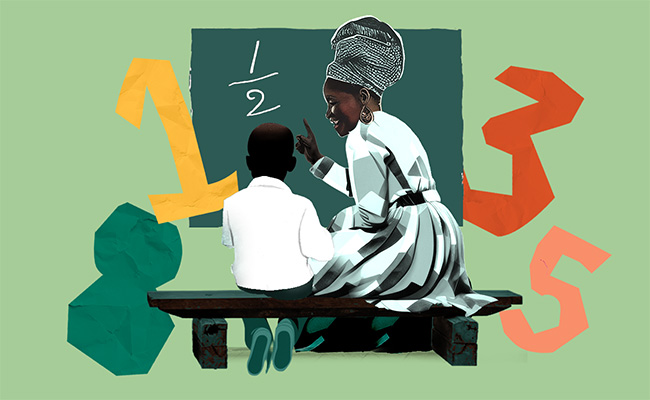

“Mathematics is like oxygen. You take no notice of it when it’s there – if it wasn’t, you’d realise you cannot do without it.” – Lex Schrijver, Centrum Wiskunde & Informatica, Amsterdam
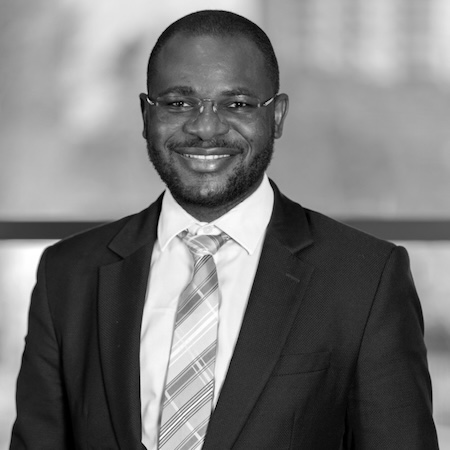
In 2005, a teacher at a Soweto high school told a student he should not be taking mathematics on higher grade. That student was Isaah Mhlanga. He ignored the advice, found Saturday classes at the Kutlwanong Centre for Maths, Science and Technology, and left matric with six distinctions. His maths mark created the path to a university application and a bursary. Today Isaah is the chief economist and head of research at RMB and a member of the Presidential Economic Advisory Council.
The story is not told for its uplift. It is told because it is load-bearing evidence: aptitude was never the constraint. The system was. And the system is still making the same mistake, at scale, every year.
We write from three distinct professional perspectives: a businessman and social entrepreneur, an economist and a strategist. While our disciplines differ, our conclusion is the same: South Africa’s unemployment crisis, its competitiveness deficit and its persistent inequality all trace in significant part to a failure to build mathematical sciences capability. The argument below is economic. The numbers demand a serious policy response.
The invisible engine
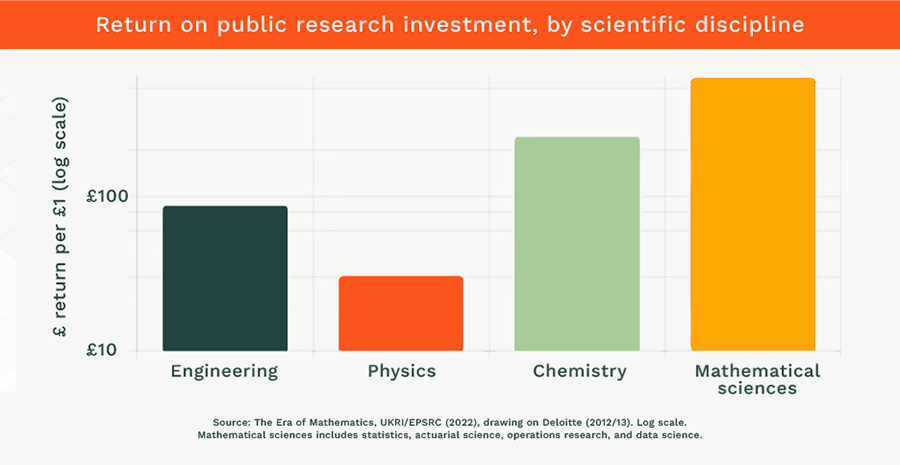
Across four national studies conducted in the Netherlands, the UK, France and Spain, mathematical sciences account for between 10% and 30% of GDP. These are not niche contributions. They span banking, IT services, insurance, healthcare, logistics, energy and manufacturing – the structural sinews of a functioning economy. UK data compiled by Deloitte for the Engineering and Physical Sciences Research Council shows that every pound invested in mathematical sciences returns £588. Engineering returns £88. Physics returns £31. The return on mathematical sciences is not incrementally better. It sits in a different category.
The Dutch input-output study shows that 26% of total employment in the Netherlands depends on mathematical sciences – not just jobs that require a maths degree, but the ripple effects through adjacent industries and supply chains that a mathematically capable workforce activates. You get three for the price of one. South Africa has no equivalent study. No rigorous estimate of what mathematical sciences contribute to GDP, employment or the wage distribution.
What is not measured is not managed.
The growth imperative
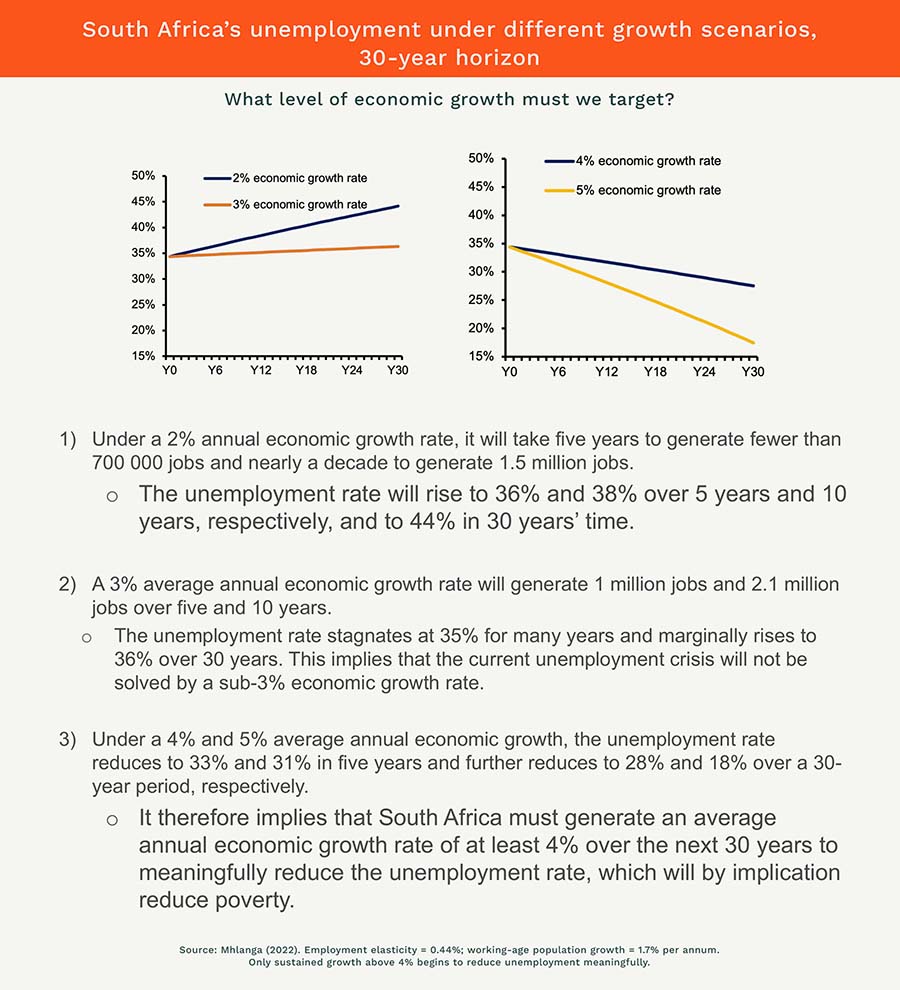
South Africa’s unemployment problem is structural and its resolution is, at its core, an arithmetic problem. By 2050 the country will have 16-million more people than today, roughly 10-million of working age, in addition to the 12.5-million already unemployed and able to work. The employment elasticity of growth sits at approximately 0.44%: 1% of GDP growth generates 0.44% employment growth. Any sustained growth rate below 4% per annum leaves unemployment rising or stagnant. The country has averaged roughly 1% over the past decade.
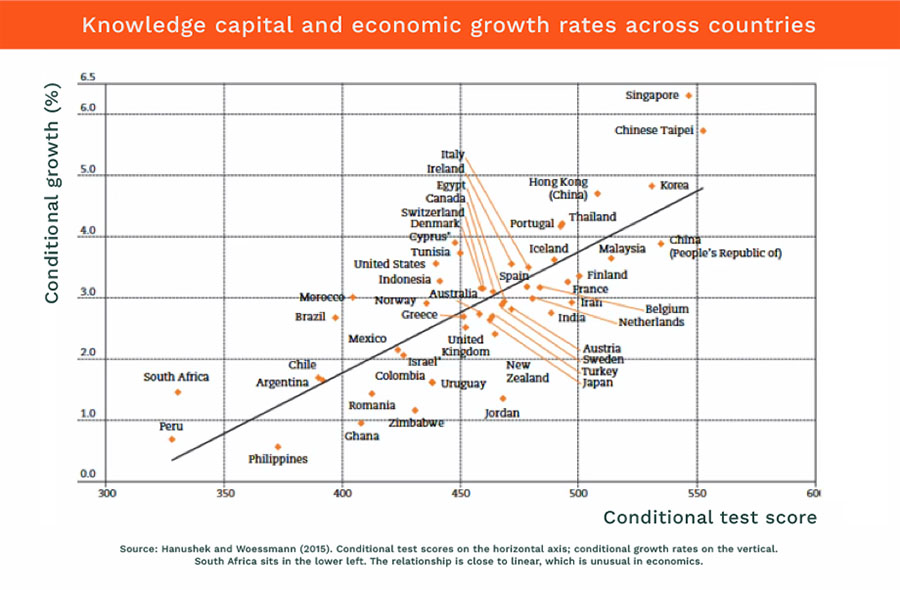
The connection to mathematical sciences runs through a clear chain. Across 160 countries studied over 65 years in the Six Factor Model developed at Boundless World, the relationship between educational attainment and income per capita is approximately linear – unusual for economics. Within that relationship, the returns to investment in mathematical sciences are disproportionate to any other discipline. Mathematics scores in the Programme for International Student Assessment (Pisa) correlate strongly with the World Economic Forum’s global competitiveness index; competitiveness drives per capita income; and income determines an economy’s capacity to absorb workers. Break the chain at the first link and none of the rest follows.
Where South Africa stands
If education matters, South Africa scores poorly. And if education in mathematical sciences matters more than other forms of education, South Africa’s rank is desperate.
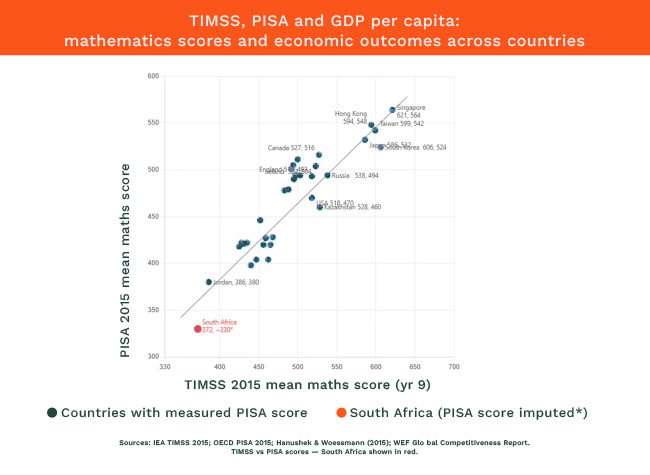
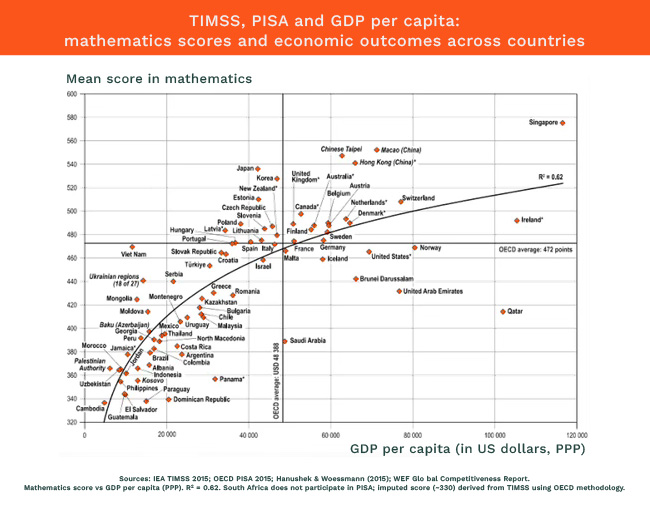
South Africa sits at the bottom of every international mathematics assessment that includes it. Trends in International Mathematics and Science Study (Timss) data for grade 8 and 9 learners places South Africa at a mean score of 372, against a Pisa-equivalent imputed score of approximately 330 – well below the Organisation for Economic Co-operation and Development average of 472 and in the company of the lowest-performing economies globally. The bottom panel of the chart below makes the consequence explicit: mathematics scores and GDP per capita move together with an R² of 0.62. Countries that build mathematical capability build income. Countries that do not, do not.
What the system is doing wrong
The 2006 policy decision to introduce mathematical literacy as a parallel subject was taken with good intentions.*
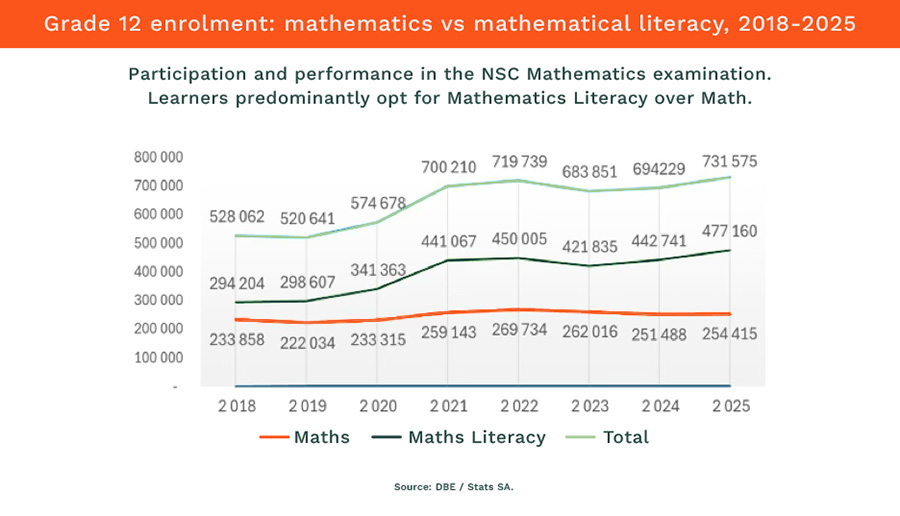
The outcome has been damaging. In the matric class of 2025 national senior certificate, grade 12 enrolment in mathematical literacy has grown to more than 420,000 while mathematics enrolment sits below 270,000. Most of South Africa’s learners are being directed away from mathematics – not because they lack aptitude but because the system defaults them there. That is a policy failure with labour market consequences that compound across every cohort.
Teacher preparation is a second structural failure. South African higher education institutions are not adequately equipping student teachers to teach mathematics. Pedagogical content knowledge – the ability to make mathematical ideas accessible to learners at different stages – is demonstrably weak across much of the system. Teaching time is insufficient, and assessment frameworks reward memorisation and routine procedures rather than the critical thinking and problem-solving that mathematical sciences actually develop.
What needs to change
Three levers carry the greatest potential for systemic impact.
The first is policy: the curriculum architecture that streams learners towards mathematical literacy by default must be redesigned so that mathematics is the standard, with mathematical literacy an informed exception. The introduction of mathematical literacy was a policy decision; reversing its unintended consequences is also a policy decision, and it is one that is within reach.
The second lever is teacher preparation. Pre-service training must be restructured around deep mathematical content knowledge. Pedagogical content knowledge is not a soft skill; it is the technical capability that determines whether a learner who could succeed in mathematics does succeed. In-service professional development must follow the same principle – sustained engagement with mathematical content, not one-off workshops.
The third lever is teaching quality and dosage. More time on mathematics, taught in ways that build reasoning rather than test recall, assessed against standards that reward critical thinking and problem-solving. These are not aspirational ideals. They are documented features of every high-performing mathematics education system. Countries that have closed comparable gaps have done so by working all three levers simultaneously and sustaining that effort across political cycles.
South Africa is not yet in the data
Every country reviewed above has a rigorous national estimate of what mathematical sciences contribute to its economy. Those numbers sit in briefing documents and curriculum policy papers and give the mathematical sciences conversation the weight of economic evidence rather than educational philosophy.
South Africa has no such estimate.
The irony should not be lost – we are not counting in social and economic terms the country’s inability to count. Beyond accepting that mathematical sciences matters, there is an urgent need to evidence to industry, policymakers and society at large the contribution to GDP, the employment footprint across sectors, the wage premium, the opportunity cost of current proficiency levels, and the scenario impacts of realistic improvement over five, 10 and 20 years. The need is to put South Africa into the data – and then use that data to drive the policy, teacher preparation and curriculum decisions that the evidence demands.
Schrijver’s oxygen image holds through to the end. We do not notice what mathematical sciences contribute until we try to imagine an economy without them – and then the dependence becomes total and obvious. South Africa has been running on a significant deficit for long enough that the symptoms are structural: unemployment above 30%, an innovation gap, a competitiveness ranking that falls year on year. The cost of not counting is now measurable in every one of those numbers.
* A note on mathematical literacy: mathematical literacy serves a genuine purpose and nothing here is intended to diminish those who have taken that path. The concern is systemic: when learners are directed towards mathematical literacy by default, without clear information about the career consequences, the system forecloses futures without consent. The goal is to ensure no learner arrives there without understanding what doors that choice leaves closed – and to widen the mathematics pipeline so it can absorb everyone with the aptitude and motivation to succeed in it.
Isaah Mhlanga is chief economist and head of research at RMB and a member of the Presidential Economic Advisory Council; Sizwe Nxasana is founder and CEO of Future Nation Schools and Sifiso Learning Group; Adrian Saville is founding director of Boundless World and a professor of economics, finance and strategy at Gibs; this story was first published on his Substack.
ALSO READ:
- Meth’s BEE sting: why targets won’t work without a schooling fix
- The economic fix: Sarupen’s roadmap to faster growth
- Real Politics: turning freedom into opportunity
Top image collage: Rawpixel; Firefly; Currency.
Sign up to Currency’s weekly newsletters to receive your own bulletin of weekday news and weekend treats. Register here.