
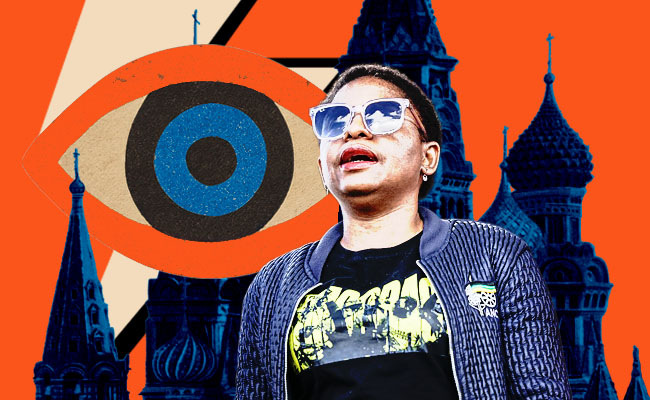


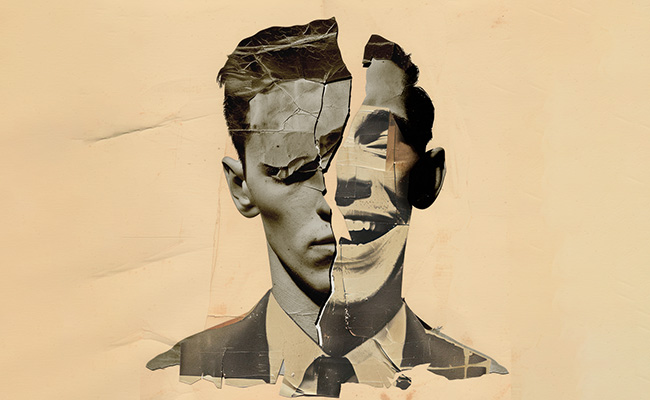
With his prescient invention of “doublespeak”, George Orwell brilliantly captured the use of euphemisms and ambiguity to hide the true meaning of a message. If you’ve ever bought a “pre-owned” car or watched a report on “collateral damage” in a military exercise, you have encountered this duplicitous language.
The etymology of doublespeak gives you an idea of Orwell’s perfect understanding of how politicians manipulate language. The phrase has its origins in two other terms – doublethink and newspeak – which appeared in his dystopian novel, 1984. This incredible work predicted the rise of surveillance totalitarianism and the populist hollowing out of democracy, which are now mundane realities.
Doublethink is the ability to believe in the truth of two totally contradictory ideas simultaneously. Orwell’s totalitarians believe in slogans such as “War is peace,” “Freedom is slavery,” and “Ignorance is strength.”
Newspeak – a contraction of “new” and “speak” – is a language invented by the rulers to prevent the use of language to harm their interests, even if this means ignoring obvious truths.
Combining the two, you get doublespeak, the language of euphemisms, of denying the obvious reality and the disguising of messages.
Deep into doublespeak
This brings us to an extraordinary recent example of the practical application of these concepts in a modern political environment by minister in the presidency Khumbudzo Ntshavheni.
The minister was attending the International Security Forum 2026 “on challenges and threats to international security in the context of the emergence of the multipolar world”.
Before even uttering a word, Ntshavheni was already knee deep in hypocrisy, for the event was taking place in the Russian capital, Moscow.
Russia, as the whole world knows, is engaged in the fifth year of its illegal invasion of Ukraine, the largest conventional warfare encounter since World War II, and one that has raged on for longer than the Soviet Union’s Great Patriotic War. The costs are from the early 20th century, too. Between 350,000 and 500,000 Russians have died in battle, with about a million more wounded.
On the day that Ntshavheni spoke, Russian forces attacked Ukraine using 147 attack drones – a pretty average day’s ordnance – and a hypersonic Kinzhal missile, which struck the capital Kyiv. Across the 1,400km frontline, drones, tanks, artillery and ground forces engaged in hundreds of contacts, adding hundreds of lives to the grim death toll.
None of this moved Ntshavheni. It was as if there was no invasion of Ukraine, and Russia was a benign and friendly country struggling to convert a violent world to its plan for global peace and for the upliftment of the poor, helpless folk of the Global South through rhetorical multipolarism. Never mind that the Russian invasion has driven a dagger through the beating heart of a rules-based order.
Ntshavheni did not mention Ukraine once, delivering a textbook example of a doublespeech.
Instead, she thanked Russia and secretary (general) Sergei Shoigu of the Security Council of the Russian Federation “for the successful organising and hosting of this third International Security Forum”.
Turning a blind eye to Russian transgressions
She went on to the key theme of her speech: “The strategic competition between major powers has intensified global tensions, resulting in major security risks such as proxy conflicts, militarisation of strategic regions, economic coercion and sanctions, diplomatic polarisation, competition for influence in Africa, competition over resources, trade routes and influence, and technological and cyber rivalry.”
The Russians nodded sagely as their marionette did her dance.
Turning to Africa – and by extension, South Africa – she opined: “Global insecurity and insecurity within the African continent have strengthened transnational criminal and extremist networks, resulting in increased human trafficking, drug trafficking, illegal mining, arms smuggling and terror financing. An undesired vicious circle. Worst is that these criminal networks threaten governance, economic stability and public safety.”
Her doublespeak conveniently overlooked Russia’s support for military regimes in Africa, in Burkina Faso, Mali and the Central African Republic, which are among the best examples of the “human trafficking, drug trafficking, illegal mining, arms smuggling and terror financing” of which she spoke.
Hypocrisy on steroids
In another excellent example of doublespeak, Ntshavheni feigned moral outrage while representing a country where leaders from her own political party have actively undermined and turned the police into tools used by corrupt politicians, as testimony before the Madlanga commission has revealed. Her president is facing an impeachment inquiry over a couch stuffed with US dollars, a very Russian way of conducting one’s personal finances.
She comes from a country where the rule of law is absent as mobs of vigilantes march through the streets, attacking foreigners and overturning their meagre wares on the pavements while the government does nothing. Dozens of her fellow leaders, including many who are still prominent in government and the ANC, have been named as participants in state capture, but have not been prosecuted.
She talks of an “undesired vicious circle”, but it is one which, for 30 years, her fellow politicians have done nothing to interrupt, preferring the enrichment that comes from rotten tenders and the proceeds of crime.
In short, she comes from a country that, mocking its democratic constitution, has been actively modelled on Russia’s predatory state, where a small elite controls resources and becomes super-wealthy, doing all the business deals and living like kings, while many live in dire poverty and unemployment.
Ntshavheni told the Russian security chiefs that “South Africa’s strategic interest is to ensure a fair, rules-based multilateralism”. Apparently, countries that invade their neighbours, leading to hundreds of thousands of deaths, are appropriate custodians of this “fair, rules-based multilateralism” or, at least, dare not be criticised.
Cultivating questionable friends
Is Ntshavheni ignorant of the absurdity of her doublespeak? Or is it something worse? Is she deliberately ignoring reality because there is some material advantage to be obtained by cultivating the malign Russian state? Material benefits would at least make such politicking understandable; the aim being to create a state based on elite enrichment at the expense of the majority, where foreign policy ensures the perpetuation of liberation mythology over human rights.
But neither of these scenarios promotes the idea that South Africa stands for the values of democracy, sovereignty and the rule of law. Just ask any Zimbabwean. Such is the stream of endless disinformation that duplicity is processed as the truth. The Russians, masters at the misinformation game, just keep turning the dial.
And the ANC, which once made an art form of mounting the moral high ground, is grappling for relevance and searching for external causes, the more it is measured on delivery at home.
Orwell might have been describing Ntshavheni’s speech when he said: “Political language … is designed to make lies sound truthful and murder respectable, and to give an appearance of solidity to pure wind.”
Ray Hartley and Greg Mills are with the Platform for African Democrats.
ALSO READ:
- South African foreign policy: vrot with contradiction
- ‘Malignment’: the direction of South Africa’s foreign relations
- South Africa’s hypocrisy is not just laughable – it’s Trumpian
Top image collage: OJ Koloti/Gallo Images via Getty Images; Rawpixel; Currency.
Sign up to Currency’s weekly newsletters to receive your own bulletin of weekday news and weekend treats. Register here.




It is bad that our government keeps sending out signals which can only be despised by the investors in the West. Until we can rewrite this script , every month will see further economic damage.
At what stage do the governments who use doublespeak , to continue dictatorial rule, E.G. China, Russia mislead themselves into ultimate failure? Or Launch WW3 as the final “1984” Strategy.
As for Ukraine Russian war , if anything, news coming from Ukrainian sources suggest that Russian losses are double those quoted here.