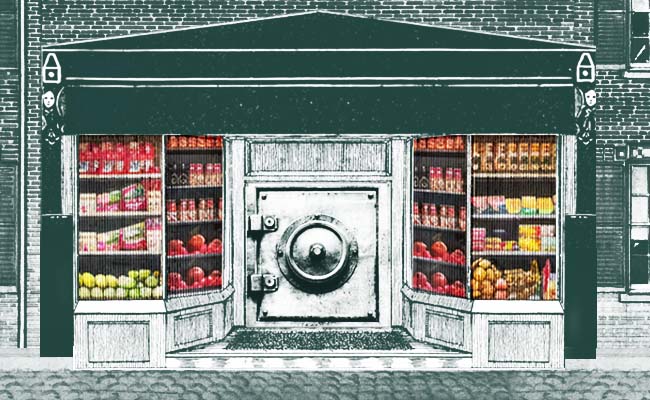

Would you bank where you buy your boots or pay your bills, and take a loan through the same people you buy your bread from? Shoprite and Pepkor are betting that for millions of South Africans, the answer will be yes.
The two major retailers are muscling their way not only into the banking sector, but the entire fintech space. Not just because the money looks good (which it does), but because this market sports a serious gap.
While global financial inclusion sits at about 85% as per World Bank data, experts think this figure is closer to 60%-70% in South Africa.
Many of those we consider “banked” locally are actually still underserved: they rely on cash, spaza shops and stokvels rather than formal products. And with the big five banks unwilling or unable to fill the gap, Shoprite and Pepkor are moving in.
Shoprite, Africa’s largest food retailer, already has its Money Market Account: a low-cost, digital-only transactional account designed for everyday use. It allows users to deposit and withdraw cash at Shoprite or Checkers tills, pay bills, buy airtime and electricity, and send money.
While Shoprite doesn’t consider itself a fully-fledged bank (at least not yet anyway), it still provides an accessible form of banking that has to date attracted more than 4-million customers. Pepkor is currently in the process of setting up its own bank, plus it already has several fintech schemes under its belt, like its insurance company, Abacus, and phone-renting scheme FoneYam.
Why the pivot?
For starters, Shoprite and Pepkor have an immense upper hand in terms of footprint and customer loyalty. While Capitec has 880 branches countrywide, there are more than 2,600 Pep stores nationwide, and more than 3,600 Shoprite outlets. The two retailers serve over 30-million South Africans – each.
“Millions of South Africans walk into a Shoprite or Pep every week; they trust the price, the queue, the returns policy,” explains Zwelakhe Mnguni, chief investment officer at Benguela Global Fund Managers. “That emotional connection transfers far more easily than a cold call from a traditional bank.”
Retailers also run “incredibly complex supply chains relying on big data to process high volumes of transactions, so it’s a very similar business to banking”, says Gary Booysen, a portfolio manager at Rand Swiss.
For him, Shoprite and Pepkor must think they “can do this a lot more efficiently than a bank can, so they can actually lower the prices, and can easily attract those customers over”.
Mnguni says the appeal for retailers is threefold: “Data, distribution and diversification. Retailers already know exactly what their customers buy, when they buy it, and how much they spend.” This is gold for credit scoring in a country where traditional banks often ignore the informal sector, he says.
And it’s not as if Shoprite hasn’t flagged its intentions clearly here; “Shoprite’s CEO [Pieter Engelbrecht] has openly talked about financial services eventually contributing up to 50% of group profit,” says Mnguni.
Pepkor’s existent fintech businesses experienced explosive growth last year, with revenue increasing by 31.1% to R16.6bn, outperforming its traditional retail operations.
In addition, Booysen notes that the “actual competitive advantage” for retailers like Shoprite and Pepkor is their access to the transactional data that reveals people’s spending habits. Access to this data allows them to see what echelon of customers, in which areas, prefer which products. “The banks have all that information, but they can’t capitalise on it the way a retailer can,” he explains.
A global push
This phenomenon of retailers-turned-banks isn’t unique to South Africa. Worldwide, retailers have turned their customer data and physical footprint into banking powerhouses.
Alibaba in China spun its e-commerce data into the digital MyBank back in 2015, which now issues loans to millions of small merchants using nothing but shopping history. The UK’s Tesco has run Tesco Bank since 1997, cross-selling credit cards and savings to grocery shoppers. Even Walmart once tried it out via its “Hazel by Walmart” banking product, which offered embedded payments and lending inside its stores.
The playbook is the same, Mnguni says. Shoprite and Pepkor are just the first two local retailers to see it.
Here, the informal sector is absolutely key. Shoprite recently bought a majority stake in R&A Cellular, a payments and technology business that makes point-of-sale devices that enable spaza shop owners to offer all sorts of financial services to customers.
In response to questions from Currency, Shoprite said that it “believes there is a significant long-term opportunity to unlock meaningful value across the group’s various brands … from these services over the next decade”.
Late to the party
Yet Mnguni argues that Shoprite and Pepkor are still “late to a party that’s been waiting for decades”.
“Rural and township customers have been banking through spaza shops for years – buying airtime on credit, paying electricity via till slips,” he says.
(To be fair, Pepkor has run its own payment solution business, Flash, for 14 years. This has been a steadily growing part of its fintech department and will likely be a large feature of its bank product.)
But Booysen warns of seeing too much good in the situation. “You’ll be amazed at the percentage fees being charged. We’re talking 20% margins,” he says, noting how overcharged the mass market is for ordinary services. These retailers might help this situation and alleviate the stress on consumers – or they might just hop on the gravy train, too.
“It’s difficult to make large money where people don’t have money. And the only real business value to that is that your margins are that much higher,” argues Booysen. “I think there’s almost predatory pricing that you can get away with.”
“On the one side, you could argue that the rates are exploitative,” agrees Mnguni. The interest rates might not sound like much, but it all adds up quickly, especially for those on South African Social Security Agency grants.
“On the other side, you have to then say, these are customers who are underserviced. They don’t have any other option. Other banks won’t give them an overdraft.”
Slicing up the pie
Will these retailers stand as serious competition for the traditional banks? “I hope so!” says Booysen, who thinks the sphere needs a shake-up. Mnguni agrees: “This competition is unequivocally good. South Africa’s banking oligopoly has kept fees high and innovation slow.”
It’s not just the fintech part of their retail banking scheme that will cut them a slice of the pie, but most importantly their ability to meet people where they are.
“South Africa is a tale of two different economies,” Booysen says. For example, there’s Discovery Bank, which has successfully targeted customers in a higher tax bracket with its fully-digital offering.
“But in the mass market, the idea that you’ve got more than 6,000 stores which can serve as cash points and mini-branches, that’s a huge advantage that does make it a serious competitor,” says Booysen.
Both reckon Shoprite has the edge at present – even if Pepkor is moving faster to become a fully-fledged bank. For Mnguni, Shoprite’s “scale, defensive food business and clear path to monetising the informal economy via R&A gives it a wider moat”.
Booysen agrees. “We’d pick Shoprite over Pepkor at this stage,” he says. “It’s a little expensive, but for me it’s a far more robust business with a better track record.”
In either case, South Africa’s financial services industry is in for a major wake-up call from this agile and highly competitive retail market. “Analysts are already warning that incumbents and even neo-banks like Tyme should be concerned,” Mnguni says. We’ll have to wait and see how big the shock is.
This story was produced in partnership with Stanlib.
ALSO READ:
- Inside Capitec’s big bet on fintech
- Can Shoprite fill the small business funding gap?
- GoTyme, Africa’s first profitable digital bank, gets physical
Top image: Rawpixel/Currency collage.
Sign up to Currency’s weekly newsletters to receive your own bulletin of weekday news and weekend treats. Register here.