




The slow-moving car crash that has been FirstRand’s investment in the UK lender Aldermore came to a head this week, with grim consequences for the reputation of South Africa’s second-largest banking group.
Back in 2017, when FirstRand bought Aldermore for £1.1bn (R20bn), it lauded this as an “ideal platform” to expand in the UK, while supporting its vehicle finance company MotoNovo. It has proved to be the exact opposite.
This week, FirstRand revealed that the UK’s Financial Conduct Authority (FCA) had decided on a final “redress” scheme for car buyers who had ostensibly been ripped off by the commission structure between lenders and dealerships. No fewer than 12-million people in the UK would be eligible for compensation.
The upshot is that while FirstRand had initially expected to face a fine of about R5.8bn, it will actually now be three times this quantum. This week, the bank said it would have to hike its provisions for this fine to R17.7bn.
This is, by any definition, a massive blow to shareholders and does serious damage to the company’s reputation for savvy capital allocation, too.
Until this point, Mary Vilakazi, FirstRand’s CEO, has maintained a brave face, saying the bank’s capital position will allow it to weather the storm even in a worst-case scenario.
Now, this worst case has arrived. The bank, scalded by this debacle, has blasted the FCA’s redress scheme as “disproportionate and unfair”, saying it reserves its rights to challenge this in court.
But despite the fighting words, it has opted for flight over fight.
FirstRand has said it is looking to “facilitate an orderly ownership transition” – surely the clumsiest way for a bank to say it plans to sell – adding that the business case for owning a UK consumer finance entity is “not within the group’s risk appetite”.
Justifying this decision to flee, the bank said the FCA process has been expensive and time consuming, “and has raised the possibility of further regulatory interventions across the consumer finance product set in the future”.
Miscalculating risk
So how is it that FirstRand, which has dextrously avoided the worst of the banking disasters in South Africa, suddenly found itself in the middle of one of the UK’s worst financial scandals, which is likely to cost that country’s banks R203bn?
Even in 2017, when it bought Aldermore, some analysts questioned why FirstRand was paying a 38% premium to the UK bank’s share price on the London Stock Exchange. Investors were sceptical too, as FirstRand’s stock tumbled 1.9% on the day the deal was announced.
“There have always been question marks about whether it was a wise decision,” says Kokkie Kooyman, director at Denker Capital.
But selling out at this point is probably the right call, says Kooyman, as the bank can likely use this capital more effectively elsewhere.
The deeper question, however, is whether FirstRand should not have seen the warning signs earlier.
Some analysts evidently feel so – and they aren’t buying FirstRand’s framing of the issue as an inexplicable regulatory shock.
“This is a train smash,” says veteran asset manager Terence Craig. He says the debacle has been characterised by “poor disclosure” and “under-provisioning” of the likely fine that Aldermore would face.
This under-provisioning also has serious governance implications, he says, as it implies the bank’s historical performance was inflated.
“Because they didn’t adequately provide earlier, they were reporting profits much higher than they should have been. Remuneration, bonuses and share options would have been based on those inflated profit figures,” Craig says.
In response, FirstRand would argue that it provided precisely the right provisions and that the current higher fine is due to the FCA overreaching.
Last December, the bank said the FCA’s “backwards-looking methodology” was of “particular concern”. Still, the bank failed to disclose the likely financial impact if the FCA proceeded with that approach, which the regulator eventually did.
Rather than warning the market of the potential worst-case scenario, analysts say, FirstRand kept its provisions anchored to its own legal view, which has proven to be overly optimistic.
This underscores the extent to which its communication over this whole ordeal has been far from ideal. This week, for instance, it first flagged a massive earnings contraction of 10%-15% from the Aldermore fine – yet, 90 minutes later, it corrected this by dialling back the estimate to between 4% and 9%.
“It means the bank miscalculated its provision and had to correct it,” Craig says. “For a bank, this is embarrassing.”
Bombing in the UK
The damage to FirstRand’s profit, in addition to its reputation, is sizeable. Even a drop of 4%-9% in earnings is a massive blow for a bank with a proud record of steadily growing its earnings every year since Covid.
To provide a sense of the scale of this damage, the R17.7bn provision is almost three times the R6.1bn profit FirstRand earned from its motor-finance activities in more than a decade of lending in the UK.
The bank, in a written response to Currency, says it has been navigating this issue for three years, “during which time its operational performance has met or exceeded market expectations, both in terms of earnings growth and return on equity”.
That may be so, but as a result of this fine, its best-in-class returns will fall to the bottom end of its expectations.
FirstRand, in announcing that it would abandon ship, reiterated that Aldermore is a “resilient and sustainable business serving an important need in the UK market, with a management team that is executing on a sensible strategy”. But the UK simply “will not deliver the returns the group requires”.
If that is the case, how will the bank find buyers for Aldermore? Especially given its warning about the “possibility of further regulatory interventions” in that market?
In a response to Currency, the bank implies that this won’t be a problem.
“Aldermore Bank and MotoNovo are both attractive businesses, and the group has been approached about selling them in the past,” says FirstRand.
Vincent Anthonyrajah, a former banking analyst and CEO of investment company Differential Capital, says the market probably always knew FirstRand was “undercooking the provision” on Aldermore.
If anything, the bank’s critics are probably breathing a sigh of relief that the outcome wasn’t worse. Another analyst puts it less politely: “When you hike your provision by more than 200%, you were either clueless or you didn’t provide properly.”
For Anthonyrajah, this is yet another example of a South African company bombing in the UK. There are many examples, including investment company Brait, which made a mess of buying UK fashion chain New Look for R36bn in 2015, and Famous Brands, which paid R2.1bn for the Gourmet Burger Company in 2016 in another ill-fated deal.
“This is a case of FirstRand saying, ‘We’ve just never made an economic return in the UK,’” says Anthonyrajah.
In a highly regulated and competitive industry like UK banking, Anthonyrajah says, “it becomes difficult to see what angle you bring other than just deploying capital – and shareholders can do that by themselves”.
Others seem to agree, suggesting that selling now may be the wisest move.
Keagan Higgins, an analyst at Anchor Capital, says the provision FirstRand has made is “effectively a sunk cost”, set aside to cover past business written under a regulatory framework that has since changed. Assessing future returns is then crucial. “It’s difficult to justify continuing to allocate capital to a business where returns can be retrospectively impaired,” says Higgins.
Pulling out of the UK would be more about protecting future returns and allocating that capital more efficiently. The question is where it can deploy this capital, as it looks to come back from its UK mistake.
Kooyman says one option is to follow its banking peers far closer to home. “Standard Bank and Absa are demonstrating that Africa has better returns on capital,” he says. “So, I think [FirstRand] said, ‘Look, let’s rather just sell it, pull the capital out, and invest it in Africa.’”
Relief rally
In the end, experts believe, FirstRand will likely bounce back, bruised but not broken.
“[FirstRand’s] exit from the UK is seen as a positive from a shareholder perspective,” says Hannes van den Berg, an analyst at Ninety One. The market likes the clarity and the potential for a conclusion, he says.
This was clear in the share price, which spiked nearly 5% after the announcement of its possible withdrawal from the UK, albeit on a day when most bank shares recovered after the ceasefire in Iran.
“The market likes the fact that the bank is willing to make the tough but potentially good strategic decisions to position the bank moving forward,” says Van den Berg.
Higgins agrees. An exit is positive for FirstRand in the long run, given that the UK has consistently provided a low return for the level of regulatory risk it entails.
Earnings will take a hit, but it is unlikely that investors will shun a bank that has historically delivered superb returns. For its last full year, FirstRand’s return on equity of 20.2% trumped that of Standard Bank (19.3%), Absa (15%) and Nedbank (15.2%).
“FirstRand has got a very high return on equity, which means their ability to generate capital is very high,” says Anthonyrajah. Equally, its strong capital position should allow it to absorb the Aldermore provision without compromising the dividend.
Still, this won’t be a mistake the bank is likely to forget any time soon. “This hit isn’t fatal, but it does tarnish their reputation as good capital allocators,” Anthonyrajah says. “They join the ranks of other South African firms that have gone and torched capital offshore.”
ALSO READ:
- FirstRand’s Vilakazi asks South Africa for a ‘more neutral stance’ as Iran war escalates
- Why do offshore expansions keep failing?
- The bank deal that isn’t. Really. But what if …?
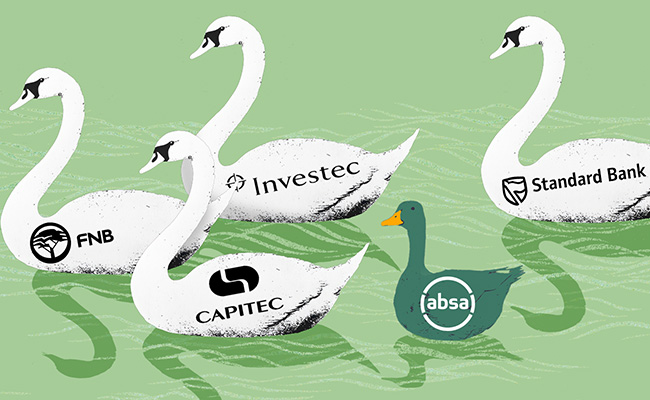
Top image: Rawpixel/Currency collage.
Sign up to Currency’s weekly newsletters to receive your own bulletin of weekday news and weekend treats. Register here.





Interesting that you don’t refer to Investec’s success in the UK. It also had to make a provision but the regulations aren’t fatal for it. The difference is that it sent its managing director Bernard Kantor to London full time to bring some energy and to make the business competitive. Ruth Leas has kept the ball rolling.