


Nkosazana Meth, South Africa’s labour minister, represents the bluntest end of policymaking, but her government’s plan to double down on employment equity amid a crumbling education system could lead to a spike in unemployment.
This emerges as one of the conclusions in a new report on BEE, produced by two consulting firms, XA Global Trade Advisors and Codera. This report, its authors say, is the first real attempt to quantify the cost and benefits of the policy.
The findings are withering: the policy, it says, has “failed” to transform the economy, and instead has led many firms to cease hiring people and investing, while damaging the economic prospects for black South Africans.
“Yet the dominant policy response has been to increase the compliance burden, tighten enforcement, and expand the reach of the legislation,” it says.
The report says that the assumption this policy response is based on – that firms are just not trying hard enough, and that compulsion will eventually deliver results – is not supported by the data.
This is relevant considering that, two weeks ago, the Constitutional Court dismissed a bid to interdict new employment equity rules, which set labyrinthine five-year targets for firms employing more than 50 people in 18 sectors.
Meth said this meant the government is now “forging ahead” with the new rules. Last year, she described the legal attacks as an attempt to “active[ly] sabotage” the country’s transformation objectives and “preserve historical inequalities”.
But critics, like the National Employers’ Association of South Africa and Sakeliga, say the targets are “irrational and arbitrary”, and “no consideration was given to the pool of skills available in each sector”. Failure to comply, without a good reason, can lead to fines of up to R1.5m or 2% of turnover.
In the financial sector, for instance, in the lowest tier of “skilled technical” workers, the target for non-white employees is 95.6% from “designate groups”, being 49.5% male and 46.1% female. For “top management”, it is 63.1%.
But Codera and XA say that for Meth’s approach – to legislate quotas and penalise companies – to be correct, three assumptions would have to be true.
First, that there is an adequate pool of skilled black labour to fill the quotas; second, that this is not being tapped because company management “would rather not employ” from this pool; and, third, that legislative pressure will force the companies to capitulate and hire those people.
“This is obviously wrong,” the report says, citing the country’s rankings.
For grade 4, South Africa came last in the most recent Trends in International Mathematics and Science Study (Timms) of 59 countries, and last of 43 countries in the Progress in International Reading Literacy Study (Pirls), with 81% of learners unable to read for meaning.
Codera and XA say the composition of the workforce reflects the fact that the education system is not creating the human capital required by society and the economy. “If policy attempts to short-cut that process without addressing South Africa’s education challenges, the outcome tends to be a shrinking economy and higher unemployment,” their report says.
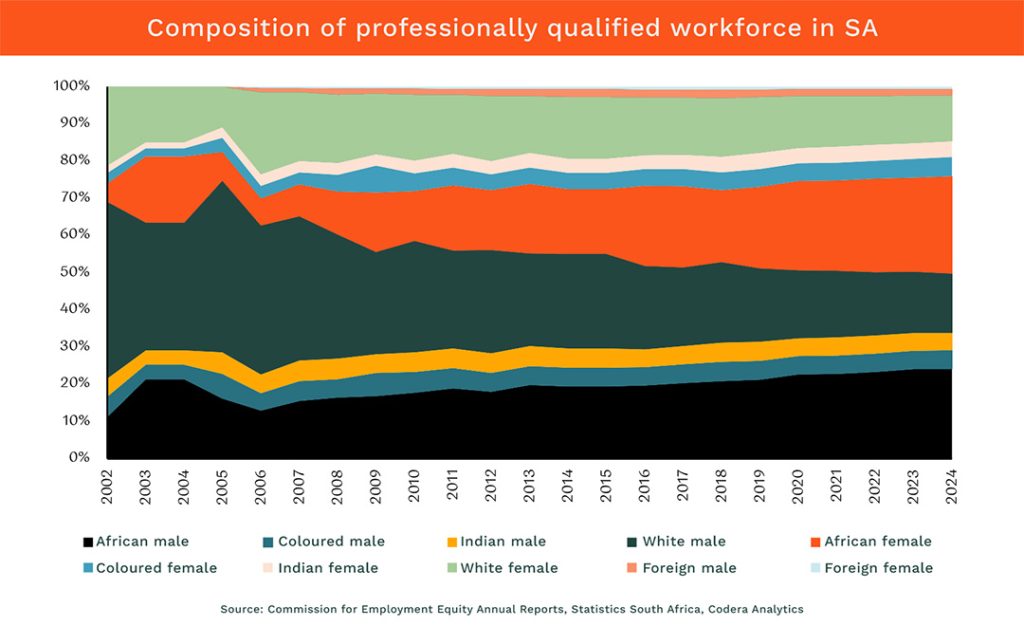
Data from the Commission for Employment Equity, the report says, shows that despite the policy focus on employment equity, “there has not been a dramatic change in the structure of South Africa’s professional workforce”.
While black participation has risen, this has been less pronounced at senior levels (see graph). This suggests a new approach is needed, rather than a bull-headed decision to double down on what hasn’t worked.
‘Not creating jobs or growth’
The new report is based on a survey of 126 companies, which responded to a request by various business lobby groups to participate.
The results were bracing: 35% of these companies said they had “reduced hiring” as a result of BEE, 61% said it had “no impact”, and just 4% said they had “increased hiring”.
Asked what impact the BEE rules had on investment in their business, 48% said it had “reduced reinvestment”, another 48% said it had “no impact”, and 4% said it had “increased reinvestment”.
The policy also cost these companies plenty. The set-up costs for these companies – some large, and some small – came to between R160,000 and R650,000, which was equal to a median of between 0.4% and 4% of their annual turnover.
The annual cost of compliance, between R225,000 and R2.5m, is even more immense. This amounts to between 6.25% and 32% of their post-tax profit to ensure their BEE scorecards are in order, including paying for advisers and lawyers, and for accreditation.
These costs wouldn’t be a problem if BEE created “growth opportunities for compliant firms, and supported job creation and investment”. Only, it hasn’t done this.
“Our survey results suggest compliance costs are so large as to either disincentivise business formation entirely, discourage firm growth, or incentivise offshoring,” the report says. “This is the very opposite of what South Africa needs to drive faster economic growth.”
This study, XA Global Advisors founder Donald Mackay says, doesn’t propose to be a statistically representative view of BEE across the corporate sector, in part because of the limitations of how the survey was structured. But, he says, given the statistical gap around the cost and benefit of BEE, this is a useful addition to the discussion.
“Is it a statistically significant sample? No – we’d have had to design it differently for that. But does it represent the views of a large number of companies for whom BEE has impacted their investment decisions? Then, yes,” he says.
While 700 companies received the survey, only 126 ultimately completed it – but this spanned small firms to those with revenue exceeding R1bn, with 25% of them in the top two tiers of BEE compliance and 37% entirely non-compliant.
The report makes a critical framing distinction that has been lost to the politicians: BEE isn’t the goal itself, it is just a policy tool to achieve the real goal – transformation of the economy.
“Because [broad-based] BEE has become so thoroughly conflated with the objective of transformation itself, questioning the instrument has come to feel like questioning the goal – and that conflation forecloses the very debate South Africa most needs to have,” the report says.
But, it adds, South Africa’s low GDP growth rate of less than 2% and its low investment rate mean there is little space to coddle a failing policy.
“South Africa does not need to abandon the goal of transformation – it needs the honesty to ask whether its current tools are fit for purpose, and work to find better ones if they are not,” it says.
ALSO READ:
- Stings like BEE: will the ANC get real?
- Legal heavyweights join forces to fight BEE rules
- Say no to ‘political economic empowerment’!
Top image collage: Gallo Images/OJ Koloti (photograph of Nomakhosazana Meth); Rawpixel; Currency.
Sign up to Currency’s weekly newsletters to receive your own bulletin of weekday news and weekend treats. Register here.







Sadly, government will simply not understand this article.