

On July 8 2024, Russian missiles were launched at Kyiv in one of Moscow’s frequent attacks on civilian infrastructure. Between the launch of the full-scale invasion in February 2022 and August 2025, Russia launched more than 9,600 missiles of various types and nearly 14,000 attack drones at Ukrainian territory, along with more than 33,000 guided bombs. According to Ukraine’s military, over this period 5,200 missiles were deliberately aimed at civilian targets – residential buildings, hospitals, schools, power plants and other non-military infrastructure.
This time, the Russians struck Okhmatdyt, the country’s largest children’s hospital in the capital, destroying a toxicology unit where children with severe kidney disease were treated, incapacitating more than half the hospital and killing two staff members.
The attack prompted international outrage. A spokesperson for UN secretary-general António Guterres said he strongly condemned the “particularly shocking” strikes against the children’s hospital and another medical facility. Italian foreign minister Antonio Tajani called the strike “war crimes”. And Keir Starmer, at that time prime minister of the UK, condemned “attacking innocent children” as the “most depraved of actions”.
The site of this atrocity was about to become the site of the war’s second dimension – the battle over the truth.
Russia’s capacity for manipulating information – its Information Confrontation Doctrine – has been well-studied. Encompassing “cyber capabilities, propaganda, psychological operations and strategic messaging”, the doctrine seeks to shape its domestic environment to keep its population servile and to influence the international order in service of its goal of “great power restoration”, according to a study by the International Institute for Strategic Studies.
On the Ukrainian battlefield, Russia deploys deepfakes and generative AI to expand its capabilities.
The strategy is a simple one: tell a lie, no matter how big, and then turn it into a truth on social media by deploying a global army of social influencers and bots to repeat the untruth until the truth is disbelieved.
And so Russia boldly claimed that the children’s hospital was in fact hit by a Ukrainian anti-aircraft missile, even though the deadly strike was not the first of its kind. By that time, more than 1,700 medical facilities had been hit since the start of the full-scale invasion, according to the International Rescue Committee.
Ukraine’s answer
Ukraine’s response to this information war could have been to deploy its own army of bots and influencers armed with its own propaganda. It certainly has the cyberskills and capacity to do so. But, instead, it opted to confront Russia’s untruths with the work of brave, energetic, tech-savvy and principled journalists.
After the attack on Okhmatdyt, Ukraine got its version out quickly, before the Russians, establishing beyond doubt that a crime against humanity had been committed. The longer game has been about changing the perspective of journalists at the frontline of a rural, simple people (given that is where much of the fighting has occurred), which is quite different to the sophisticated lifestyle of those in the major cities. And there was an imperative to correct the Russian narrative of “corrupt Ukraine”, even though Moscow preferred that quality to keep Ukrainians divided, down and out.
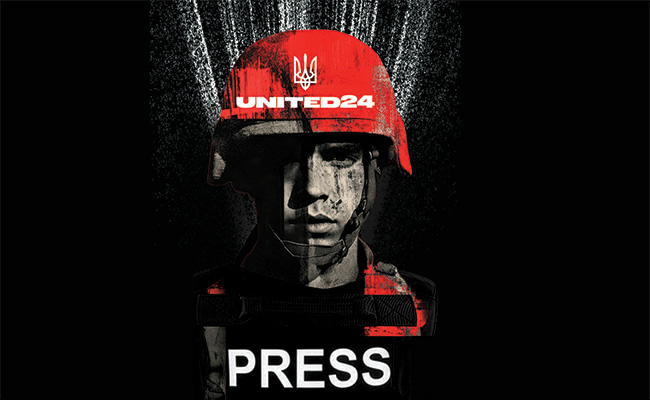
The driving force behind this campaign, which relies on reporting and the publication of unmanipulated video evidence, is Ukraine’s United24, which was born as a presidential fundraising platform and news project run by the ministry for digital transformation, headed by Mykhailo Fedorov from August 2019 until January 2026, when he took over as the minister of defence. At the time of United24’s establishment, Fedorov was 31 years old, about the average age of the 100 journalists on the staff by 2026.
The idea was to keep Ukraine in the news, show the world what was going on, and counter Russian disinformation presenting “Ukraine as a corrupt post-Soviet state”, says United24’s editor Eugene Slavnyi. “The challenge was that Ukraine was not communicating well enough about Russian actions and we needed to tell our story: one of two different worlds, of democracy and freedom versus autocracy and fear.”
Under his leadership, United24 has become the largest English-language Ukrainian media platform, reaching 75-million viewers monthly in sharing the Ukrainian perspective. To achieve this, as a first step, United24 had to understand what people consumed on social media as their preferred information portal, and respond to their preferences. News only ranked third, below connecting with friends and entertainment. “Our main competitor is not Russia Today or Sputnik, but videos of people with cats, or food,” Slavnyi laughs.
‘Pre-bunking’ disinformation
To be an effective instrument of soft power, United24 has had to be fast in getting its story out first to “pre-bunk” any Russian narrative, and to be truthful. “We wanted to show Ukraine as we know it, as a modern force consuming the same goods as the West, not as a rural people ravaged by war. To deliver this real face, we would not rely on bullshit propaganda, but inform people about real Ukrainians, why we are so badass, and why we can win this war,” he says.
United24 does not push its stories by paying for digital prominence, instead relying on organic, networked growth. “We have an international team, so we reach audiences through their lens. Out of 10 videos, eight drive growth, while two cover more cultural or social issues.” With the largest of its 250-million monthly Instagram views in the US, at just 16% of the total, the audience is impressively diverse. There is little room for complacency and nostalgia. “Every two weeks we adjust our strategy based on the data feedback, and we are ruthless in making those changes.”
Pre-bunking, such as getting in front of the Okhmatdyt missile story, requires moving fast. But it demands close co-ordination with the Security Service of Ukraine to gain access where required to CCTV footage, for instance, in vividly reporting on events.
The video-only format is popular, with 4.5-billion views annually, and 2-million YouTube followers. But this demands that United24 speaks on behalf of the Ukrainian people rather than the government, explaining why it took a strong editorial line over Federov’s sacking. This is helped by only 30% of its funding coming from the state, the rest from private donations.
So successful is United24 as an expression and practice of Ukrainian agency, that the Russians have taken to producing fake United24-branded videos, including in Polish.
“Ukrainians were always like this, owning the struggle,” says Slavnyi. “There is a long, long history of resistance to empires, and a history also of ancient culture, language and traditions. Russia has tried to erase our identity, but we have survived like a Cossack khutor,” he says – a reference to creative, eco-friendly communities and artistic collectives.
Ownership matters – and it shapes stamina and resolve.
Ray Hartley and Greg Mills are with the Platform for African Democrats.
ALSO READ:
- Trump-Putin summit: this isn’t how wars are ended
- Totally Volga: South Africa’s Orwellian diplomacy hits a new low
- Duped, deployed, disappeared: MK’s Russia debacle
Top image collage: Rawpixel; Currency.
Sign up to Currency’s weekly newsletters to receive your own bulletin of weekday news and weekend treats. Register here.