

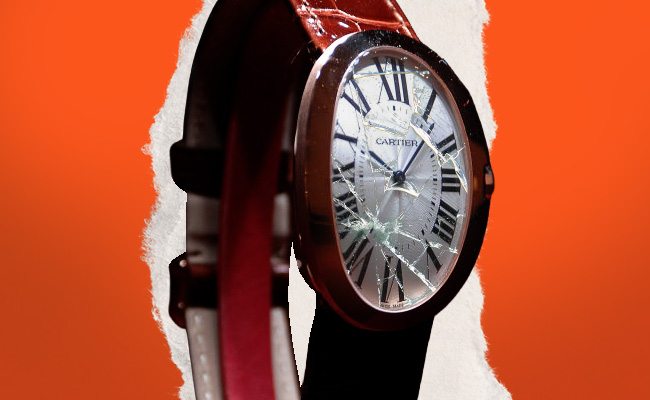

Don’t you just hate it when the market doesn’t take instructions, or even respond the way you think it should?
So when a company does exactly what you hoped it would do, produces results considerably better than its rivals, confirms every element of your investment thesis, and its share price goes down anyway, it’s irritating.
This was, more or less, the fate of Richemont last week. The Swiss luxury group, which owns Cartier and Van Cleef & Arpels, reported results that in almost every operational respect were rather dazzling. Annual sales reached €22.4bn, up 11% at constant exchange rates. Sales in its final quarter rose 13%.
Its jewellery maisons (a “maison” is a “division” in Richemont speak), which also include Buccellati and Vhernier, increased annual sales by 14% at constant currencies and fourth-quarter sales by 16%. The Americas grew 17% for the year, marking nine consecutive quarters of double-digit constant-currency growth. Cash flow from operations rose to €4.9bn, and the company ended March with €8.5bn of net cash.
And yet, on results day, Richemont shares fell about 1.8%. It is as though the market opened the Cartier box, admired the workmanship, asked for the receipt and then wondered aloud whether gold had become rather expensive.
Tight-lipped
Bernstein luxury analyst Luca Solca, one of the best-known followers of the sector, said in response to questions for this article that the market initially liked the results, but the company’s subsequent presentation left investors unsatisfied.
“Talking to investors, what they didn’t like is that Richemont was tight-lipped and provided no hint on where margins could go on the back of the gold price impact,” says Solca.
That is the tension at the centre of Richemont’s position. While its products are selling extraordinarily well, luxury goods companies are no longer enjoying the carefree, all-boats-rise market of the immediate post-pandemic years.
Bain estimates that the personal luxury goods market declined by about 2% in reported terms in 2025 to €358bn, roughly flat at constant exchange rates. More significantly, the industry lost about 20-million consumers during the year as customers bought less often, traded down, moved towards second-hand goods or preferred experiences to yet another handbag with an increasingly alarming price tag.
The great luxury boom has become a more selective business. The industry’s clients have not collectively run out of money; they have apparently run out of patience with very expensive handbags and silk scarves whose value rests largely on marketing. That means jewellery is currently in luxury’s sweet spot.
It has craft, brand, recognisability, gifting value and the useful psychological defence that at least some of what you are paying for is an intrinsically valuable material. A handbag may be exquisitely made and culturally meaningful, but when prices rise too aggressively it can begin to look like a leather protest against consumer intelligence. A gold Cartier bracelet, on the other hand, can still be presented – to oneself, if necessary – as an heirloom.
Richemont is unusually well placed for precisely this market, and its jewellery maisons generated just over €5bn of operating profit at a margin of 30.5%.
So why the initial sour market response?
The gold price problem
The answer is gold. Or, more precisely, gold, currencies and tariffs.
While Richemont’s sales were excellent, its gross margins actually fell by 250 basis points, to 64.4%. Operating margin declined from 20.9% to 20%. Operating profit rose by only 1% at actual exchange rates, despite growing 23% at constant currencies.
The company was unusually clear about the causes. Foreign exchange movements accounted for a 210-basis-point hit to gross margin, driven mainly by the US dollar, Swiss franc and Chinese renminbi. Of the increase in production costs, approximately two-thirds resulted from raw-material inflation, chiefly gold, while one-third came from additional US duties.
Gold is the issue investors can most easily grasp because it lies at the heart of the Richemont paradox. For a jewellery company, rising gold is both lovely and awful. It encourages customers to think of jewellery as permanent, transferable and reassuringly substantial; it also raises the cost of producing every beautiful thing in the window.
Red herrings
Richemont chair Johann Rupert, in the results call, put the pricing issue rather plainly: “We did not use pricing to offset tariffs.” Luxury houses damage themselves when they try to pass every external irritation instantly on to customers. If you make a Cartier bracelet seem like a vehicle for collecting customs duties, some of the romance may drain away.
Solca, however, argues that investors are worrying too much about this. He calls the gold-margin concern “a red herring”, saying Bernstein’s analysis of Richemont’s gross-margin mechanics points to margins being sustainable relative to consensus forecasts. He also notes that gold prices have eased in recent weeks, to about $4,500.
If gold prices stabilise or drop further while jewellery demand remains strong, Richemont could see a rather attractive improvement in profit conversion. If gold stays elevated, currencies remain unhelpful and tariffs continue to intrude, investors may face more quarters in which excellent sales arrive wearing disappointingly modest margins. Solca’s conclusion is disarmingly simple: “I keep calm and stay the course. Organic growth couldn’t have been better.”
Opportunities for the patient
Vestact fund manager Bright Khumalo agrees: “Richemont’s numbers were genuinely good. Sales were strong, jewellery remains best-in-class, the balance sheet is clean as ever, and Cartier/Van Cleef are probably among the highest-quality luxury assets in the world.”
The issue is more about the sector in general than Richemont specifically, he says. “Luxury is grossly out of favour right now, so even good results are being met with scepticism. Investors don’t want to own the category right now. That usually creates opportunity if you’re patient.”
David Shapiro, long a fan of the luxury goods sector, says the results, “under the circumstances”, were in fact “extraordinary”.
“Over 10 years on price only – ignoring dividends and special dividends – your returns are over 14% per year. I can live with that,” he says. He’s of the view that while AI stocks are drawing a lot of liquidity and attention away from luxury, that is likely to change, and markets will return to quality companies that have lagged, especially once the Iran conflict is wound up.
“Bottom line – the super rich around the world are travelling and buying at Cartier. That’s good enough reason for me to keep buying the share,” he says.
In fact, as we were writing this story, Richemont shares were already staging a recovery, and closed almost 5% higher on Wednesday.
At more than 20 times trailing earnings before interest and tax, Richemont is already being treated as a luxury winner. It has earned that status, but premium-rated companies are required to bring not only good news but also an acceptable degree of clairvoyance.
Richemont is strategically better positioned than LVMH or Kering in the present market, less spectacularly priced than Hermès, and now confronting margin pressures that could ease without any heroics from the underlying business. The company does not need China to return to the delirious days of old, or watches suddenly to become wildly profitable, or wealthy Americans to acquire three wrists each. It needs Cartier and Van Cleef to remain desirable and its input-cost problems to become merely irritating rather than aggressive.
That is not a guaranteed investment case. But it is not a bad one either.
This story was produced in partnership with Stanlib Asset Management.
ALSO READ:
- The investment case for luxury firms
- Keeping it in the family: a conversation with Alexander Mavros
- The Rupert empire stubs out its last smoke
Top image: Harold Cunningham/Getty Images (photo); Rawpixel; Currency.
Sign up to Currency’s weekly newsletters to receive your own bulletin of weekday news and weekend treats. Register here.








Witty wordplay!
I like Richemont, their jewellery division is a gem.