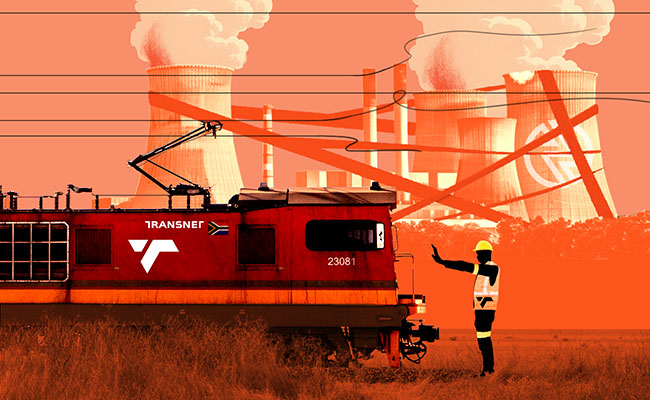

South Africa’s reform efforts are hitting a wall – held back by the very same state-owned entities that have strangled growth, rationed electricity, throttled ports and neglected rail networks – and are now hindering the changes meant to break their monopolies.
We know the culprits: one starts with an E, the other a T (and between them they stuffed the economy up from A to Z …)
The Business Leadership South Africa (BLSA) Reform Tracker is a scorecard of government progress on the structural reforms needed to lift economic growth. Run by research consultancy Krutham since March 2024, it tracks 245 deliverables across economic, criminal justice and governance reform areas, scoring each on how far it has moved from the agenda to full implementation.
Governance – covering municipalities, state-owned enterprises and the professionalisation of the public service – did not move at all for a second straight quarter.
It ranks lower than criminal justice and the economy, which remains the biggest driver of reform gains, and has barely budged in two years. That’s mainly because of “undue political interference, particularly patronage and the appointment of unsuitable officials, in key positions across government, as evidenced during the state capture era”, says the report.
Unsurprisingly, of the 120 reforms the momentum indicator monitors, 90 showed no movement. Only 21 advanced. Nine went backwards.
The sharpest retreat came in freight logistics, even though deal activity, on paper, has rarely looked better. Seven private train operating companies are in advanced talks with the Transnet Rail Infrastructure Manager. The Durban Gateway Terminal concession is operational. Qualification requests have gone out for Richards Bay and Ngqura.
Missing: the rules
Yet what’s missing is the “institutional architecture needed to make deals bankable”, says Krutham. The rules that would let private operators run trains on Transnet’s network – the so-called network statement, which sets access terms, tariffs and risk allocation – were due in February and remain unpublished.
The Transport Economic Council, which is the independent regulator tasked with adjudicating access, has been delayed past its April start date. And this isn’t going down well with private operators. Already, Traxtion, a rail firm that has committed R3.4bn to new rolling stock, says further investment hinges on the rules being finalised.
Transnet, meanwhile, is still running the process that will introduce its own competitors: designing the access regime, issuing the tenders and hiring the advisers. The same is true for Eskom. The department of electricity and energy backed Eskom’s unbundling plan, which would have left the National Transmission Company without meaningful control over the grid. President Cyril Ramaphosa had to step in to overrule his minister.
“The architecture of both sets of reforms, at this stage of their unbundling processes, leaves them both referee and player at the very time their industries and business units are being opened up to private sector participation,” says BLSA CEO Busisiwe Mavuso.
Putting their interests first
“This framework explicitly incentivises Eskom and Transnet to put their interests first.”
In the meantime, says Junaid Kader, head of infrastructure and public-private partnerships at consultancy Tsebo, exporters are absorbing higher logistics costs, some are diverting cargo to alternative ports at significant additional expense, and “South Africa is missing out on global shipping opportunities because port and rail systems cannot fully handle increased demand”.
The international record underlines the stakes. Kader notes that markets such as the UK and Australia have shown unbundling can unlock competition and investment – but only where an independent transmission operator and strong regulation are in place from the outset. Where regulation has lagged, prices have turned volatile, and markets have concentrated; where transmission investment has been underdone, bottlenecks have simply migrated from generation to the grid. “The reform response is therefore not only about unbundling, but about getting the sequencing and institutional design right,” he tells Currency.
To entice investors to build factories, explore for minerals or dig mines, and move into the energy and logistics, more certainty is needed.
That’s clear in the gross fixed capital formation stats, which grew all of 1.3% in the fourth quarter of 2025. National Treasury estimates fixed investment must reach 20% of GDP for the economy to hit and sustain 3% growth – a level last seen in 2008 in the run-up to the 2010 World Cup.
Piecemeal approach
This piecemeal approach is now becoming its own risk, says Christelle Grohmann, strategic development and advisory partner at BDO South Africa.
“We need the entire system to work, and this will start and end with structural reform,” she tells Currency. Without it, procurement keeps stalling – and the delays themselves become openings for contracts to be manipulated.
Meanwhile, the man in charge of reforming South Africa’s municipalities, co-operative governance and traditional affairs minister Velenkosini Hlabisa, conceded on a BLSA panel discussion that, when local governments “are dysfunctional, they impact negatively on economic growth”.
Mavuso asked why there is no minimum competency requirement for elected officials, pointing out that a councillor can pay R12 to join the ANC and then contest for a seat.
“In all other institutions, there is a minimum requirement. What makes us think that we shouldn’t even have a minimum requirement in [this] institution … [when] we’re entrusting a R5-trillion economy [to them]?”
Wanted: literate councillors
Hlabisa pointed out that there could be constitutional challenges if those conditions were not there in the first place, even though he conceded that a person who “cannot read and comprehend a financial statement or audit outcomes, that person cannot plan for the future of the city”.
Under the review of the white paper on local government, he said, technical and municipal manager appointments will require approval from both provincial department structures and the relevant national minister – an attempt to include competence on the administrative side of municipalities, even though it can’t be required of elected representatives.
Operation Vulindlela’s own dashboard, published the day before the Tracker, tells the same story: 67% of reforms are on track overall, but 60% of freight logistics reforms are delayed.
Aalia Cassim, acting chief director of the microeconomic policy team at Treasury, was cited by Engineering News as saying that a fully independent transmission system operator will be completed by the end of 2027, following the establishment of the Eskom restructuring task team.
Operation Vulindlela, a joint initiative of the Treasury and presidency to unclog blockages in the state, reported a 60% delay in logistics projects. “Transport reforms have moved quite slowly and what’s important to mention is that even though there’s been a slow pace of reforms, we still have seen a sustained improvement in terms of the recovery in volumes,” Cassim was quoted as saying.
Rudi Dicks, head of Operation Vulindlela, said the pace around logistics has to improve: “Confidence doesn’t pay the bills, but confidence is an important part – that people trust that we’re moving in the right direction.”
ALSO READ:
- The economic fix: Sarupen’s roadmap to faster growth
- The 10 power moves to reset South Africa’s electricity market
- Has the economy finally turned? It feels like it
Top image: Misha Jordaan/Gallo Images (photo)/Freepik/Rawpixel/Currency collage.
Sign up to Currency’s weekly newsletters to receive your own bulletin of weekday news and weekend treats. Register here.