
“No one applauds the person who halves your income.”
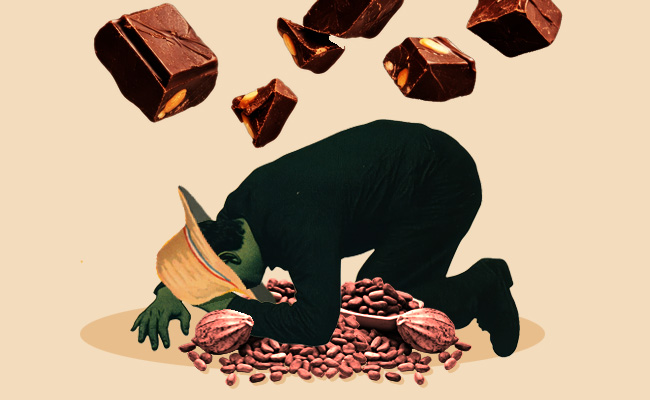
Farmers’ union leader Moussa Koné could hardly be more damning over the Ivorian government’s attempts to convince the public that bringing down the farm-gate price of cocoa by 57% should be seen as a brave and gallant move to save the country’s premier commercial agriculture sector from ruin.
Koné made his comments in March. A month later, agriculture minister Bruno Nabagné Koné boldly announced the country’s cocoa crisis was over.
“Time to turn the page,” he intoned. The response from farmers? Not so fast.
First, there was the court application by 13 farmers’ co-operatives against the government, while demanding a proper inventory of cocoa stocks.
And, second, there is the fact that Cote d’Ivoire’s cocoa farms are in the grip of persistent and fundamental problems that imperil a commercial sector that supplies 40% of the world’s cocoa, and keeps between 6-million and 7-million Ivorians alive.
How it works
Côte d’Ivoire, like its neighbour Ghana, uses a farm-gate pricing system that the regulatory bodies in the sector (Cocobod in Ghana; Conseil du Café-Ccacao (CCC) in Côte d’Ivoire) set at the beginning of the harvest season, every October. They adjust that price, if need be, halfway through the season, in April. Those first six months cover roughly three-quarters of total production; in Côte d’Ivoire this is 2-million tonnes.
The system hinges on advance sales to traders and manufacturers, and is intended to protect farmers against wild moves on the world market, creating some income stability for them and their families.
But, in 2024, a perfect storm of extreme global price movements and a presidential election produced the exact opposite.
Thanks to deeply disappointing harvests in the 2023/24 season, the result of what some have called “whiplash” weather – an initial deluge of rain followed by a terrible drought – Ghana and Côte d’Ivoire’s harvests were decimated. Actual supply shortages and jittery market sentiment drove global cocoa prices into the stratosphere. By the end of 2024 they had hit record highs of $12,906 a tonne – having started the year at $4,000.
By the time prices started rallying in earnest, production was on its way back to higher levels, too. And, unsurprisingly, all through 2024 the talk in Côte d’Ivoire was why farmers were paid so little when the world market price was so high. “Look at Cameroon,” the argument went, “they get up to three times as much …”
As long as the party lasts, that is. And Cameroon does not use the system Côte d’Ivoire and Ghana have adopted.
That’s because the fixed-price/advance sale system works both ways. While it bars producers from accessing higher prices, it shields them from falling prices too (at least, in theory).
Enter the president
As the global price continued to increase, the CCC in March 2024 issued a stern warning: anyone in the value chain, from farmer to exporter, caught paying more than the farm-gate price it had stipulated would be fined and, in the case of a repeat offence, lose their licence. At the time, there was a vast smuggling racket into Liberia and Guinea, where prices were paid that responded more closely to where the market was trading. Until the party ended.
When production levels reverted to normal during the 2024/25 season, prices started falling in January, and continued to do so for the next few months.
The Ivorian authorities still had time to respond to this drop; after all, farm-gate prices would not be set until October. But then politics decided to stick its oar in and render the ensuing disaster inevitable.
In July, President Alassane Ouattara decided to run for his fourth term of office. As part of his campaign, Ouattara decided that it would be an excellent idea to personally announce the new cocoa farm-gate price, the highest in history, which he did in early October 2025.
But that is not his job; it is the CCC that announces farm-gate prices. However, the CCC directorate is close to the ruling party, whose leader is Ouattara. He tends to get what he wants and what he wanted was to personally tell the farmers they were getting an unprecedented 2,800 CFA francs per kilogram for their produce. “Vote for me as a thank you,” was the obvious message.
Unsold stocks
Experts at the time considered the new price level ill-judged – and they were right: world market prices for cocoa had dropped to $6,500 per tonne by the time Ouattara made his announcement, and when his re-election was confirmed three weeks later (it was never in doubt anyway) they had dipped below $6,000 per tonne. With the new farm-gate price announced by the highest office holder in the land, the crash was now a matter of when, not if.
That’s because the high farm-gate price resulted in buyers refusing to buy stock at that high price, since the crashing cocoa price on the world market made certain that they would lose money.
As early as November, port authorities in Abidjan and San-Pedro noticed that ships scheduled to take in new bulk were arriving late, if at all, because international traders were delaying or halting the acquisition of new stock. Cocoa started piling up in the two ports, and in lorries and warehouses across the country; at one point there may have been as much as 700,000 tonnes blocked in this way – or 40% of total production.
The money pipeline ground to a halt, too: after the early contracts had been honoured and no new ones were forthcoming, payments that normally percolated through the system slowed down and stopped.
The system really hit the skids when the global market price dropped below the per kilogramme level Ouattara had personally promised the farmers, which happened on February 2 2026. With ballooning stocks and unpaid farmers, panic set in. And the response of the responsible authorities was depressingly predictable: they started telling lies.
Slashing the price
By this time the Ivorian state had stepped in, spending a colossal 291-billion CFA francs (just over $500m) to buy back remaining stock at the “old” price. But while world prices continued to plummet, the CCC and its director told the nation as late as February 16 that the “old” price of 2,800 CFA francs per kilogramme would be maintained until April 1, when the next half of the season would begin. That was not an “assurance”; it was a lie.
On March 4, almost one month before the usual mid-season announcement, the inevitable happened: the CCC slashed the farm-gate price by more than half, to 1,200 CFA francs per kilogramme. The move was sold as the only way to save the value chain from complete collapse; the authorities even invoked president Ouattara’s heroic role in saving and protecting the farmers, handily ignoring that it was he who had led them down the garden path in the first place …
For its part, the CCC repeatedly obscured exactly how much cocoa was still inside those warehouses and what its condition was. It took the unions’ threat of a general strike and thus the shutdown of the entire pipeline, which they made public on March 25, to force an emergency meeting of the agriculture minister, the CCC director and representatives of traders, exporters and cocoa processors. On that occasion the CCC finally admitted the size of the unsold stock still in the country: a whopping 123,000 tonnes.
‘No more scams, no more lies’
Farmers are at the mercy of a system they can’t influence, and that system has concocted a perfect storm. Extreme international market volatility was produced in London and New York, not Abidjan or Accra. Only a handful of multinational companies (like Cargill, Nestlé and Barry Callebaut) buy cocoa directly from producer countries to send to chocolate manufacturers. And few seem keen to invest in chocolate factories inside Côte d’Ivoire or Ghana.
Meanwhile, in Cameroon, farmers who were euphoric over what they were getting paid have responded to the precipitous fall in cocoa prices in sadly predictable ways, like destroying their crops.
Away from the markets, there are other issues. The plantations are old and not being structurally replenished, which leads to production falling. This is aggravated further by the effects of climate change that cause erratic rain patterns: plantations are flooded; crops catch diseases or rot away. Then there is the opaque and dysfunctional internal delivery system, where middlemen and multinational exporters determine the value of the exported crop, which may or may not conform with what the CCC has announced.
There’s the added problem of local (rogue) agents who speculate with stocks and underpay farmers. Usually, these agents would be barred from participating in the value chain, but the problem is that these players are connected to the ruling party and even the Ouattara family; they are therefore untouchable and unaccountable.
One thing that could improve matters is the newfound strength of the farmers’ unions, whose trust in the regulators and authorities has evaporated. Based on his in-depth knowledge of the cocoa sector, one analyst put it like this: “Farmers and their unions have found their voice. And they have said ‘Enough. No more scams, no more lies.’ And while this is long overdue, it is a good thing.”
ALSO READ:
- China’s African harvest: trade wars are reshaping the fruit bowl
- Africa in 2026: Harsh trade realities, yet big growth still possible
- Scrooge McDuck’s $4,000 moment
Top image: Rawpixel; Currency.
Sign up to Currency’s weekly newsletters to receive your own bulletin of weekday news and weekend treats. Register here.