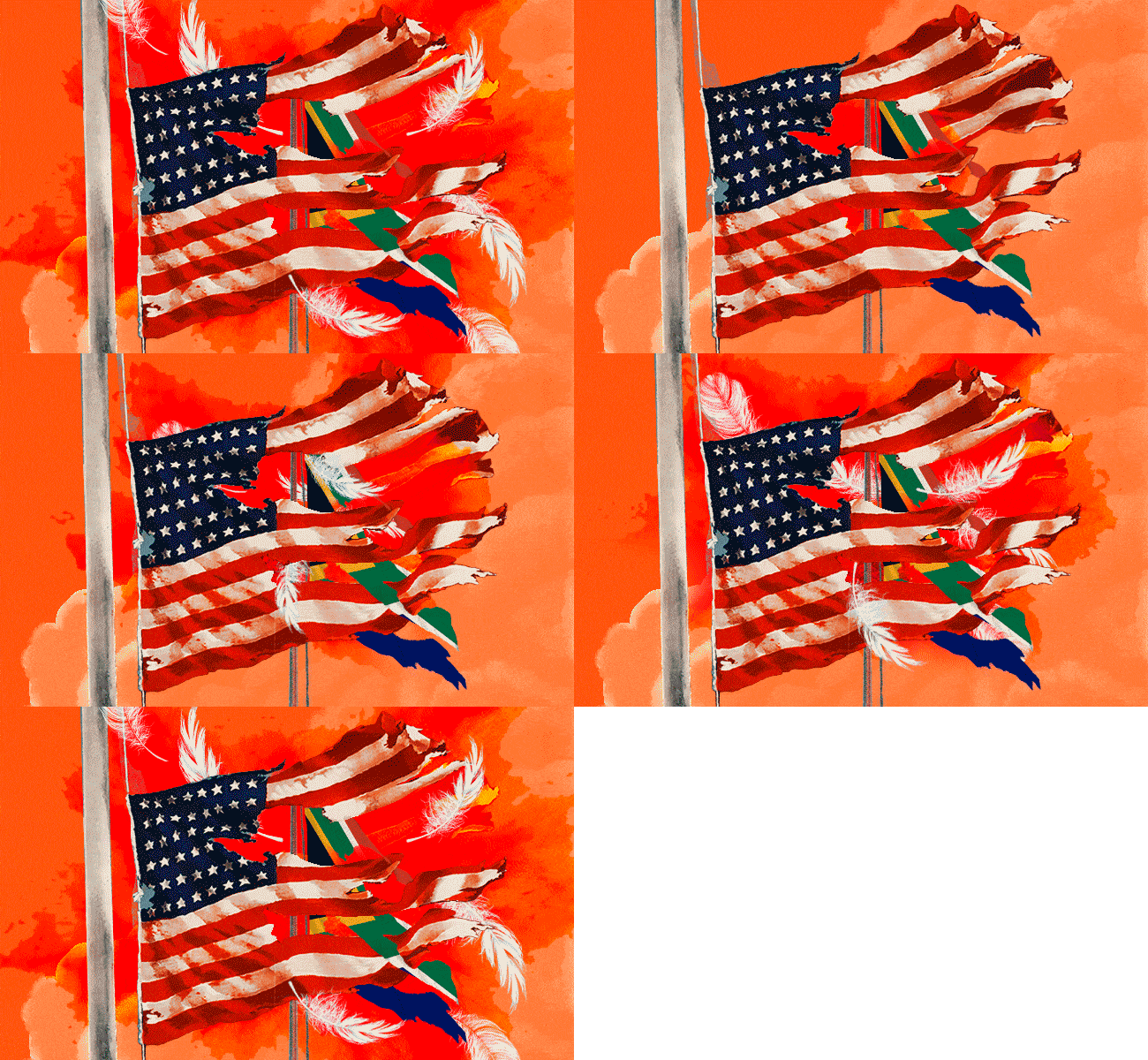

The local poultry industry is back on the warpath over American fowls. Only this time, it’s not fighting a hostile Trump administration.
The South African Poultry Association (Sapa) is suing its own government over concessions that allow US producers to ship in chicken meat weighing as much as hundreds of fully-loaded Boeing 737s each year, free of anti-dumping duties.
And, in return, Sapa argues, South Africa gets nothing.
The case is due to be heard in the Joburg high court in July, with Sapa hoping to force trade, industry and competition minister Parks Tau to scrap a 2015 rebate tied to the African Growth and Opportunity Act (Agoa) that lets up to 72,000 tons of bone-in chicken into South Africa annually. This chicken is absent the anti-dumping duties meant to stop countries selling surplus product abroad below what local producers can sustain.
“Why would a minister make a decision that causes harm to the industry with no benefit to South Africa,” asks Izaak Breitenbach, CEO of Sapa’s Broiler Organisation. For its part, the US bars South African chicken on phytosanitary grounds – leverage that Breitenbach argues could have been put on the table.
The case turns on a single clause: if South Africa ever lost an Agoa benefit, the rebate was meant to fall away automatically.
Rebate revolt
That moment came on April 2 last year, when Trump’s “Liberation Day” tariffs hit South Africa with 30%, later cut to 15%. On Sapa’s reading, that lapse should have voided the rebate on its own. It did not – the department of trade, industry and competition (dtic) told Washington it would keep the rebate – and, Breitenbach says, would not discuss it with the industry. Hence, the court action – which the department is opposing.
Sapa also says the minister handed Washington a second concession on self-regulation of bird-flu controls, though the details are disputed between the association and the department. Agoa itself, the preferential trade scheme for Sub-Saharan African countries, has been extended to the end of 2026, with South Africa bidding to renew it for a further 15 years as the pact is renegotiated.
Shane Naidoo, treasury and trade management specialist at Nedbank Commercial Banking, tells Currency that South Africa might not want to bring chickens into the Agoa fight at all.
“Does chicken actually matter in US trade negotiations? Not really. It has become a symbol,” he says.
South Africa is a net poultry importer, and US volumes are limited; the US, he adds, “may have a good foundation for being treated differently under Agoa” than under World Trade Organisation rules governing duties on Brazilian and EU chicken. Pretoria, he notes, did not drop those duties – it created a tariff-rate quota sitting on top of them, and acted within its mandate, reserving the right to change course should dumping or material injury be established.
Still, he says, South Africa could have bargained for more: an adjustment fund, underwritten by the US, for farmers hit by avian flu; joint research, veterinary training, and access to US vaccines and technology; or disease-free zone certification that would open export markets and cut the country’s dependence on imports.
‘Find other markets’
His larger argument is that the smarter approach is to stop spending political capital on the quota and pivot elsewhere.
“It’s not about emotions, but rather a business and economic strategic imperative,” Naidoo says – and the imperative is to find other markets, soon.
The African Continental Free Trade Area already gives local producers an edge that the US market does not; Southern African Development Community demand is growing; and Mozambique relaxed some import bans in 2023. Beyond the continent, the Gulf and Asia want frozen and halal poultry – South Africa won access to the United Arab Emirates in 2022, a premium market – while Japan and South Korea remain open if disease-free zones can be established, and the Philippines and Vietnam are large buyers of deboned product.
Pressed on 702’s The Money Show by Stephen Grootes on whether antagonising the Trump administration would be reckless when “they have a better deck of cards than we do” and could simply cancel Agoa, Breitenbach was unmoved: “What we would like to do is to force the hand of dtic and force them to withdraw the rebate.”
He frames the threat in scale. The largest US producer slaughters 45-million birds a week, he told the programme; the entire South African industry slaughters 23-million. Chicken carrying anti-dumping duties, South Africa can compete with; dumped chicken it cannot, and the rebate, in effect, makes the dumping legal. “You can see the massive amount of power that they have in sending dumped products,” he said.
No direct damage
But a major integrated producer, which asked not to be named, tells Currency that US imports have done no direct damage to its business over three years: no farms closed, no workers retrenched, no contracts lost to retailers. Pressed on whether a court win would change anything, the producer says it “will have no direct impact on our business”. Selling prices, it says, track commodity costs and a local market that is currently well balanced.
The producer also rejects the idea that imports slip in under weaker health rules. When Brazil suffered a bird-flu outbreak last year, it was barred from exporting to South Africa, the producer notes, because global phytosanitary rules block exports from any country during an outbreak.
So why fight? On principle, and on the rule. “When Agoa expired, the 72,000-ton quota was meant to fall away. This has not happened,” the producer says, echoing Sapa’s case.
The government, it argues, should either scrap the quota or apply the same anti-dumping and import duties to US chicken that everyone else pays.
The opposite danger is just as real: strip out all protection, as the importers’ lobby – the Association of Meat Importers and Exporters – wants, and there would be job losses and smaller producers going under. The objection is not that US chicken is hurting the industry now, but that the rule leaves it exposed.
Capacity to grow
Wandile Sihlobo, chief economist at the Agricultural Business Chamber and the presidential envoy on agriculture and land, sees an opportunity rather than a threat. “The South African poultry industry still has a capacity to grow and play an active role in import substitution,” he tells Currency, noting that the government already protects the sector through tariffs and that the commitments in the Poultry Masterplan “remain vital”.
South Africa, he points out, still imports about 20% of the poultry it consumes.
The government calls Sapa’s action premature, since the Agoa deal at its heart may lapse before the matter is even heard. Sapa calls that the point: it wants to be heard before Tau settles South Africa’s position on the next round of trade talks with the US.
This week, debating his budget in the National Assembly, Tau told MPs that trade with the US “remains strong” – exports rose to R260bn in 2025 from R238bn in 2024, Agoa was extended and jobs were protected. In seven pages, he did not mention chicken once. The dtic declined to comment beyond that.
Still, the fight exposes what neither side disputes: that South Africa’s trade with Washington rests on temporary deals, renewed at America’s discretion, on increasingly uncertain leverage for the smaller economy.
ALSO READ:
- From Agoa to AfCFTA: navigating Africa’s new trade landscape
- Farmers ‘maak ’n plan’ as they adapt to Trump’s turmoil
- South Africa’s tariff system is choking business confidence
Top image: Rawpixel; Currency.
Sign up to Currency’s weekly newsletters to receive your own bulletin of weekday news and weekend treats. Register here.