
Even readers numb to bad economic news should flinch at the fact that fixed investment fell to 13.9% of GDP last year, the lowest since 1950 once Covid is set aside. The economy grew by just 1.1% over the same period. Manufacturing, which once made up around a fifth of national output, now contributes less than 13% and continues to shrink.
By now the causes recite themselves: ageing infrastructure, unreliable energy and logistics, an insufficient skills base and a policy environment too incoherent to give investors the confidence to commit.
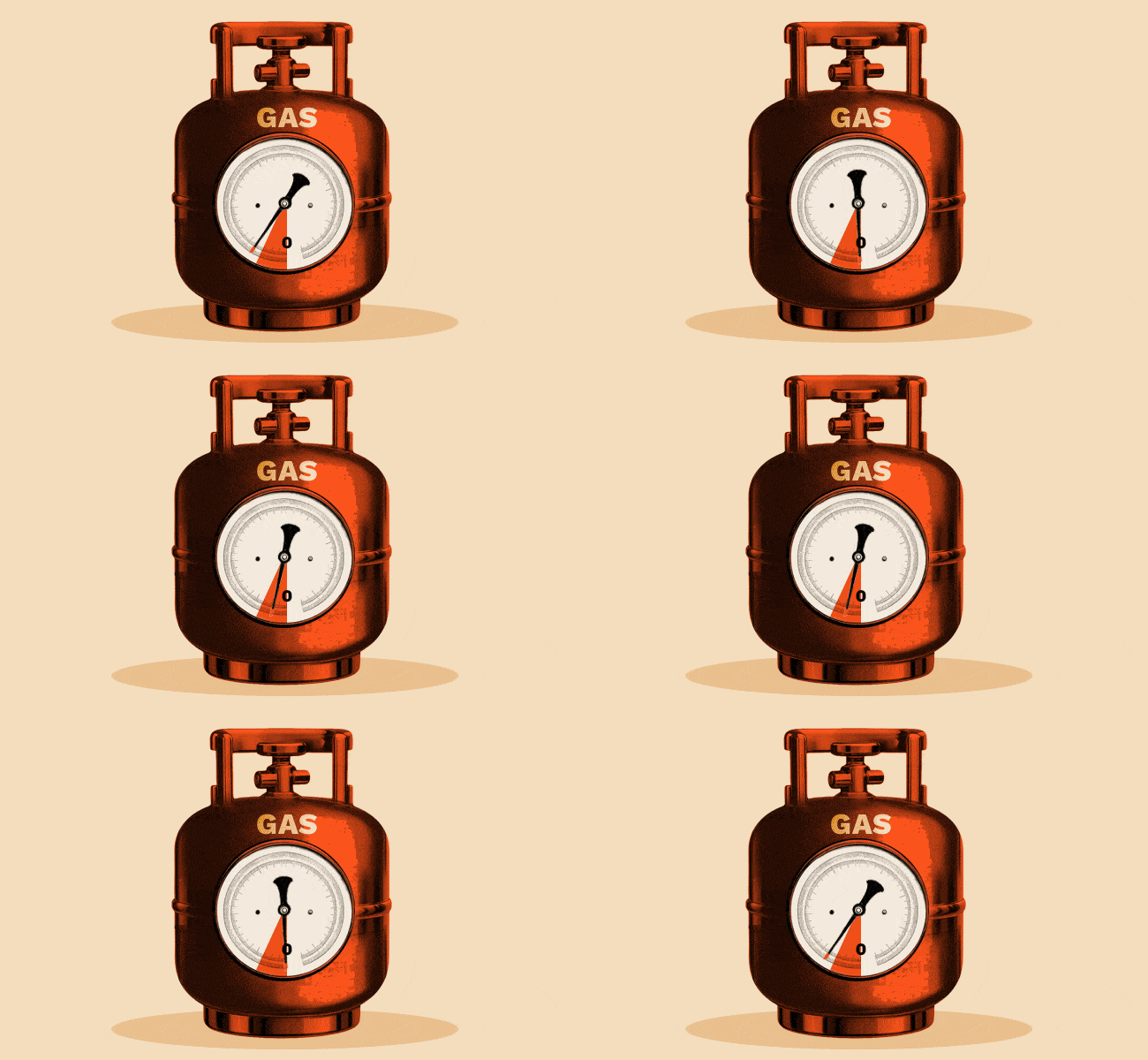
Bearing down on all of it is a gas cliff. Sasol’s supply from Mozambique’s Pande and Temane fields runs dry in 2028, and the industrial users who depend on that gas – in glass, steel, food, mining and chemicals – underpin roughly 8% of GDP and about 75,000 direct jobs. A disorderly end to that supply will shock the economy.
This month, cabinet approved a revised Industrial Development Strategy (IDS) that sets out to halt deindustrialisation and lift growth to 3% a year. The document is honest about the diagnosis, conceding that industrial policy implemented in isolation across departments has lacked coherence and that the country needs a whole-of-government approach. It identifies the right priorities: reliable and affordable energy, functioning ports and rail, a skills base aligned to industry, and infrastructure investment backed by public-private partnerships. It says a great deal of what needs to be said.
The missing element: execution
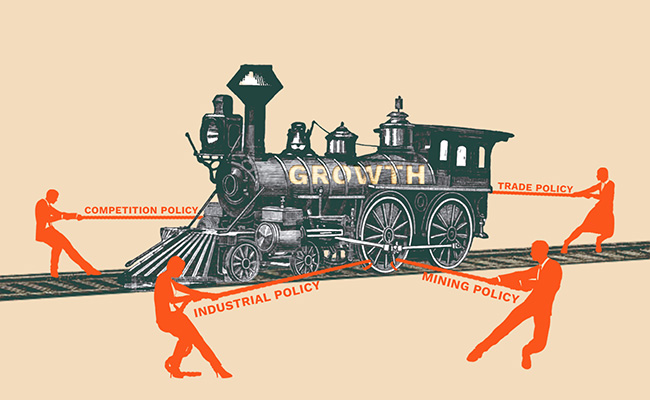
The difficulty, as industry knows from long experience, lies in execution. A national industrialisation strategy is a machine with many interlocking parts – policy, trade, skills, capital, infrastructure – and each must turn in time with the others. Coherence on paper is a necessary first step. Delivering it across departments, agencies and state-owned enterprises, each with its own mandate and timetable, is where ambition has repeatedly come undone.
We’ve seen exactly how this plays out, even when the solution is simple, defined and laid out in full. The Industrial Gas Users Association – Southern Africa’s Gas Roadmap 2025-2042 sets out a sequenced, costed pathway through the cliff and beyond it: seven supply sources building to more than 1,000 petajoules a year by 2042, anchored by West Coast Gas. It spells out the policy positions required and the order in which decisions must be taken. It has been shared with every department that should care about it. And yet, after seven years of engagement, there is still no substantive partnership between government and the industries that actually use the gas.
We’ve been clear, for years, on what is needed from government. Reaching financial close on supply infrastructure will take a fiscal support framework that makes projects bankable on a risk-adjusted basis. It will take government, in parallel, to aggregate, sequence and commit to industrial gas demand, so that developers can match the timing and cost of infrastructure to a market they can count on. Industry is ready, with aggregated demand, commercial momentum and the capability to execute; what it cannot provide is government alignment and co-ordinated LNG demand-sequencing. And West Coast Gas, the anchor of the whole roadmap, hands the state a rare lever across the entire value chain – upstream supply, midstream transport and storage, downstream industry – if it chooses to pull it.
Government lagging
Government has made no meaningful progress in any of these respects. There is still no integrated, co-ordinated industrial energy policy for gas. The IDS calls for a whole-of-government approach; on the most urgent and most solvable problem in front of it, the state has not yet convened the room.
The result is that industrial users face a crisis they did not create and one that is eminently solvable, held hostage to the state’s inability to co-ordinate itself. If the country cannot deliver on a single, well-defined problem with a costed answer already on the table, how will it deliver on the far broader and more complex task the IDS sets itself? The strategy itself names co-ordination as the prize. Achieving it will mean empowering someone, somewhere, with the authority to align departments and the mandate to hold them there long after the launch headlines have faded.
None of this is a reason to dismiss the strategy. The IDS is a real step in the right direction, and the candour of its diagnosis is welcome after years of fragmented master plans that did little to revive the sectors they targeted. The question now is whether the government can build the delivery machinery to match its intentions.
A looming deadline
It is not hard to picture what success would look like. Co-ordinated planning, driven and protected through a structure housed in the presidency, with the mandate to make departments work in lockstep and to hold them to deadlines. Bankable projects reach financial close because the fiscal and regulatory pieces are there. A revitalised industrial sector draws in the investment that has drained away, putting people back to work and lifting growth towards that 3% target.
That destination is frustratingly close. The planning is sound, and in the case of gas the answer is already costed and sequenced, waiting only for someone with the authority to act on it.
The new IDS will be judged not at its launch, but in 2028. Will the gas have run dry? Or will the state have managed to co-ordinate itself in time? That deadline is fixed. It will arrive whether or not a solution is in place. The same is true, on a longer horizon, for every other commitment we need to make to fix the ports, the railways, the skills pipeline, the public-private partnerships. So solve the one well-defined problem, and build the systems and teams needed to tackle the broader one.
Government knows what it needs to do. Now industry, investors and the millions who need the jobs this strategy promises will, once again, watch and hope that it does it.
Jaco Human is executive officer of the Industrial Gas Users Association – Southern Africa.
ALSO READ:
- The department of grand plans and small results
- Mozal goes dark as power prices crush beneficiation ambitions
- How ASPI is bringing the Renergen dream to life
Top image collage: Rawpixel; Currency.
Sign up to Currency’s weekly newsletters to receive your own bulletin of weekday news and weekend treats. Register here.