
The latest GDP growth data might give the South African Reserve Bank (SARB) reason to pause when it next considers the course of interest rates on July 23.
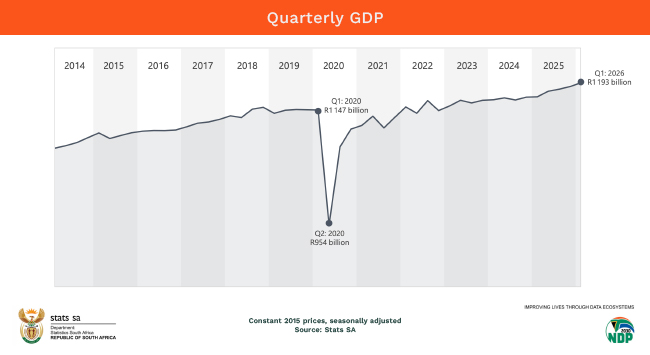
The economy expanded by a better-than-expected 0.5% in the first quarter, compared with a 0.4% increase in the final quarter of last year, Stats SA said this week. That beat the 0.3% estimate from economists polled by both Bloomberg and Reuters.
Even so, aside from the now more than three-month conflict in the Middle East, there are two warning signs that the risk of an economic slowdown is building: household consumption growth slumped to its lowest level in two years, while fixed investment turned negative for the first time in three quarters.
“We need both household consumption and fixed investment to rise at a faster rate to see stronger growth,” Sifiso Mkhwanazi, macroeconomist at Alexforbes, tells Currency. “We’re not excited about this print because this is just before the impact of the conflict fully shows. But, looking at just how much, we should be concerned, you should look at household consumption.”
Household consumption – which makes up almost two-thirds of GDP – weakened to just 0.1% in the quarter, down from the prior quarter’s 1.2% growth, as consumers slashed spending. Consumption growth on discretionary goods and services plunged from 2.6% the prior quarter to a contraction of 1.7% in the first three months of 2026. Spending on restaurants, hotels, food and beverages, and alcohol and tobacco also shrank. Fixed capital formation fell 1.1%, subtracting 0.2 percentage points (pp) from growth, as businesses slashed spending on machinery and equipment.
“I’m not upbeat about the numbers from the second quarter going forward,” says Mkhwanazi. “At the same time, households will be squeezed, as they will face a double whammy of higher inflation as well as higher interest rates.”
Revised projections
Alexforbes has since revised its GDP growth projections for the year and is now looking at 1.2% for 2026, from a 1.4% forecast at the beginning of the year. That’s still better than the International Monetary Fund, which cut its estimate for South African growth this year to 1%.
The SARB trimmed its outlook in May, lowering its 2026 forecast to 1.2% from 1.4% and its 2027 forecast to 1.7% from 1.9% due to weaker global growth, higher energy costs and geopolitical uncertainty.
Last month’s meeting also marked a shift in policy, with the benchmark repo rate increasing by 25 basis points (bp) to 7%, the first hike in two years, as the outlook for inflation deteriorated due to higher oil prices and the possibility of “second-round effects” bleeding throughout the economy despite the weaker growth outlook. Four members voted for the increase, two preferred to keep rates unchanged, while the possibility of a 50bp hike was also discussed. Before the conflict, two rate cuts were on the table; now, some analysts are looking at up to two more rate increases, which means pressure on consumers will only intensify the longer the conflict drags on.
“Inflation and monetary policy trends acted as tailwinds for the consumer earlier in this year, but these have turned into headwinds as higher inflation outcomes, lower disposable income growth, and higher interest rates become more of a burden for debt-laden consumers,” says Sanisha Packirisamy, group economist at Momentum.
‘Pockets of resilience’
Citadel chief economist Maarten Ackerman now expects growth to be below 1% this year, underscoring the economy’s inability to reach a faster, job-creating track that would make its people richer rather than poorer, given the country’s population growth. The economy has grown at an average rate of 0.7% over the 10 years through 2025 (though this includes the pandemic-induced slump and its subsequent rebound).
“South Africa still has pockets of resilience, but it does not remove the structural challenges facing the economy,” Ackerman said in an email.
Agriculture was the fastest-growing sector at 3.9%, thanks to good weather conditions and favourable harvests. The finance industry followed with 0.9% – due to its relative size it contributed 0.2pp to overall growth – while agriculture added 0.1pp. Mining rose 0.7%, helped by higher commodity prices. Manufacturing was the only sector that contracted, tumbling 0.8%, with half of the 10 manufacturing divisions reporting negative growth rates, the worst from petroleum and chemical products.
“Manufacturing production has faltered, in particular, on the back of tariffs, global protectionist policies, higher electricity tariffs, stringent labour laws, stiffening competition, weaker external demand and more lately a resilient currency, which weighs on exporters,” says Packirisamy.
The favourable conditions that have stoked the agricultural sector may also come under threat amid the ongoing conflict in the Middle East and the surge in fertiliser and fuel prices, which together account for about half of the input costs of some field crops, according to the Agricultural Business Chamber of South Africa. Forecasts of an El Niño in the season ahead, which could spell less rainfall and drier conditions in the country, will likely place additional strain on the sector, as farmers face lower commodity prices for harvested crops, specifically grains, oilseeds and sugarcane.
Consumer spending carrying the economy
Economists at Nedbank aren’t that pessimistic, revising their GDP growth estimate for 2026 to 1.3% from 1.1% previously, though “risks remain firmly skewed to the downside”, given that further rate increases cannot be ruled out.
“Looking ahead, consumer spending will continue to carry the economy, underpinned by real income growth and still relatively low interest rates,” Nedbank economists Johannes Khosa, Crystal Huntley and Nicky Weimar said in a note, cautioning that discretionary incomes are likely to narrow and consumer spending will slow from last year. “Fixed investment will also likely pick up, supported by public sector projects, while the ongoing structural reforms could boost private sector investment somewhat.”
While exporters face stiff competition from China and other Asian countries, the extension of the African Growth and Opportunity Act and lower US tariffs will provide some relief, they said.
For investors, growth headwinds underscore the importance of building a well-diversified portfolio, says Ackerman.
“In an uncertain environment, investors should remain well-diversified across asset classes and geographies; fixed income markets may offer improved opportunities as the monetary policy cycle shifts, while currency markets can present tactical opportunities during periods of heightened volatility,” he said. “Offshore diversification also remains important, as it provides exposure to broader global growth drivers.”
ALSO READ:
- Inflation looks contained. But just wait …
- Factory floor: the manufacturing recovery that may never be
- Jobs market looks grim – and the Iran shock is still coming
Top image collage: Rawpixel; Currency.
Sign up to Currency’s weekly newsletters to receive your own bulletin of weekday news and weekend treats. Register here.