In South Africa the gap between ambition and execution still remains when it comes to ESG. Sustainability frameworks get published, targets get announced and certifications are pursued, when the timing is convenient. Attacq Ltd has taken a different path: making the capital commitments early, building the infrastructure before it was standard practice, and accumulating a body of independently verified results that now speaks with a clarity that no amount of corporate positioning can replicate.
Attacq, the strategic development partner behind Waterfall City, has spent the better part of a decade embedding environmental, social and governance discipline into the structural DNA of how it builds and operates real estate. What was once a forward-looking capital allocation decision has become a demonstrable track record, with third-party certification to back it up.
Spending with intent
Attacq invested more than R65m in environmental sustainability initiatives in FY25, a 37% increase from the prior year. The spend is directed not at branding or compliance optics, but at the physical infrastructure that determines whether a building remains operational when the national grid wavers and the municipality cannot deliver. In South Africa’s current operating environment, such resilience adds significant commercial value.
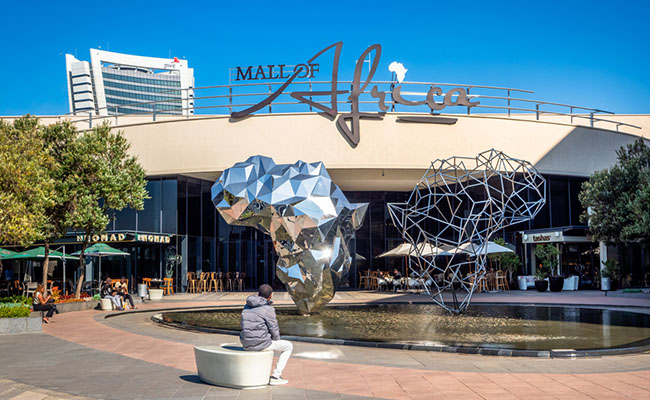
The rooftop solar programme and back-up water storage projects are the most tangible expression of this philosophy. Attacq set a 7MWp rooftop solar target, achieved it, and is still going. Total installed capacity across the portfolio now sits at just under 16MWp. At Mall of Africa, the upgraded total of 6,086kWp installed capacity covers about 13% of the mall’s total energy requirements. At Garden Route Mall that figure is 24%, and at MooiRivier Mall it is 26%. Collectively, these systems produce 18,500,000-million kWh per annum.
These are not marginal offsets designed to satisfy a sustainability report. They are real reductions in grid dependency for assets that trade seven days a week, year-round, at significant scale. The consequence: the combined scope emissions or total greenhouse gas (GHG) footprint reduced by 3.5% (from 175 tCO2e in FY24 to 181 tCO2e in FY25), a consistent, compounding decline that reflects genuine operational change rather than accounting adjustment.
Load-shedding absorbed management attention and investor anxiety for the better part of five years. Water is its structural successor: slower in its progression, less visible in its daily disruption, and arguably more difficult to resolve at a systemic level. Attacq assessed this risk early and invested accordingly.
Most buildings in the Attacq portfolio now operate independently from municipal water supply for a minimum of two days. Five new back-up water installations were completed in FY25, bringing total storage capacity to 9,311 kilolitres, more than double the prior year’s figure. Every property feeds into Attacq’s SUH platform, a live digital dashboard that monitors utility meter data and in this instance water consumption, as it identifies leaks in real time. New developments at Waterfall City Junction are being designed with rainwater harvesting and on-site back-up storage as standard components of the brief, not as value-adds appended at the end of the design process.
This approach to water resilience is not reactive risk management. It is the kind of long-cycle infrastructure thinking that separates developers who will remain relevant through the next decade of municipal strain from those who will spend it managing crises.
A global first, built in South Africa
For decision-makers who track what genuine sustainability leadership looks like, FY25 produced one landmark result that warrants close attention: Mall of Africa became the first shopping centre in South Africa, and the largest retail real estate asset anywhere in the world, to achieve EDGE Advanced certification, the highest tier of the International Finance Corporation’s resource-efficiency standard. A super-regional mall receiving more than 43-million shoppers annually now holds a global certification that no other shopping centre on earth has achieved at that scale, which is a structural competitive differentiator for Attacq.
Equally instructive is what Attacq chose to do with its own head office. Nexus Waterfall holds South Africa’s first Net Zero Carbon Level 1 certification by the Green Building Council of South Africa. When a company builds its own workspace to the highest available standard, the signal is unambiguous: the commitment is institutional, not performative.
Across the broader portfolio, 20 buildings in Waterfall City hold green certifications and 39 properties have obtained Energy Performance Certificates covering 578,750m2 of gross lettable area. For institutional investors running capital against ESG mandates, and for South Africa’s largest pension funds and asset managers, this portfolio profile matters. Attacq has consistently outperformed global sub-sector and industry averages in FTSE Russell ESG ratings. In a market where ESG credentials determine whether an asset appears on a shortlist at all, that consistency translates directly into cost of capital.
What Waterfall City Junction signals
The clearest indication of where Attacq’s sustainability thinking now sits within the organisation is Waterfall City Junction, the large-scale logistics precinct taking shape north of Joburg. Rooftop solar, smart metering, rainwater harvesting, and building certification standards and principles are not being layered onto this development after the design is settled. They are in the brief from day one.
That is the signal sophisticated investors should read carefully. When sustainability disciplines are embedded at the inception of a new precinct rather than bolted on at the end, they reflect an institutional operating philosophy, not a reporting cycle commitment.
Attacq has spent a decade building what other large companies have been promising. The track record is independently verified, the certifications are globally recognised, and the infrastructure is in the ground, and more is going in. In the South African listed property sector, that kind of quiet conviction is rare. In the current investment environment, it is exactly what long-term capital is looking for.
Sign up to Currency’s weekly newsletters to receive your own bulletin of weekday news and weekend treats. Register here.