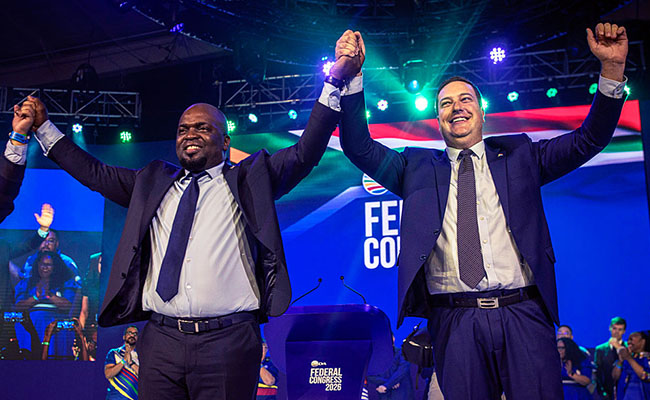


South Africa, weighed down for three decades by political dysfunction, is about to enter a new era of contestation as the DA renews itself with a young, diverse leadership.
In the words of newly elected DA leader Geordin Hill-Lewis: “Our ambition must be to lead the national government. That is the next chapter in our party’s proud history.”
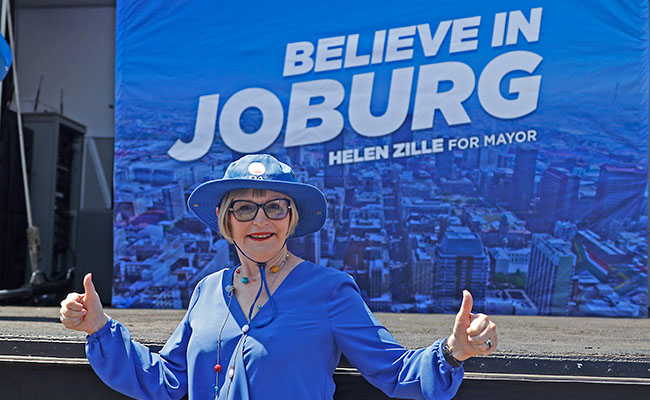
The first test of this ambitious new direction will come in the local government elections expected in November. The DA has long finalised its mayoral candidates who, like Helen Zille in Joburg, are already campaigning at full tilt, rubber duck and potholes included, while the ANC is yet to make up its mind as key regions such as Gauteng remain beset by factionalism.
The DA congress in Midrand last weekend marked a turning point for the opposition and possibly for the country, signalling that the centre is holding and that a new politics, which prizes clean governance and technocratic skill, is taking root.
Fading moral authority
In the 30 years from 1994 to 2024, South Africa’s political game was a simple one. Apartheid was defeated, and a liberal democratic constitution was introduced. The National Party, which had ruled for just over four decades, was replaced by the ANC liberation movement that had led the struggle against apartheid. It famously promised, in the words of Jacob Zuma in 2004, to govern “until Jesus comes”.
Following his ignominious presidency, which plunged the country into state capture, Zuma has left the ANC and is now, presumably, on his knees praying for the rapture.
The ANC won successive elections, promoting itself as the only party capable of bringing about a new post-apartheid order. But its moral authority began to fade as it dawned on voters that a small elite – estimated to be 100 or fewer individuals, according to political scientist William Gumede – were being rapidly enriched while unemployment, crime and corruption were the experiences of most.
What was absent was that critical ingredient that makes democracy work: strong political competition. Without the hot breath of a competitor on their necks, politicians will revert to type and game the system for the advantage of themselves and their cronies.
Embracing the centre
Zuma took this all the way, openly seeking to turn the state into a money-printing apparatus for himself and his cronies. The result was that the ANC saw its electoral fortunes in sharp decline, and it had no choice but to dump him and look around for someone more electable. This first sign of political competition working was welcome even if it did come some two decades after democracy was ushered in.
But, after Cyril Ramaphosa saved its blushes in 2019, the ANC was unable to escape the suspicion that it was continuing with state capture by other means, and its support continued sliding. In 2024, it fell below 50%, leading to the government of national unity (GNU) in which the DA – the only major party to gain votes – was the major partner.
Since then, South Africa has been on a remarkable journey. While the rest of the world has been riven by populism and the rise of extremists, South Africa has embraced the centre, somewhat murkily located between the DA and those inside the ANC who favour economic reform.
The turning point was the decision by the DA not to buy into the ANC’s 2025 budget, which sought to raise VAT to fund greater consumption expenditure on civil servants. The DA drew a line in the sand and, after a painful period of finger-pointing and wagging, it got its way.
New blood
There are of course, pitfalls, not least those that derive from the ANC’s internal chaos. While Ramaphosa has testily embraced the GNU, he has permitted populists such as Gauteng’s Panyaza Lesufi to chart their own way. Most recently, Lesufi appointed an EFF luminary with a dodgy record as finance MEC, setting the stage for a new round of questionable spending.
The DA also has little say over portfolios that the ANC regards as “key”, such as international relations, where it cultivates autocrats and disdains democracies, presumably in exchange for party benefits, and security, where a nest of competing criminal networks seems to flourish because of their links to one or another ANC schlenterer.
But, given the course the country was on under unilateral ANC rule, the GNU nonetheless represents a substantial improvement.
Voters favour the GNU in surveys, and the DA is routinely polling at 10% more than it achieved in the last election, raising the tantalising prospect of it becoming the largest party in 2029, an event which would signal the country’s political maturity.
With its track record of governance in the Western Cape and Cape Town, which has seen even the ANC’s champagne socialists packing their bags for Fish Hoek, where there is water, electricity and roads that are navigable in a Fiat 500 cabriolet, the DA is well positioned.
At its congress, it took another big step by choosing a slate of young leaders to its top six positions – average age 39 years old – instantly making the ANC look geriatric with a top seven that is, on average, 22 years older.
This and the party’s growing diversity finding its way to the party’s top structures augur well as the local government elections loom.
Steenhuisen’s legacy
And then there is 2029. By then, the ANC will have bade farewell to Ramaphosa, who ends his second term as leader in December 2027, and appears unable to choose a successor, with candidates including the clownish Fikile Mbalula and the Deputy President Paul Mashitile, who vacillates between pragmatism and populism. Neither inspires confidence.
In the wings is Patrice Motsepe. Leaving aside whether or not Chiefs and Pirates fans can stomach Sundowns winning the presidency, Motsepe has a long and difficult road to the top job. He may entrench the notion that the party is one of rich elites, a message that is playing rather badly at present.
John Steenhuisen’s legacy was not only to propel the DA into government, but to put the party in a position such that both good governance and South Africa’s prosperity now depend on the DA’s participation in government.
For now, Hill-Lewis and his revitalised leadership core have the momentum and the youthful energy to turn politics upside down. This will require not only positioning the DA at the centre of South African politics, but putting people first. It is Hill-Lewis’s job to convert this fresh promise into a permanent reality.
Ray Hartley and Greg Mills are with the Platform for African Democrats.
ALSO READ:
- The DA just got much younger. The ANC should worry
- PODCAST: Can the DA be South Africa’s largest party?
- Real Politics: The ANC rebels out to kill the GNU
Top image: New DA federal chair Solly Msimanga and DA federal leader Geordin Hill-Lewis at the DA federal congress on April 12. Picture: Per-Anders Pettersson/Getty Images.
Sign up to Currency’s weekly newsletters to receive your own bulletin of weekday news and weekend treats. Register here.