
Engagements are often filled with excitement, wedding plans and big dreams for the future. But for many couples, one of the most important conversations is also the easiest to avoid: money.
That omission is not trivial. Divorce data in South Africa points to a growing strain on marriages. Stats SA reports that more than 22,000 divorces were granted in 2023, rising to more than 24,000 in 2024 – an increase of nearly 9% in a single year. Almost 42% of those 2024 divorces involved marriages that had lasted less than a decade. That suggests that many relationships unravel before financial foundations are firmly in place. In 57% of those cases, it was the wife who filed.
Stats SA does not assign percentages to the causes of divorce. But the financial context in which these relationships operate is becoming harder to ignore, with data from the South African Reserve Bank showing that household debt accounts for nearly 62% of disposable income.
Fidelity Investments’ 2024 Couples & Money Study, the most recent of its biennial surveys, found that 45% of partners argue about money at least occasionally, and more than one in four identify it as their greatest relationship challenge. A 2023 study by researchers at Carleton University in Canada, published in the Journal of Social and Personal Relationships, identified eight recurring themes in couples’ financial conflicts – from unfair contributions to perceived irresponsibility – and found that the issue is rarely the money itself.
A separate longitudinal study of married women, published in 2012, found that those who argued “often” about money were nearly three times more likely to divorce than those who did so only sometimes or hardly ever. The link held even when considering income, debt and assets.
The importance of interpretation
What sets money fights apart, the research consistently shows, is not how often they happen – couples typically argue more about chores, in-laws or personal habits – but how they unfold. Money disputes last longer, escalate faster and are resolved more poorly than other conflicts.
In practice, this often surfaces long before a couple realises there is a problem. I recently worked with a couple preparing to get married who were beginning to combine their financial lives. On paper, they were well-positioned – stable incomes, manageable debt and shared long-term ambitions. But beneath that, their financial habits were pulling in different directions. One partner prioritised structure and long-term security; the other valued flexibility and the ability to spend more freely. Neither approach was wrong, but without a shared framework, both felt uneasy – one about stability, the other about being judged.
What we worked towards was not a compromise but a structure. The disciplined partner kept saving and investing on a fixed schedule; the other retained discretionary spending without having to justify it. Neither felt restricted nor judged.
The underlying issue is not income – it is interpretation. Money carries emotional meaning: security, independence, identity. When those meanings are left unspoken, financial decisions become proxies for deeper concerns.
Alignment and intention
Couples who make financial decisions together tend to experience fewer financial problems, reinforcing that alignment matters more than the structure itself. The implication is straightforward: there is no universally “correct” way to manage money as a couple – only a way that is mutually understood and intentionally chosen.
The starting point is not spreadsheets or budgets, but conversation. That means full transparency around income, debt, assets and obligations. It also means a deeper discussion of attitudes to risk, spending and long-term priorities.
From there, practical decisions become easier.
Couples should define shared financial goals – whether buying a home, building an emergency fund, or planning for children – and attach realistic timelines and costs. They should agree on how expenses are split, whether equally or proportionally to income, and create a structure that balances joint responsibility with individual autonomy. Formal decisions, such as marital regimes or antenuptial contracts, should be approached not as legal technicalities but as financial guardrails that protect both parties.
Just as importantly, financial arrangements should be revisited regularly. Financial plans are not static; they need to evolve alongside careers, economic conditions and family circumstances. Regular check-ins create space to adjust before small misalignments become entrenched problems.
The long view
Couples who engage openly with their finances tend to build trust – and trust is the foundation of financial resilience. It enables better decision-making under pressure and reduces the likelihood that setbacks become sources of blame.
When people feel judged, they shut down. But when the conversation shifts to curiosity and partnership, couples start seeing money as something they can work on together, rather than something that divides them.
For couples preparing for marriage, the advice is simple but often overlooked: start these conversations early. Working with a certified financial planner can help by providing structure and objectivity.
Too often, couples invest heavily in planning a single day, while neglecting the decades that follow. The data is unequivocal: avoiding financial conversations does not eliminate conflict – it compounds it.
Shaun Chennells is a financial planning professional at BDO Wealth, based in Pretoria. He holds qualifications in investment management and financial planning, including a BCom honours in investment management, a postgraduate diploma in financial planning, and the CFP designation.
ALSO READ:
- Divorce: The costliest mistakes made in battle
- Retirement dreams, real numbers: Are you truly prepared?
- Start investing before you’re ready
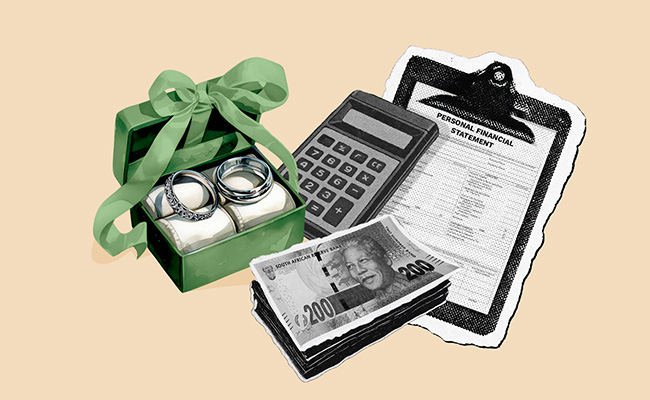
Top image: Rawpixel/Currency collage.
Sign up to Currency’s weekly newsletters to receive your own bulletin of weekday news and weekend treats. Register here.