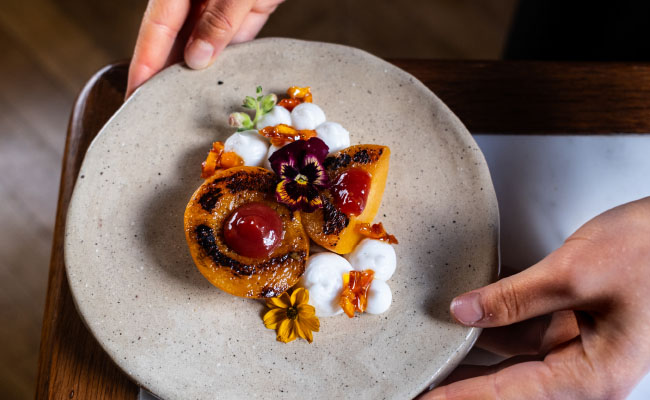

Growing food is an act of magic. From seed to fruit to harvest, each moment is exponential. Serving food is an act of love. From farm to production to restaurant, the energy of a team becomes more than the sum of its parts. Sustainability keeps the magic going. And for that you need good soil, which is not a given in Khayelitsha.
From farm
I’m with Janus Schoeman, Josh Cawood and Sarchen Gainsford driving through residential Khayelitsha, past stores and containers, dogs and donkey carts. Left, left, and a right onto a flat expanse of land. More sand, so much scrubby grass. Then suddenly a farm, rows of vegetables stretching beneath green shade-cloth that ripples in the wind.
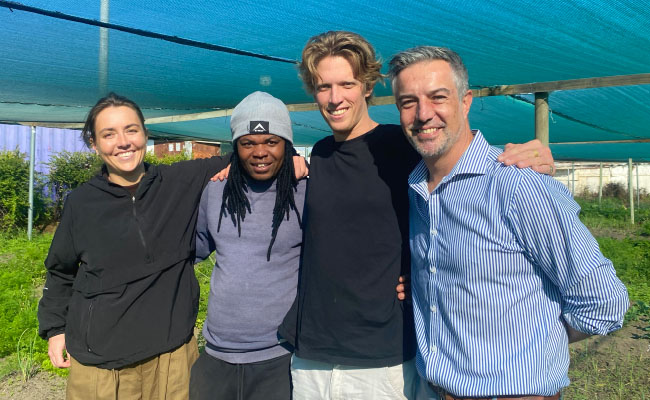
Set up in 2014, Moya we Khaya is a community farm that focuses on sustainable soil, biodiversity and regenerative farming. But, as Cawood points out, in order for this to truly work it needs “cash flow and consistent purchase”.
Cawood is floppy-haired, bright-eyed. After studying and some work experience, he managed to sell an e-commerce-based app. “It bought me a little bit of freedom. I had some trajectory and figured, well, the thing I don’t know how to do is grow my own food.”
So, as one does if one is so inclined, he joined a small-scale farm in Noordhoek. At the time it was managed by Abraham (AB) Mutsambiri. Friends Cawood, Gainsford and Mutsambiri met Tobias Alter, owner of the very gorgeous boutique hotel Gorgeous George, and the kernel of a true farm-to-table restaurant developed. That was the start of the Tambourine restaurant idea.
Cawood is now the COO of Planteam Resi, which operates the hotel, the restaurant and guesthouse Harpers House. Gainsford is creative director, bringing big ad agency experience, translating her skills into something with meaning, while Mutsambiri has become a certified permaculture expert employed to lead the integration between farm and fork. As Gainsford says, it was “simply a story of the right people meeting at the right time”.
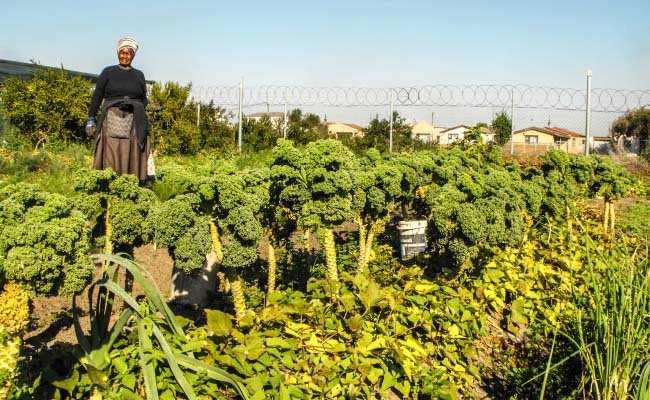
At the farm, Christina Kaba runs a team of retired schoolteachers. The plan is also for the elders to transfer skills – more magic – teaching permaculture to younger farmers. But the African Dream is harder in reality (yes, those are capitals, more on that later).
They’ve just finished hosting their first round of a subsidised youth development programme but the “brutal reality of farming is that it requires attention. It requires nurturing. It requires showing up daily. And we live in this fast-paced ecosystem where people are constantly chasing immediate gratification, which is everything that agriculture is not,” Cawood says. Going forward, the learnings have been integrated, with a smart pivot for the next iteration.
Sustainable food production is notoriously unpredictable. Initially this led to a lack of consistency for both the farmers’ income and the kitchen’s turnover. (You can see this in the earlier restaurant reviews, with scores changing on a weekly basis.) True to their commitment, the team did not fall back. Schoeman, the newly hired general manager has a background in sustainable hospitality: “The farm is the reason,” he says.
The group becomes embedded, absorbing risks while also reaping benefits. “In many ways,” Cawood adds, “we’re fortunate that the owner of the business cares about the purpose behind the work.”
To table
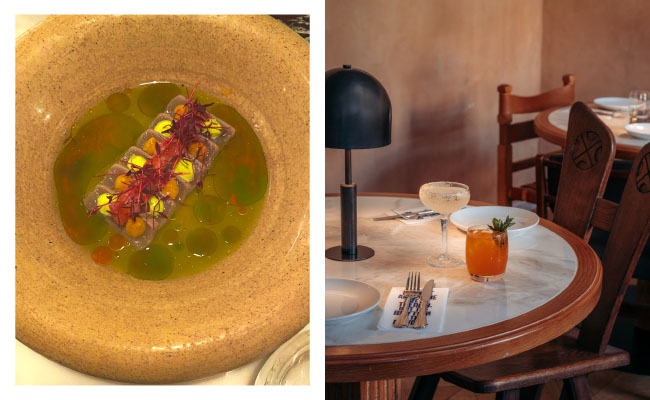
That Tambourine, or Tambo as it’s affectionally known, is part of the Gorgeous George group is obvious when you walk through the velvet curtain: Alter and his team do sublime interiors. The building is an old parsonage, exposed ochre bricks and gorgeous mismatched wooden chairs, a playlist of mixed beats and chilled tunes. This is a room you want to sit in, a house you want to visit.
The ceviche was standout: dashes of peppery nasturtium oil and the addition of a carrot atchar purée, served with handmade potato crisps, wrinkled and salty. From our farm visit, I know the nasturtiums grow abundantly while also functioning as pest control; and the carrot atchar comes from a small batch of carrots that weren’t sweet enough on their own, but worked perfectly when pickled and given the tangy sour flavour South Africans love so much.
At just 25, chef Mthobisi Lubisi joins a team rooting for success – and brings with him the same commitment and warm energy. Originally from Mozambique, he had a revelation as a teenager while working at a KFC: say no to hot oil and fast food; say yes to fine dining. So he attended the International Hotel School, followed by the obligatory stint at wine farms and high-end Cape restaurants, as well as a year at Upper Union that’s apparent in some expert sauces and inspired garnishes.
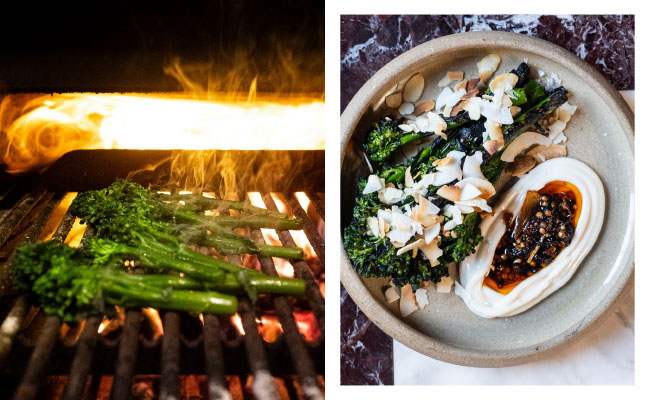
Tambourine’s Resonance menu sits at R550 for five courses (that’s nine plates) and so it’s great for South Africans looking for a special occasion. But I’d suggest Tambourine is best as a regular outing: the cocktails are well priced – try the soetbloed – the wine list is excellent (I had a glass of Scions of Sinai Atlantikas Pinotage that tasted light and wild), and the small plates change – ahem – with the weather. There’s a sublime steak with tallow and chimichurri that’s fired tableside with a blow torch, a burrata with a tomato jam (or relish, depending), and the bread course still has me wondering (how so soft, how so buttery?).
Our dinner ended with a sipping rum: deceptively clean, followed by a zing of zesty aromatics and a small, rather pleasant, dizzy spell. It’s a good overview: what appears on the surface belies the depth of flavour – and lasts longer.
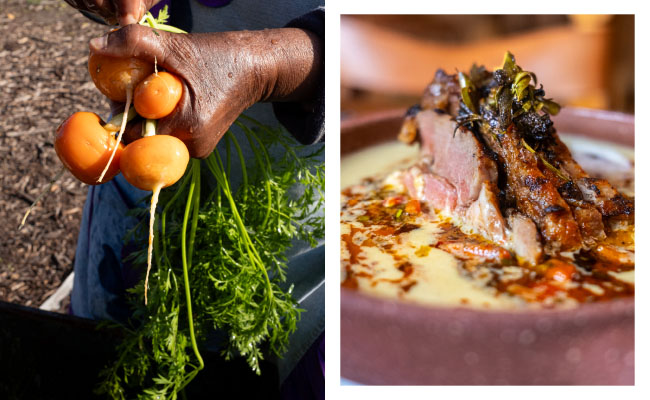
I don’t often say this, but you’re going for more than the food. It’s the taste of being part of something: the culture of labour, the effort that goes into your dish, grows beyond flavour. It feels good. At the restaurant it’s notable in the attentive service. It’s genuinely welcoming, probably because the staff know there’s a career path here, a clear system designed to advance each employee’s potential.
Schoeman says when we work this way “everyone gets uplifted. It’s everything combined. And to get vegetables like this, for a tourist, [it’s] absolutely insane, and knowing that what you’re spending is going to a good cause.”
And back again
Speaking of, while at the farm, examining bushes of bright chillis ready for bottling, an unrelated group arrive in a tour bus. As Capetonians, it’s always a bit bizarre, this overlap of living in a city, while presenting ourselves: see us doing good, see us trying. Plastic garden chairs were arranged in a circle. The convenor beckoned Cawood and Mutsambiri over, handed them the mic, made them talk about plans for the future. There’s Mpho Tutu (yes, the late Arch’s daughter) holding a board of the building plans for a market and co-op; everyone is nodding, yes yes.
Then Vicky Sampson is pushing aside her chair to stand alongside the crates of fresh veg headed for the restaurant and she’s singing My African Dream. I’m going to be honest and tell you she was off key. But even that brings a tear to my eye, the dream indeed, in all our hope, that there’s a new tomorrow.
ALSO READ:
- From flat whites to fashion: inside the Marc’s by Marc Jacobs café
- Sealand: gold standard for green business?
- Pantry vs Relish vs Zuney: Joburg’s burger triangle, ranked
Images: supplied.
Sign up to Currency’s weekly newsletters to receive your own bulletin of weekday news and weekend treats. Register here.