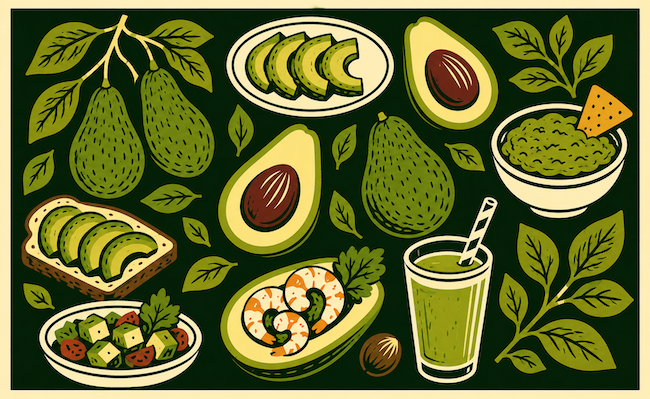

The Aztecs gave the avocado its Nahuatl name, ahuacatl, a word that also served as a euphemism for testicle, owing to the fruit’s paired hanging habit, thus providing all the evidence we didn’t need that schoolboy humour has always been with us.
Happily, civilization staggered on, and adherents of this buttery superfood (actually known as “butter fruit” in India and Hong Kong) found more dignified uses for it than giggling at its ancient name. Across the world it has been mashed, sliced, sweetened, salted, blended, Instagrammed, and its pit, impaled by toothpicks, has been suspended over glasses of water by people briefly convinced they are about to own an orchard.
The real drama of the avocado, however, is not its anatomy but its shelf-life. Like pears, the brief window of avocado ripeness can cause considerable emotional stress. Finding one at its peak feels like winning a small domestic lottery, while finding six perfect ones on the same morning is less a blessing than an administrative emergency.
If it is, in fact, possible to have “too many” ripe avocados, guacamole is not the only solution, though it is most assuredly a contender for top spot in comfort eating when a Santa Ana tortilla chip is the vehicle used to scoop it into your mouth. The former New York Times restaurant critic Frank Bruni agrees: “I suppose there are people who can pass up guacamole, but they’re either allergic to avocado or too joyless to live.”
Origins of a food deity
Native to Mexico, the avo grows in most Mediterranean and sub-tropical climates. More than 500 varieties are in the record books with Hass (rightly) holding the title of most popular, with its dark green wood-chip skin, satisfying 80% of the world’s appetite for avocados. Mr Hass was a postal worker with a garden. Imagine what his patent has earned his descendants. The Maluma hails from South Africa; it’s a relatively new species, of unknown parentage, discovered in the early 1990s by farmer Dries Joubert. Fingers crossed for Joubert’s family fortune.
Estimates suggest the global market is currently growing at a compound annual growth rate of 7.4%, to reach $26bn by 2030. Some TikTok influencer with perfect nails and a ring light is probably responsible. I mean, there is an emoji 🥑 in my phone! I’m guessing this should not be confused with the Mayan glyph representing the 14th solar month in their agricultural calendar.
Avocados have other uses than garnish for your poke bowl. Their leaves have been used as trad meds for centuries throughout Central and South America to treat everything from respiratory issues to kidney stones. The leaves possess a higher concentration of powerful antioxidants than the actual fruit flesh, itself providing more protein and potassium than bananas. Mexican recipes often call for using certain avocado leaves in a braise or stew (toast them first over a bare fire). The authors helpfully suggest that those of us who don’t have avocado trees may use bay leaves instead, since they are cousins in the same laurel family.
Maya and Aztec women used mashed avocado as a natural hair conditioner and skin moisturiser. Colonising Spanish barbers eagerly expanded its application to hair tonics and shaving cream. Today, companies are turning the pits into the eco-friendly straws and cutlery handed out with your takeaways, biodegradable in less than a year.
To conclude our fun-facts section, you must know that in botanist circles, a debate is, well, not exactly raging, but finding its way into academic discussions over whether the so-called Prehistoric Ghost Fruit is an evolutionary oddity. A whole book comprising 304 pages (!) has been published about its requirement for megafaunal dispersal – ground sloths, early ancestors of the elephant, and the like – to eat the fruit and excrete its large pit whole to spread propagation. When the animals (and the avocado) faced extinction, some clever humans stepped in to cultivate the fruit after this very Big Game disappeared some 13,000 years ago.
Avocados, surprising and sweet
The oldest known English recipe, from 1697, was for an avocado dish from the Caribbean that mixed its flesh, lime juice, sugar and a pinch of salt together, spread over hot roasted plantains.
Vietnam and Indonesia also treat avocados as a dessert. In Hanoi cooks blend ripe avos with sweetened condensed milk, ice and coconut milk. In Jakarta, you’ll find an avocado shake with thick chocolate syrup swirling about, often kicked up a notch with a shot of espresso. Brazilians enjoy the flesh with lime juice, sugar and milk for a chilled pudding. A trade staple now in Ethiopia and Kenya, you may find “spirit juice” on chic Nairobi menus – a layered drink made of thick unblended purées of avocado flesh, mango and papaya.
While it may sound somewhat unusual to pair avocado with sweet tastes, one food writer remarked that tasting avocado with honey for the first time is like revisiting a house you lived in decades ago – at once familiar and unnervingly not so. On point, Guardian writer Meera Sodha has developed an avocado and honey lassi with cinnamon for two: blend the flesh of an avocado with 200ml thick yogurt and 300ml full-cream milk, 4 Tbsp runny honey, 2 tsp cinnamon, 1 Tbsp rosewater. And vegans have been in on the secret for a while as exemplified by this recipe for a duvet of a pudding made with peanut butter, chocolate and avocado.
Whether you slice it onto a BLT, roll it up into maki or California rolls, cube it with tacos, shakshuka, Turkish eggs or Cowboy Caviar, you’ll agree that it is not difficult to use up an avocado, or 20.
Turn the halves into “boats” for the classic prawn cocktail, tuna salad or servings of the Smitten Kitchen’s “obsessively good avocado cucumber salad”.
Let the green enhance the black using an avocado garnish for a rich black-bean soup; smother sweetcorn fritters with an avocado “crema”; or toss curly kale pulled from a frosted ground when it’s at its sweetest with a Green Goddess dressing – whisk ¾ c mayo with ¼ c sour cream and 1 Tbsp lemon juice. Mash an avo until smooth, stir in with ¼ c snipped chives, 2 Tbsp parsley and 1 Tbsp fresh tarragon. You can, of course, as I certainly would, add five to six mashed anchovy fillets.
The other salads in which avocados are indispensable include the Cobb salad and one of baby spinach, halved strawberries, toasted pecan nuts, feta and avos, with a slightly-sweet vinaigrette. Poppy seeds are optional.
The retro giant
Millennial and Gen-whatever Instagrammers and the above-mentioned influencer posting on #avocadoTok should take note: avocado toast was not invented in the 21st century at their local brunch spot. A century ago, Art Deco hostesses were toasting white bread, removing the crusts, halving the squares into triangles, glazing them along their hypotenuses with mayonnaise and spreading them with smoothly mixed avocado, an acid, salt and a little cayenne pepper. Sourdough may have replaced the white bread, but carry on. And don’t forget to sprinkle with gently roasted pine nuts.
No self-respecting writer of things avocado can possibly neglect to mention the 1960s and 70s craze for avocado-coloured kitchen appliances. This manic pixie hallucinogenic decorating dream spilled over into the food served with the batch-mixed martinis washing it all down.
Consider the unhinged creations of hostesses wearing arms-race rocket-nose-shaped bras possessing gelatine moulds, mayonnaise, and a desire to outdo each other in the realm of these lawless concoctions. I’ll give you Exhibit A from none other than First Lady Pat Nixon: dissolve lime- or lemon-flavoured powdered jelly in hot water. Stir in mashed avocados, canned (canned!) grapefruit slices, and finely minced celery. Pour into a ring mould and chill until it firmly jiggles. Once unmoulded, fill the centre with a mixture of whipped cream and mayonnaise. One reviewer noted that biting into the hidden celery felt like crunching into the “exoskeleton of an insect” amid the limey avocado mush.
We cannot end on this revolting note, and so on the other end of the civilisation scale, I bring you a lightly-edited extract from MFK Fisher’s Serve it Forth, in an essay called “On Dining Alone”.
An old man … at a quiet corner table … was dressed carefully in rather old-fashioned dinner clothes, with his feet in tiny twinkling pumps, like a doll’s.
An avocado was brought to him, cradled in a napkin. He felt of it delicately, smelled it, usually nodded yes. It was cut in two with a silver knife. Then he himself detached the stone-skin from each half, placed one part of the fruit gently on a large plate before him, and sent the other back to the kitchen.
Powdered sugar was brought, and the old man pressed it into the hollow of the fruit. He spent some time over this, making it firm and even.
Next the sommelier appeared a bottle of clear Russian kümmel. He poured a generous liqueur glass of it, waited for the old man’s sniff of approval, and went away.
Drop by drop the kümmel disappeared into the moon of white sugar, very slowly, very patiently. Very delicately it was stirred and pressed down and stirred again.
Finally the old man ate a small spoonful of the smooth green fruit flesh, then another. Sometimes he stopped, sometimes he finished it. Then he drank a mouthful of coffee and left.
And there, mercifully, the avocado is restored to dignity: no ring mould, no mayonnaise, no influencers; just a quiet old man, a silver knife, and the sort of dessert that makes even guacamole seem almost vulgar.
ALSO READ:
- From flat whites to fashion: inside the Marc’s by Marc Jacobs café
- The key ingredient: apples
- Fehmz and the making of a damn good bestseller
Top image: Currency.
Sign up to Currency’s weekly newsletters to receive your own bulletin of weekday news and weekend treats. Register here.