
Evidence from perhaps the world’s most unscientific poll (but with a sample size of several friends and the whole of the internet), concludes that there are far more celery haters than celery lovers out there.
Exhibits A, B, and C: “Celery is 95% water, 5% existential dread”. “Pale green and stringy and stubborn as an adolescent.” “I doubt celery even likes itself.”
Poor celery.
Growing up in the Mediterranean region, with wild populations in other parts of Europe, North Africa and parts of Asia, celadon-hued celery (no shared etymological root) belongs to the parsley family with four main cultivated forms: stalk (or rib, if you prefer the pedantry), leaf, root (celeriac) and seed. It hails from the botanical family Apiaceae, which also includes parsley, carrots, dill, lovage and fennel.
China grows the most, but Spain exports the most (some 82-million kilograms, according to the UN’s Food and Agricultural Organisation). South Africa is a blip on the crop-report statistics, but a KZN agriculture guide helpfully notes the hyper-fragile shipping truth of celery. It can be difficult to stop the stalks wilting into botanical despair.
Celery as symbol
Wild celery was grazed by the horses of the Myrmidons in Homer’s Iliad in the marshes of Troy and has the rare virtue of symbolising both death and victory – a funerary garland in Ancient Egypt and in Greece, where “to need celery” meant someone was close to death, and instead of the brand endorsements of today, winners at the games were offered celery wreaths. Short-changed, you might say.
During the Victorian era in the UK, celery moved from funeral plant to status symbol. Because it was difficult to grow and obtain, wealthy household displayed it in special glass or ceramic celery vases. In New York’s Gilded Age, it was the third-most expensive item on fashionable menus, surpassing even caviar. The world’s only celery soda, Dr Brown’s Cel-Ray, began life in that city at the same time, as a celery tonic.
The more witchy properties of celery in all its forms include assisting with mental clarity, protection and energy enhancement. Celery can, apparently, strengthen psychic abilities, boost stamina and maintain balance between the physical and spiritual realms. And of course, we can’t forget its aphrodisiacal properties. There. Surely that’s enough to persuade you that there are reasons to adore celery?
A culinary building block
Of course, for the astute readers who may have noted that none of the distinctions above have a thing to do with actually eating it, let me put together some ants on a log (a childhood after-school snack of celery sticks stuffed with peanut butter and dotted with raisins) and I’ll try to convince your taste buds.
As both a herb and a vegetable, celery contributes to the foundational building block of many cuisines. With onion and carrot, it is a vital addition to a classic Italian battuto and a French mirepoix; cooked until soft in olive oil, it becomes soffritto, the basis of any decent soup or stew or ragù. In New Orleans it is part of the “holy trinity”, along with onion and green pepper, and essential for a gumbo or jambalaya. Alongside red bell peppers it serves as the base for dishes in Spain and Cuba, with Puerto Rico adding garlic and fresh coriander stems.
Anything you can do to food, you can do to celery. Eat it raw or cooked; make soups, sauces, salads; the root can be boiled, mashed, shredded, roasted and steamed.
Anyone for drinks?
You can even drink it. And I’m not talking about green smoothies. If the Infinity Pool – requiring mezcal, celery bitters, Lillet Blanc and a juicer – is a little Too Much, don’t forget that one of celery’s greatest achievements is to ensure that a Bloody Mary can be described as a complete meal. Not only do your celery stir-sticks (technically more a garnish than a key ingredient) suggest that nutrition and responsible life choices matter while drinking at 11:00am, they also make excellent tools to wave about for drunken emphasis.
If you don’t like a Bloody Mary (who are you, anyway?) but still need an accessory to make your point, try using the crunchy, salty, sesame-drenched celery sticks from NYC’s Bar Goto: marinate about five stalks cut into 10cm sticks in a tablespoon each of furikake, toasted sesame seed oil, and soy sauce for at least half an hour. Sprinkle with toasted sesame seeds when you bring them to your table in their very own celery vase.
Souped-up celery
In addition to the starter veg in so many dishes, spicy and flavourful, or the catalyst for a clean-out-the-fridge soup, a good, honest, deliberate celery soup (cream of) can set a tone for a meal as clearly as the opening lines in a novel you know you will read in one go. Food writer Nigel Slater describes a good one as having the “muted tones the colour of a winter sky and a soothing ‘There, there’ quality.”
Mine: chop a whole bunch of celery, a peeled potato and an onion. Let these pals swim about in a bath of butter – about 80g – with some salt until the onion is softened and then pour over three cups of a good, rich chicken or vegetable broth. Simmer ten or 15 minutes and then blend it all up until it’s silky smooth and to each person’s bowl, add a dollop of cream or soured cream, and some dill.
Cool celery combos
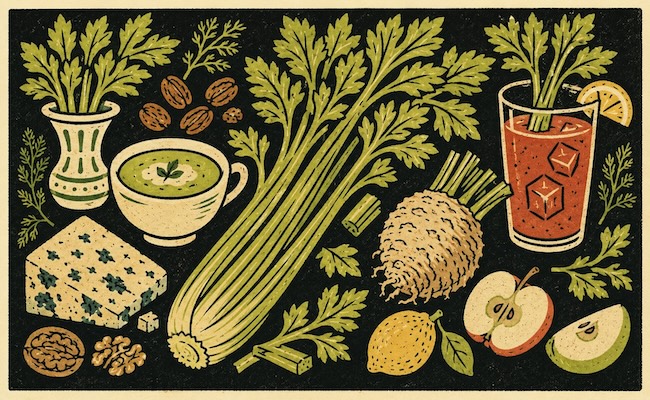
Celery’s other best pals include beef, blue cheese, apples and walnuts.
Try this for beef, which builds the basis for an excellent gravy: construct an edible celery lattice under joint as it roasts.
Fuchsia Dunlop’s Sichuanese recipe for Send-the-Rice-Down chopped celery with minced beef works with celery you’ll find in your grocer – even though Asian celery has thinner, hollow stalks and a much stronger, more pungent flavour.
Similarly in Vietnam, wok-fired black pepper beef and celery is readily available in those street stalls with the tiny child-sized plastic chairs.
And if you’re not crazy about beef, Persian cooking pairs lamb and celery in a koresh, while the Greeks and the Turks also stew celery and lamb in a lemon sauce.
Celery and blue cheese do not merely play second fiddle to Buffalo chicken wings. They make a fantastic hot-weather snack sitting next to and flirting with the stuffed eggs.
But by far the most fun you can have with celery is making your friends happy by letting it take the lead in salads, especially after meals that otherwise offer very little crunch. And who doesn’t like a food that it is claimed requires more calories to consume and digest than the stalks contain?
In case you need a recipe for Waldorf salad (on the subject of apples and walnut buddies) this one is pretty good – important, since bad ones were responsible for meltdowns in both Bret Easton Ellis’ novel American Psycho and an episode of Fawlty Towers. (For another famous hotel dish, I give you Celery Victor, named for the chef at San Francisco’s St. Francis Hotel.)
Part of my celery evangelism was developed eating the well-paired celery salads with dried fruit. And because celery is a long-life vegetable, these side dishes also hold up well for potluck lunches or dinners. Try celery salad with dates, almonds and Parmigiano Reggiano; Ottolenghi’s barley, celery and pomegranate salad from Plenty; and in Mexcla, Ixta Belfrage includes a fantastic braised celery and raisin salad. You can make a celery slaw with seeds and dates from this recipe. And Ina Garten’s celery salad, which benefits from adding some chopped fennel, reminds me of my mother’s.
If you’re still dreaming of Asia and your tiny chair, try this Asian tiger salad. Korea dresses up celery by putting a little sesame oil behind its ears in a salad and this pickled dish is often served as a banchan to accompany bulgoki or other hearty dishes.
And so to the root
While celery root (celeriac) is a distinct variety from the plant cultivated for its stalks, it is indispensable to the classic bistro fare, céleri rémoulade, and makes a wonderful mash with potatoes and an artery-slamming amount of butter (I see a pattern here). You’re welcome.
As always, the poet Ogden Nash weighs in on the subject to hand and helps us understood and appreciate the versatility of this bumptious vegetable:
Celery, raw,
develops the jaw,
but celery, stewed,
is more quietly chewed
Which is about as neat a summation as one could hope for: celery is the vegetable that can both announce itself from across the room and disappear politely. It is crunch, savour, architecture, garnish and punchline.
So give it a second look. Don’t just relegate celery to being something you gooi into your soups while pretending not to notice it. Buy the whole bunch; use the leaves; salt the stalks; braise the hearts; roast the root. Put it in your centrepiece in its own vase.
Love our Rural Cook’s take on celery? Try her on all sorts of other ingredients here.
Top image collage: Rawpixel; Currency.
Sign up to Currency’s weekly newsletters to receive your own bulletin of weekday news and weekend treats. Register here.