
If there was one way to shake up a room full of bankers, it was political analyst Prince Mashele’s declaration at the RMB Think Summit on Tuesday that the relative stability South Africa has enjoyed under the government of national unity (GNU) will probably unravel spectacularly after the ANC’s elective conference in December next year.
“There are only 1.5 years left for Ramaphosa as leader of the ANC: somebody is going to replace him [in December 2027] and I can bet he [Ramaphosa] will not read the state of nation address in 2028,” said Mashele, the director of the Centre of Politics and Research, at the gathering.
“I don’t see the GNU surviving beyond February 2028 – and the new [ANC] leader won’t come from Ramaphosa’s faction; it will be an anti-GNU leader who will align with MK and the EFF.”
Hello Paul Mashatile, in other words.
“If this scenario unfolds you have to price it in,” said Mashele. “It’s going to be populist, and its business will be to undo what the GNU has done.” Like reversing the unbundling of Eskom into three separate entities, for example. Or undoing the introduction of badly needed private partners into rail and ports operator Transnet.
Mashatile, Mashele pointed out to the increasing discomfort of the crowd, “is very close to the EFF. He would seek to reconstitute the ‘old’ ANC. That’s why Zuma has never relinquished his leadership. That’s the strategy. We must keep our eyes open.”
This, of course, would all have grave consequences for South Africa’s policy and fiscal trajectory – as well as the reforms that have been set in motion under Ramaphosa’s Operation Vulindlela programme, which has the firm backing of the DA, its biggest partner in the GNU.
The local government test
On some counts, at least, unwinding progress may be easier said than done. As panellist and political analyst Mpumelelo Mkhabela made clear, some of the key reforms implemented in the past few years have become law; in order to overturn them, opponents would have to go through parliament – a much trickier process than simply setting them aside.
Still, he warned, “there is a lot of government that is discretionary. The president has decided he will bring in informal private sector players; another president may decide he doesn’t want that structure, which could unravel even institutionalised reforms.”
If it’s any consolation, neither Mkhabela, Mashele or Sithembile Mbete, executive director of the Public Affairs Research Institute, see the GNU imploding before December 2027, though that’s not to say it won’t be tested by the local government elections in November.
Unsurprisingly, Mbete predicted “a lot more” coalition arrangements – but said that partnerships struck at local level could be vastly different across provinces, like the DA working with the IFP and ANC in KwaZulu-Natal but not in Gauteng.
The biggest problem, she said, is that the GNU has still not been able to pass a new act that would introduce a 1% electoral threshold in order to get into council. This, if passed, would limit the number of very small parties acting as kingmakers – as they have done to great and ruinous effect in the City of Joburg.
Asked by RMB chief economist Isaah Mhlanga what the biggest faultlines in the alliance are, Mkhabela suggested the issue is governance, not ideology. Between the ANC and DA, “you have two parties who want to govern and oppose at the same time”, he explained. “That difference for me is a major faultline.”
Looking ahead
The conversation also focused on what the future political landscape may look like – including the 2029 national elections. If you want to predict how those will play out, said Mkhabela, it’s worth paying close attention to who gets what in November.
By way of explanation, he pointed out that in the 2011 municipal elections the ANC’s overall support was 63.6%, while in the 2014 national poll it was 62.1%. By 2016, its share of the municipal vote had dropped to 55.6%, and it scored 57% in the 2019 national election. Two years later, its municipal tally had fallen to 47.5%, a precursor to the 40.1% it scraped in the 2024 elections.
“Now, your guess is my guess. Could it be a precursor for the 30s? That outcome tells you what will determine the permutations in the metros,” said Mkhabela.
On the more immediate horizon there’s the November poll – where Joburg is top of mind. While Mashele reckons the DA’s Helen Zille will become the metro’s new mayor, Mbete believes the mayoralty will go to a smaller party like the PA.
And if there was one thing all three agreed on it was this: Patrice Motsepe for president in 2029? Not a chance.
ALSO READ:
- Birth pains of the GNU: fears of Ramaphosa’s resignation
- Real Politics: the ANC rebels out to kill the GNU
- How Eskom and Transnet are blocking growth reforms
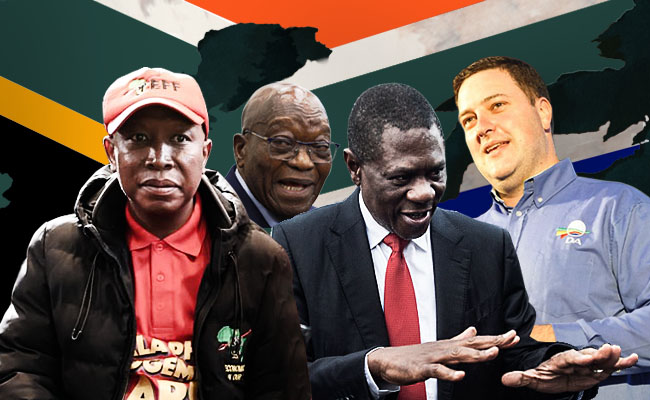
Top image collage: Luba Lesolle/Gallo Images via Getty Images (Julius Malema); Ziyaad Douglas/Gallo Images via Getty Images (Jacob Zuma); Brenton Geach/Gallo Images via Getty Images (Paul Mashatile); Laird Forbes/Gallo Images via Getty Images (Geordin Hilll-Lewis); Rawpixel; Currency.
Sign up to Currency’s weekly newsletters to receive your own bulletin of weekday news and weekend treats. Register here.