
Rumours/2026 is an exhibition that captures the creative range of the late, globally celebrated photographer Santu Mofokeng, and his role as a critical voice in Southern African history. Currently showing at the Standard Bank Art Lab in Sandton, the exhibition was put together by the bank’s curator Dr Same Mdluli, along with Lunetta Bartz, on behalf of the Santu Mofokeng Foundation.
Standard Bank held a major retrospective of the artist’s work in 2007 – a significant moment in Mofokeng’s career. Almost 20 years later, and following his death in 2020, photography has been used as a starting point to navigate Mofokeng’s life and practice as a researcher, archivist and writer. Whether or not you are familiar with his images, it offers an excellent opportunity to connect with Mofokeng’s work and his world behind and beyond the lens.
The show presents three bodies of work drawn from Mofokeng’s extended engagement with the small Vaal town of Bloemhof and its surrounding communities between 1988 and 1994. The title itself creates an internal tension for the viewer: which rumours, and who’s spreading them? As the curatorial text suggests, “it gestures toward how knowledge moves laterally, informally and often without resolution”. Mofokeng was deeply interested in the questions that exist outside the frame, encouraging viewers to search for narratives beyond the image directly in front of them.
“The exhibition brings us into proximity with the ways images live beyond their making,” says Mdluli. “The title is rooted also in how we see things as viewers, the images prompting us to look beyond, to sit and interrogate them rather than take things at face value.”
A life in images and words
Born in Joburg in 1956, Mofokeng was raised during the full turbulence of apartheid South Africa – an era in which photography itself became a political act. To that end, and through written texts spread across the walls of the Art Lab, alongside archived reports and research papers, the exhibition creates a tangible and immersive environment. Visitors are invited not only to look, but also to read, grapple with context and engage with the layered histories embedded within the work. The result is an exhibition that becomes as much an exploration of the man as it is of South African life under apartheid.
“To me, the most compelling aspect of this exhibition was the opportunity to give equal weight to Mofokeng’s writing, which so critically informed his photographic process,” says Bartz.
Some written extracts on display are painful, while others document the ordinary rhythms of everyday life in Soweto. Together, they provide insight into the emotional and social realities that informed Mofokeng’s practice. Take for example, this extract:
“My father died in 1960. I still don’t know how old he was. Angie, our last-born, died in her seventh month the same year, and grandma also. I contracted TB, as did my younger brother and older sister.”
The personal is political
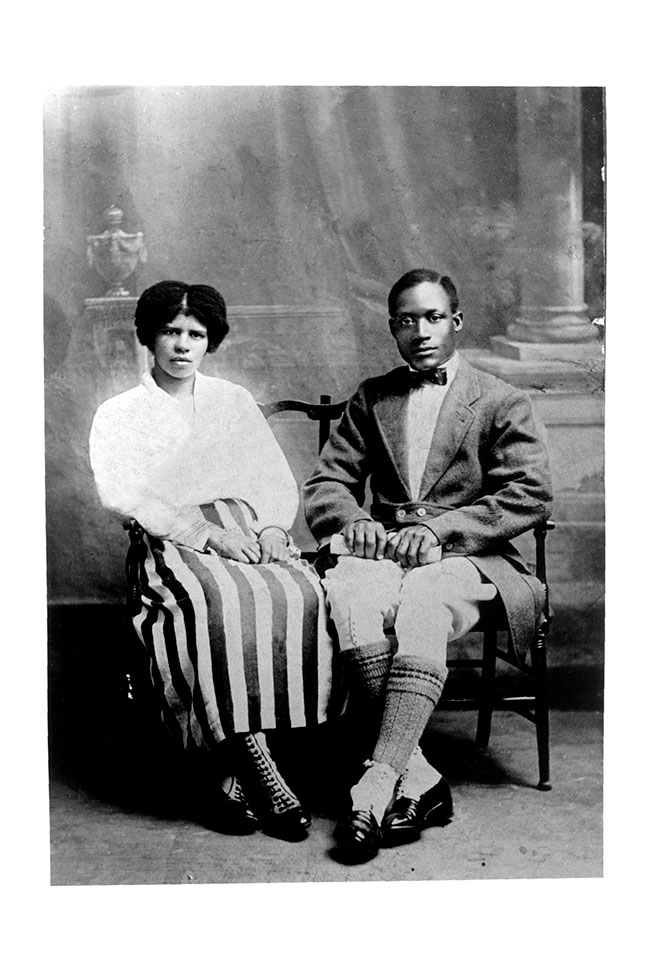
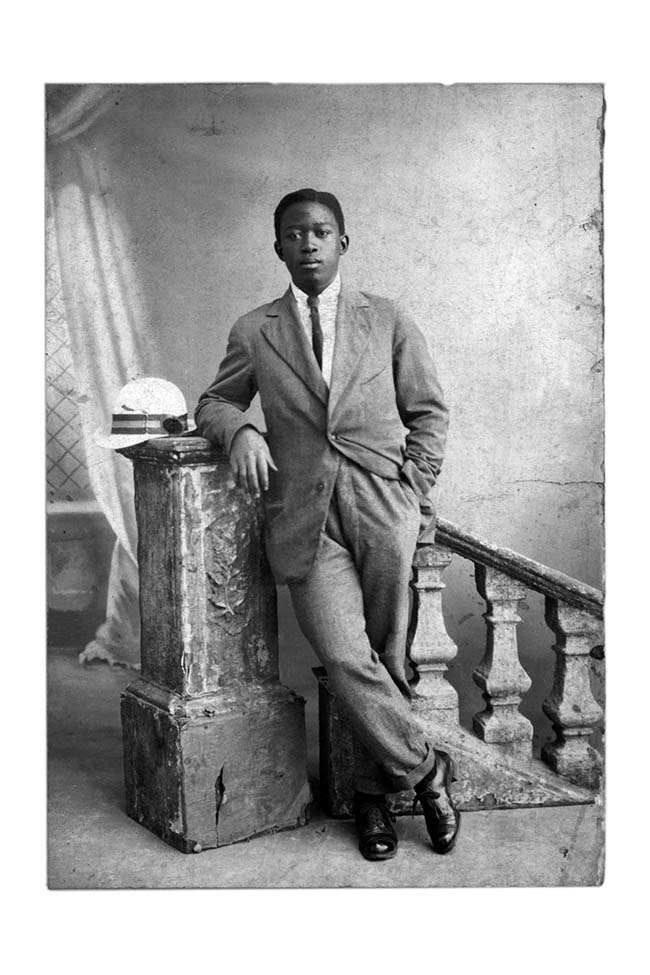
The Black Album/Look at Me: 1890-1950 is the first body of work that draws viewers into the exhibition space. The collection emerged from an ongoing research project that sought to archive commissioned studio portraits produced between 1890 and 1950. Mofokeng collected many of these photographs while working at the Institute of Advanced Social Research at Wits University.
“Though I had encountered Ntate Mofokeng’s work before, it was The Black Album that resonated with me most,” says Mdluli. “Some of us have seen these images in our own homes; there was something familiar about them. My grandmother was photographed in a similar way.”
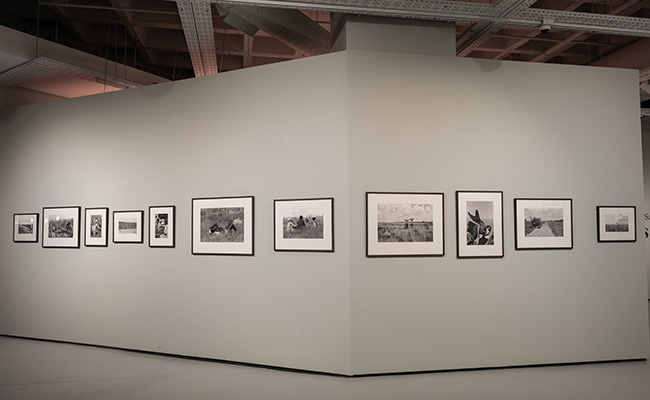
Displayed in black frames, the black-and-white portraits of working- and middle-class black families immediately draw attention to clothing, posture and composition. The assembled eras of buttoned-up shirts, double-breasted jackets and carefully constructed poses speak to dignity, aspiration and self-representation. In the introduction to the album, Mofokeng noted that these photographs were often left behind by deceased relatives, hanging quietly on parlour walls in township homes. “The images are not unique, but the individuals in them are,” he wrote.
At a time when black existence was systematically erased and reduced to a singular visual language, Mofokeng offered another perspective. Rather than claiming authorship, he reframed and preserved these intimate family archives. Images once hidden in shoeboxes beneath beds or tucked into leather albums are elevated into public memory and historical significance.
“From an artistic and creative point of view, his photographic style has been highly influential in its composition and approach to the brutality of black life in South Africa, presenting it from a black perspective with honesty and empathy,” says award-winning photographer Thero Makepe. Makepe’s own practice explores public and private archival material, including family photographs, documentary screenshots and newspaper clippings.
Where dominant narratives often centred black grief, pain and despair, Mofokeng became interested in the unspoken – the silences and emotional complexities that language itself could not fully capture, but which remained deeply understood.
Leisure and labour
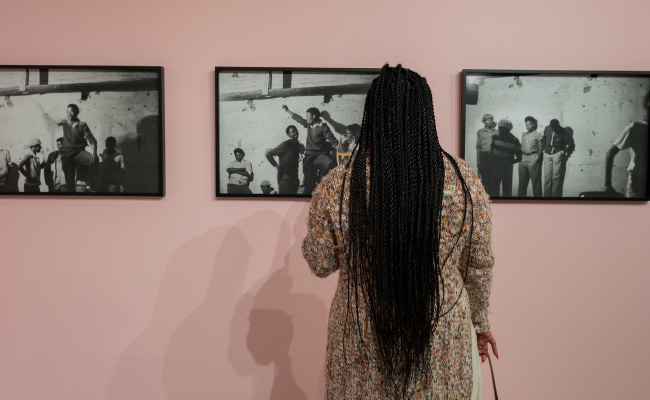
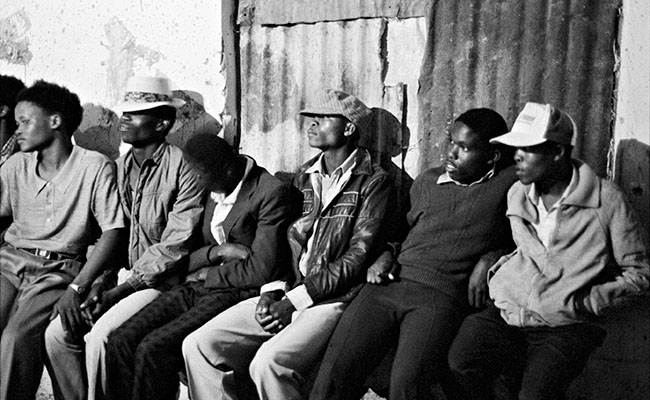
Elsewhere in the gallery, the Concert at Sewefontein collection introduces a different atmosphere entirely. The walls, painted pink, create a playful and intimate backdrop for photographs taken during a gathering of farmworkers and tenant labourers in November 1988. Here, Mofokeng captures moments of leisure, intimacy and freedom: black women and men in conversation, dancing, resting and simply being. As he wrote: “Out of the purview of employers and minders, they are free to frolic, mate and get drunk, according to their wish and inclination.”
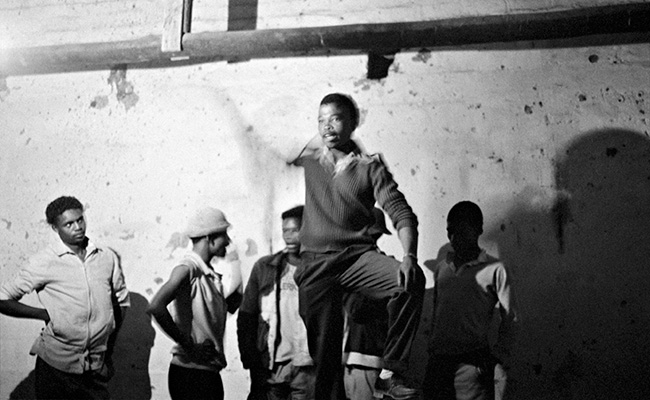
Says Makepe: “The way he organised a frame when photographing an environment from a distance was precise in some cases and elegant in others. His work in close proximity, like Train Churches and Concert at Sewefontein, was direct and emotive.”
The Labour Tenancies collection offers yet another emotional register. Close-up images of children sleeping and playing, an elderly man reading a newspaper and women resting beneath a tree evoke a deep familiarity. The photographs feel recognisable, grounded in the textures and artefacts still found in many South African homes today.
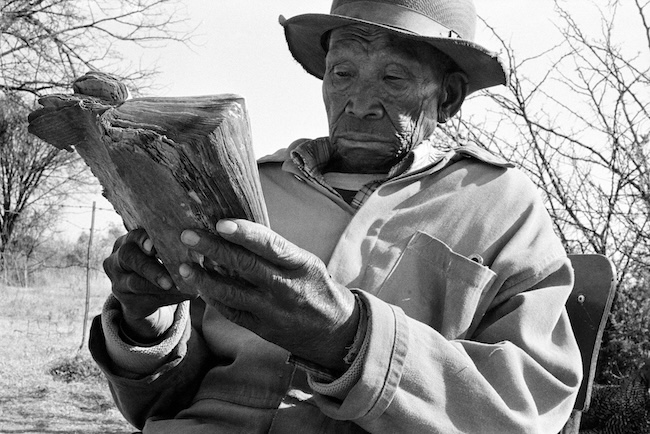
Produced during Mofokeng’s research among tenant farming communities, the collection examines black labour in the context of apartheid South Africa. Yet the images resist reducing their subjects to political symbols alone. Instead, they hold space for contradiction – intimacy and distance, tenderness and hardship, familiarity and estrangement.
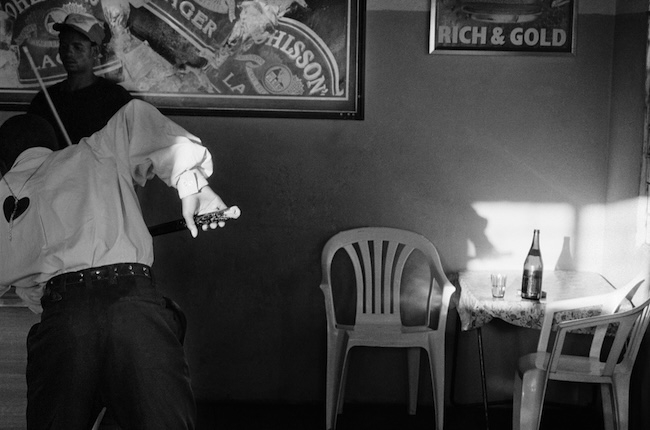
The exhibition ultimately reveals the complexity of lives shaped by apartheid but never fully defined by it. Beyond photography, Rumours/2026 becomes an archive of memory, emotion and experience, reminding viewers that images continue to speak long after the moment of their making.
‘Rumours/2026’ runs until October 18 2026, and is open to the public for free.
ALSO READ:
- We review: ‘Ernest Cole: Lost and Found’
- New exhibition celebrates 35 years of Artist Proof Studio
- Sanell Aggenbach’s beautiful, unsettling take on a fractured world
Top image: Rumours/2026 at the Standard Bank Art Lab.
Sign up to Currency’s weekly newsletters to receive your own bulletin of weekday news and weekend treats. Register here.