
The Freedom Front Plus has discovered an unexpected political asset in Pieter Groenewald – black admiration for his performance as minister of correctional services has given the party attention it could never buy.
Yet, it remains unclear whether a meme doing the rounds with the phrase “nangu umlungu”, which means, “here comes the white man”, is the start of a multiracial political realignment or simply a social-media protest against the ANC.
Groenewald has done what no Freedom Front Plus campaign has managed in three decades: he has made some black South Africans curious about an Afrikaner party.
His growing popularity reflects a frustrated voter, tired of excuses and maladministration, who cares less about a leader’s race than whether the job gets done. Failures have long been blamed on apartheid, budget shortfalls or hostile courts – explanations with some truth, but none that fix a pothole or stop public money from being stolen.
Groenewald’s appeal comes from his forthrightness. He identifies a problem, tells the public what is wrong and explains what he is doing about it. The prison bread scandal is a case in point.
According to Groenewald, correctional services was paying as much as R24.50 per loaf of bread from a contractor that did not own a bakery – it allegedly subcontracted the baking at R15 a loaf and pocketed roughly R1m a month. The Freedom Front Plus leader stopped the arrangement and offenders now bake bread in prison at a reported R8 a loaf.
The department runs 12 bakeries, with another planned, and says it is nearing 97% self-sufficiency in bread. Its agriculture, manufacturing and food-production programmes reportedly saved more than R200m last year. Consultant spending fell from a projected R119.3m in 2024/25 to R29.2m in 2025/26; future appointments will need Groenewald’s direct approval.
Prison security has reportedly improved too: escapes fell from 20 in 2023/24 to four in 2025/26; more than 2,300 officials faced disciplinary action; and prison schools posted strong matric results.
This is not a complete turnaround. Prisons remain overcrowded and understaffed, and tens of thousands of unsentenced detainees are still awaiting trial. But politics is comparative – voters measure a minister against the excuses and drift they see elsewhere, not against perfection.
Celebrating competence
That is what lies behind “nangu umlungu” (which has even inspired music) – not necessarily an expression of racial submission, but often a sarcastic rebuke to black leaders who promised liberation and delivered tenderpreneurs. The voter using it need not support Afrikaner nationalism or the Freedom Front Plus’s opposition to affirmative action. They may simply mean: here is someone doing the work.
That distinction will define the Freedom Front Plus campaign before the November 4 local government elections.
The party has historically performed better in municipal elections than its small national footprint suggests. In 2016 it won about 229,000 ward and proportional votes – just under 0.8% – and about 67 council seats. In 2021 support surged to roughly 549,000 votes, or 2.34%, and about 221 councillors, more than doubling its vote by taking Afrikaans voters from the DA.
The momentum did not hold in 2024. The Freedom Front Plus won only 219,053 national votes, or 1.36%, and fell from 10 to six National Assembly seats, as voters who had used it to punish the DA returned to the larger opposition party. That is the Freedom Front Plus contradiction: a history of local breakthroughs, but vulnerable once national voters consolidate around the DA.
Since 2021 it has recorded only one clear ward gain from the DA, in Bela-Bela in 2022. But warning signs are emerging. In Tshwane’s ward 57, in Centurion, the Freedom Front Plus rose from 16% in 2021 to more than 44% in a January 2026 by-election, with the DA surviving by about 270 votes.
The party is strongest in Afrikaans suburbs across Tshwane, Limpopo, North West and the Free State – enough to frustrate DA growth, if not replace it nationally.
Sending a message
The DA has problems of its own: anger over the foot-and-mouth disease crisis could hurt it in rural farming towns.
John Steenhuisen’s handling of the outbreak cost him the agriculture portfolio; he was demoted to deputy minister of trade, industry and competition. By then, the outbreak had reportedly affected more than 297,000 cattle and led to the culling of more than 120,000 animals, disrupting auctions, dairies and export markets. Farm organisations accused him of reacting too slowly and insisting on central control of vaccines instead of working with private vets; a court challenge exposed the breakdown.
Changing the minister does not restore culled cattle or closed markets, and some farmers who traditionally backed the DA may punish it in November.
The crisis also feeds a conservative complaint that the DA is too accommodating towards the ANC in the government of national unity (GNU) and too reluctant on rural security and farm crimes – ground the Freedom Front Plus has occupied consistently, speaking forcefully on farm attacks and property rights.
This gives the Freedom Front Plus two routes to growth: Groenewald’s record to attract black voters tired of incompetence, and anger over foot-and-mouth disease and GNU compromises to pull conservative Afrikaans voters back from the DA.
The danger for the DA is that Groenewald is making its own argument for it – the one it uses to promote Cape Town and the Western Cape: judge us by what we do, not by what our opponents say about us.
The Freedom Front Plus still faces a racial and ideological ceiling. Black admiration for one minister does not automatically translate into support for Corné Mulder or a party built around minority rights. Social-media applause is not a secret ballot.
But the meaning of “nangu umlungu” should not be underestimated. It tells the ANC that liberation history is losing its power to excuse present failure. It tells the DA that it does not own the constituency for clean, competent government. And it tells the Freedom Front Plus that its most effective campaign among black voters may not be a new slogan – it may simply be one minister doing his job.
ALSO READ:
- Real Politics: voters want service delivery, not ideology
- PODCAST: Can the DA be South Africa’s largest party?
- Real Politics: winning Joburg may not be enough for Zille
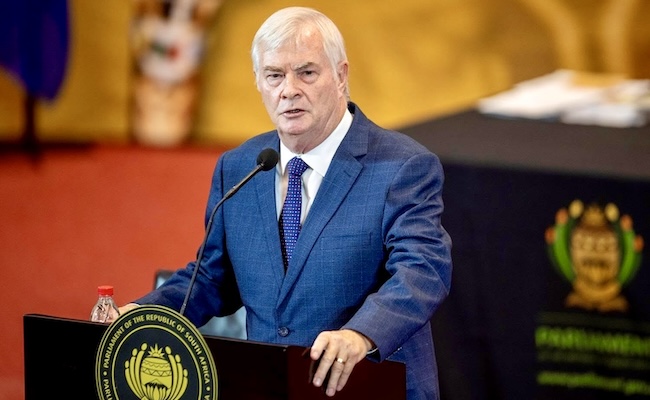
Top image: Correctional services minister Pieter Groenewald. Picture: www.vfplus.org.za.
Sign up to Currency’s weekly newsletters to receive your own bulletin of weekday news and weekend treats. Register here.